
Key Highlights
- Lower Volatility: Bitcoin’s volatility (measured by annualized standard deviation) fell to 38%, its lowest in ten years, and pointed to an approach to being considered a traditional investment.
- Institutional Anchoring: The introduction of the ETF era has seen the injection of more than $110 billion into US spot Bitcoin ETFs, essentially creating a sustained buy for Bitcoin against retail sell-offs.
- Correlation with Equity: In the month of March 2026, the correlation of Bitcoin to the Nasdaq-100 and S&P 500 indexes was 0.65, which suggests that Bitcoin was part of any risk-on investment portfolio.
- $80,000: Psychological Resistance Level: Even though Bitcoin had hit the price level of $126,000 in 2025, the cryptocurrency was encountering psychological resistance at $80,000 in April 2026 after a 36% retracement.
- Usage of Bitcoin Around the Globe: The countries like Venezuela and Nigeria were using Bitcoin not for investment purposes but as retail money to avoid the depreciation of their currencies.
Bitcoin: Risk or Refuge? Bitcoin’s Stability in 2026
According to the statistics, the total cryptocurrency market capitalization was $2.53 trillion, while Bitcoin’s market share (BTC.D) rose above 60.6% by the end of April 2026.
According to recent studies by CoinMarketCap and S&P Global, despite a 50% drop from its peak of $126,000, the current floor is much higher compared to previous cycles. IG and CoinShares analysts note that the current floor of $65,000 is being supported by huge institutional investment, amounting to $1.2 billion in January 2026.
The introduction of Spot ETFs has changed price dynamics. Bitcoin is not only responding to crypto-specific events; it is also responding to Federal Reserve interest rate hibernations (currently at 4.75%) and world liquidity flows. This professionalisation has generated what S&P Global describes as “volatility compression”, in which the range of price fluctuations is decreasing even as trading volume is increasing.
Price Action and Market Sentiment
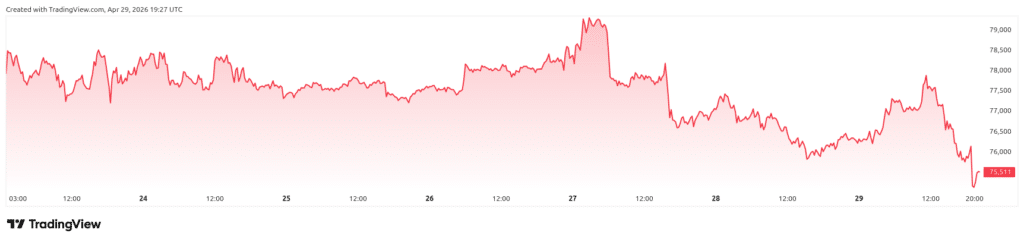
In the last week of April 2026, the Bitcoin price action exhibited a “squeeze” within a 4% band. Having rebounded from a low of $70,800, the asset spiked up to $78,900 on news of reduced geopolitical tension in the Middle East. But the market is still treading carefully as almost $1 billion in liquidations recently “flushed” high-leverage traders, showing that the path to $100,000 is far from smooth.
Responses from the Internet
Recent discussions in the r/Bitcoin subreddit focused on the role of adoption in stability, with many claiming that institutional investors are rewriting the “four-year cycle”.
- Cycle is Dead: d1rtball postulated that the four-year cycle may no longer be a hard-and-fast rule, discussing that with more institutions and long-term holders, it is “maturing into a more stable asset” where retail hype doesn’t affect price as much as before.
- Efficiency vs. Hype: Constant_Truck_4967 suggested the “Intelligent Investor” approach means that once a strategy like the four year cycle is common knowledge, it’s baked into the price. They said the market is becoming more efficient and that might have killed the super returns of prior halvings.
- The Supply Shock Factor: On the other hand, Adventurous-Peace691 and Gloomy_Dependent_985 said that “the cycle is still important because miners offload 70% to 90% of their production”. They believed that the reduction in new supply is a real factor that can’t be completely explained away by adoption.
- Volatility Compression: MCL-Jonathan wrote that “volatility compression is kicking in,” meaning that future moves will be “stable or capped.” They recommend others invest more in Bitcoin as a DCA (Dollar Cost Averaging) rather than a speculation.
- Dollars vs. BTC: A point of perspective was made by Moolamakerrr who observed that while the dollar price is difficult to forecast, “priced in Bitcoin, it is as stable as a currency can be”. This was countered in a snarky manner by Scary_Metal2884: “The price of an apple in apples is always an apple.”
The Macroeconomic Context of 2026
Bitcoin’s current price stability is correlated to the “Soft Landing” of the U.S. economy. Since the Fed indicated a possible stoppage of interest rate changes in April 2026, there has been a shift towards the appreciation of hard assets among investors. In addition, the role that Bitcoin can play as a hedge against the inflation resulting from the devaluation of fiat money is bolstered by evidence cited in the IMF’s report on Global Financial Stability.
On the other hand, even though the so-called “Bitcoin Strategy” practiced by firms such as MicroStrategy is quite successful, it can also be considered an issue to worry about. Although their large investments act as a “supply sink,” there is always speculation about potential sales amid market corrections. Nevertheless, with more than 4,500 organizations holding Bitcoin via different institutional funds, it becomes clear that the cryptocurrency has reached maturity and become part of mainstream finance.
Looking ahead to 2026 mid-year point, the forecast made by investment specialists at companies like Fundstrat and JPMorgan seems quite optimistic. They predict that the gradual increase in prices will bring the cryptocurrency to levels ranging from $120,000 to $170,000. Such behavior describes the current “adolescence” stage of development of Bitcoin.
Disclaimer: BFM Times acts as a source of information for knowledge purposes and does not claim to be a financial advisor. Kindly consult your financial advisor before investing.