NEW YORK — Larry Fink, Chairman and CEO of the largest asset manager in the world, BlackRock, has made a groundbreaking appeal to the global financial sector to switch to one common blockchain to enable the tokenization and security of all financial assets. In a speech at the 2026 World Economic Forum earlier this year and reiterating the point in his latest annual letter to shareholders published this week, Fink explained the change as a needed evolution to modernize the clunky and old-fashioned infrastructure of Wall Street.
The relocation is a major turning point in the financial giant, which currently manages close to 150 billion assets of a digital nature. Fink suggested that by registering ownership of stocks, bonds, and real estate on a single digital registry, the middlemen would be removed, corruption would be minimized, and the trade could be settled in near-real time.
The 1996 Internet Moment
Fink likened the present condition of blockchain technology to the internet in 1996. He has remarked that although the plumbing is yet to be constructed, the integration of finance into one safe ledger is bound to happen.
Fink said in his speech that crypto tokenization on one common blockchain needs to be moved at a faster pace. We could minimize corruption if we had a single blockchain. The operations are most likely to be processed and safer than ever.
The CEO highlighted such emerging markets as Brazil and India as the leaders in this field, stating that they are fast adopting digital currencies and tokenized assets. He cautioned that the developed economies will run the risk of being left behind unless they standardize their financial rails in the shortest time possible.
Market Impact and Price Action
The demand to have a single blockchain is being made when the crypto market is revitalizing its volatility. The major institutional flows have been on Bitcoin (BTC) and Ethereum (ETH) after the success of BlackRock’s own exchange-traded funds (ETFs).
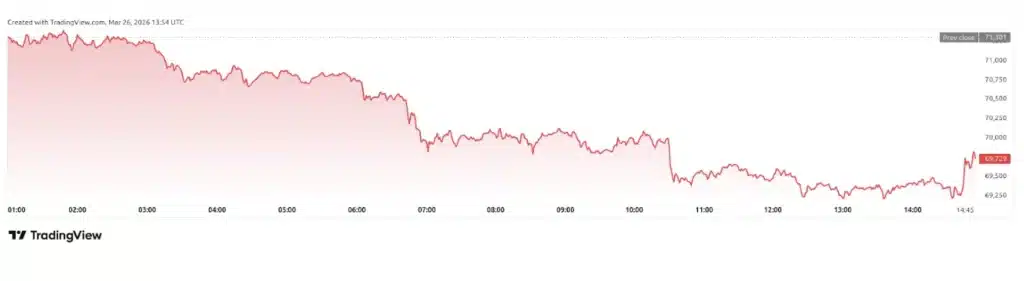
Bitcoin is currently trading at around 70,500 on March 26, 2026, and it has been on a consolidation trend following a recent surge. According to analysts, even though Bitcoin is the main store of value, Ethereum is gaining institutional adoption as the probable winner of the common blockchain by BlackRock because of its established smart contract functionality.
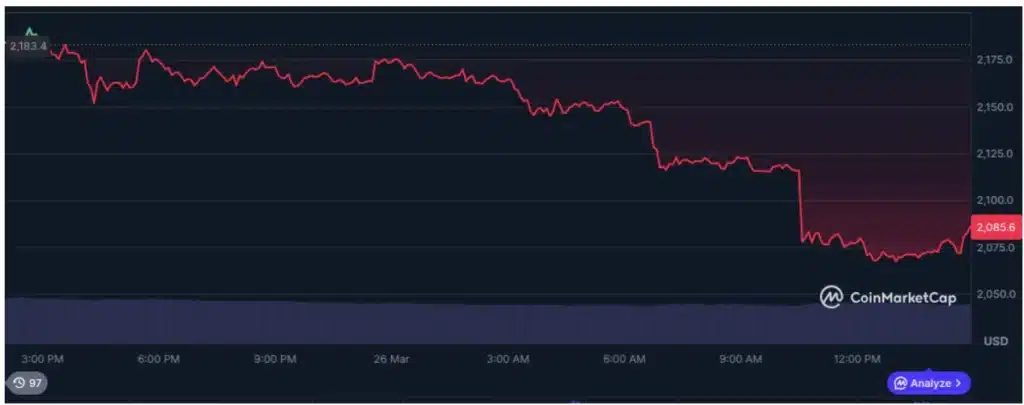
Ether has also been on a rise and is currently trading at about 2,180. Although there is a minor negative premium on the US exchanges, such as Coinbase, demand in the world is high because the BUIDL fund of BlackRock, which is tokenized on the Ethereum network, is still expanding.
Efficiency and Accessibility
The main motivation of the proposal presented by Fink is the democratization of finance. With tokenization, it is possible to fractionalize high-value assets such as private equity or Manhattan skyscrapers, and smaller investors can own a portion of assets that previously were not accessible to them.
Fink wrote in his letter that half a billion people in the world have a digital wallet on their phone. Suppose that the same digital wallet could also enable you to invest in a wide portfolio of companies on a long-term basis as easily as sending a payment.
Presently, securities settlement systems are traditional and require several days (T+2) to complete. A blockchain-based network would shift this to T+0, or instant settlement, and greatly decrease counterparty risk and release trillions of dollars of locked capital.
Challenges to a Unified Standard
The road to one common blockchain has high regulatory and technical barriers despite the excitement of the largest asset manager in the world. The Clarity Act is a bill that is pending its passage in the Senate in the United States, and it seeks to establish a legal framework for tokenized equities and digital assets.
Critics and industry analysts, such as those of the Boston Consulting Group, indicate that although tokenization might grow to a 19 trillion industry by 2033, there is a risk of fragmentation. The competing private ledgers currently in use by different institutions may be the reason why the commonality that Fink is seeking is not being achieved.
The tokenized assets are real, and they can be traded; however, they are not as deep or data-driven as institutional capital needs, according to Laurens Fraussen, a research analyst at Kaiko.
What This Means for the Future
BlackRock’s aggressive approach to tokenization suggests that the company is no longer treating crypto as a marginal asset category but as the future of its main business. The company is successfully establishing the bridge between digital and traditional finance with its iShares Bitcoin Trust (IBIT) and Ethereum Trust as the market leaders in terms of inflows.
Fink ended his comments by encouraging policymakers and industry executives to construct this digital bridge as fast and securely as they can because the point is not to dismantle the trusted structures of the modern finance system but rather to modernize them to a digital-first world.
Frequently Asked Questions
What are ways to earn Bitcoin as passive income?
You can earn Bitcoin through methods like lending, staking, mining, or interest-earning platforms.
Is earning Bitcoin passively safe and reliable?
It can be profitable but involves risks like market volatility, platform security, and changing returns.
Do I need a large investment to earn Bitcoin passively?
No you can start small but higher investments usually generate better returns.
Disclaimer: BFM Times acts as a source of information for knowledge purposes and does not claim to be a financial advisor. Kindly consult your financial advisor before investing.