Key Facts
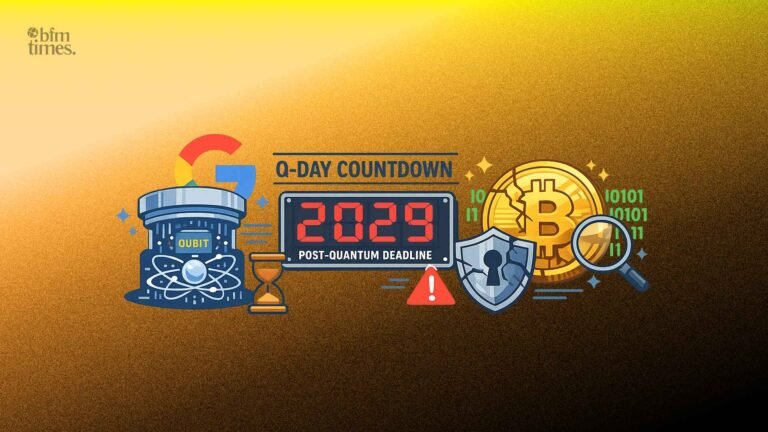
- Google has formally established a deadline of 2029 to move its global infrastructure to post-quantum cryptography (PQC), due to faster-than-anticipated progress in quantum hardware.
- Approximately 6.8 million $BTC (valued at more than 470 billion dollars) is stored in either a legacy or reused address, which is mathematically susceptible to quantum-level decryption.
- According to security experts, today, malicious actors are already gathering encrypted data, which will be decrypted once quantum computers have reached the necessary level of maturity.
- To add quantum-resistant signatures, developers of Bitcoin have suggested BIP-360, but the decentralized consensus makes the transition much longer than the internal transition of Google.
- Although there is no threat at the moment, analysts indicate that unless Bitcoin is quantum-ready in 2028, it might lose institutional trust and may experience price volatility.
In-Depth: The 2029 Line in the Sand
Google has increased its pace towards a post-quantum world in a move that has rocked the cybersecurity and financial industries. On Tuesday, March 24, 2026, Google VP of Security Engineering Heather Adkins and Senior Cryptography Engineer Sophie Schmieg put their signatures on an official statement: the entire infrastructure of Google will be quantum-safe by 2029.
The announcement is the first occasion that a leading technological powerhouse has placed a particular hard deadline on the threat of a cryptographically relevant quantum computer (CRQC) breaking the existing encryption systems, such as RSA and Elliptic Curve Cryptography (ECDSA). Google states that the quantum frontiers can be nearer than it seems, as the breakthroughs in the area of error correction and scaling of the number of qubits happen at a rapid pace.
Bitcoin’s $470 Billion Vulnerability
Although Google can impose a unilateral deadline on its servers, Bitcoin $BTC is decentralized, and this makes it a more difficult task. Bitcoin uses the ECDSA algorithm to protect the privacy keys. With a quantum-enabled world, a powerful enough machine with the Shor Algorithm would be able to extract a private key from a public one in a few minutes- something that would take trillions of years with classical computers.
According to the data provided by Project Eleven, a dedicated cybersecurity company, more than 6.8 million Bitcoin, which is close to 35 percent of the total amount, is stored in addresses where the public key is already known. This consists of coins and addresses that were reused in the early Satoshi era. In these cases of Long Exposure addresses, Q-Day is not a future risk; it is a time bomb.
The “Harvest Now, Decrypt Later” Strategy
A network collapse is not the most pressing issue that investors will be concerned about, but a data theft that will go undetected. Adkins and Schmieg pointed out the so-called threat of Harvest Now, Decrypt Later (HNDL), in which state actors and advanced hackers intercept and store encrypted data nowadays.
The Google blog post stated that the threat is present-tense. Although the quantum computer has yet to be created to unlock these files, the information is already in the possession of the opponents. In the case of Bitcoin, it implies that any transaction that is currently being broadcast might be logged and decrypted the instant a CRQC is online in 2029 or later.
Bitcoin’s Defense: The Race for BIP-360
The Bitcoin community is not stagnant, yet the way to safety is very thin. BIP-360 (Bitcoin Improvement Proposal) has been added to the official repository. It suggests a new form of output, known as Pay-to-Merkle-Root (P2QR), that would use hash-based signatures – a type of math that quantum computers do not solve easily.
Nonetheless, the developer Jameson Lopp, who was the co-founder of Casa, cautions that a complete migration might take five to ten years. In contrast to Google, which can revise its code during the night, Bitcoin must have a soft fork or a hard fork, which must be approved by thousands of autonomous miners and node operators.
According to Lopp, Google manages its infrastructure; Bitcoin is subject to a decentralized consensus. All miners, exchanges, and users should be in motion at the same time. That is the actual risk of asymmetry.
Market Context and Institutional Outlook
The 2029 deadline is something that institutional players are keeping a close eye on. With Bitcoin becoming a digital gold in the ETFs and nation-state, the quantum-proof nature of the network is a precondition to long-term holding. It has been proposed by some analysts, such as Charles Edwards of Capriole Fund, that a failure to show quantum readiness by 2028 might lead to a pre-emptive capital flight, which would in turn drive the prices down, irrespective of whether the technical threat was real or not.
Also Read: Bitcoin Gains as Trump Pauses Iran Strikes & Markets Breathe Again
Frequently Asked Questions
Am I secure with my Bitcoin in a hardware wallet such as Ledger or Trezor?
Currently, yes. The majority of the modern wallets operate with Pay-to-Script-Hash (P2SH) or SegWit, in which the public key is not disclosed until you are trying to spend the money.
Why is 2029 the magic number?
Both Google and IBM have set their roadmap to 2029 to provide a fault-tolerant quantum system.
Will I be required to transfer my Bitcoin to a new address?
es. When a quantum-resistant upgrade (such as BIP-360) is enabled, all users will probably have to transfer their funds to a new type of address, the quantum-safe one.
What becomes of the lost coins (Satoshi coins)?
This is one of the controversial aspects. The lost coins or the 1.1 million BTC that Satoshi had cannot be transferred to new secure addresses because the private keys are probably not available.
Disclaimer: BFM Times acts as a source of information for knowledge purposes and does not claim to be a financial advisor. Kindly consult your financial advisor before investing.