
In what is considered to be a major breakthrough that marks a new paradigm shift in the world’s financial industry, Western Union has officially introduced its stablecoin, referred to as the U.S. Dollar Payment Token, which will be based on the Solana blockchain network. This revolutionary initiative seeks to revolutionize the stagnated remittance industry, which has remained unchanged over the last century, by employing the capabilities of instant blockchain transfers and over 360,000 cash pickup locations in 200 countries.
- The Dawn of the Digital Asset Network
- Why Solana? Speed, Scalability, and Low Fees
- Institutional Backbone: Crossmint and Anchorage Digital
- Impact on the $700 Billion Remittance Sector
- Competition in the Stablecoin Space
- Regulatory Compliance and the “GENIUS Act”
- Conclusion: The Future of Global Money
- What is Western Union’s USDPT stablecoin?
- Why did Western Union choose Solana for the USDPT stablecoin?
- How will USDPT impact the global remittance market?
Also Read: Solana Coin Explained Price Use Cases & Future
The Dawn of the Digital Asset Network
Western Union is not simply launching a new stablecoin; it is unveiling a new paradigm of a comprehensive Digital Asset Network (DAN) that will revolutionize the crypto space by solving the so-called last-mile problem, i.e., how to easily swap digital currencies for cash in developing markets.
The new stablecoin, which will be referred to as the U.S. Dollar Payment Token, will enable consumers to send digital dollars anywhere in the world in just seconds. This is as opposed to other wire transfers, which take as long as 3 to 5 business days to be completed. This is because of the high-performance nature of the Solana blockchain, which will enable the transactions to be completed almost instantaneously. Once the digital currency is received, consumers will be able to exchange their digital tokens for local currencies at any physical location of the company.
Why Solana? Speed, Scalability, and Low Fees
The rationale for choosing the Solana blockchain over other similar technologies, including the Ethereum blockchain, is purely economic and performance-based. In fact, the CEO of Western Union, Devin McGranahan, has stated that the fee structure associated with the Solana blockchain, which is roughly 0.000005 SOL, or fractions of a cent, makes it the only viable option for high-volume, low-value retail remittance transactions.
For instance, when sending a remittance worth $200, the fee structure associated with sending money via traditional means is such that it will consume a huge chunk of the amount, roughly 6.5%, which is quite high. By choosing the Solana blockchain, therefore, Western Union will be able to save significantly on fee costs, which will then be reflected in the price for consumers.
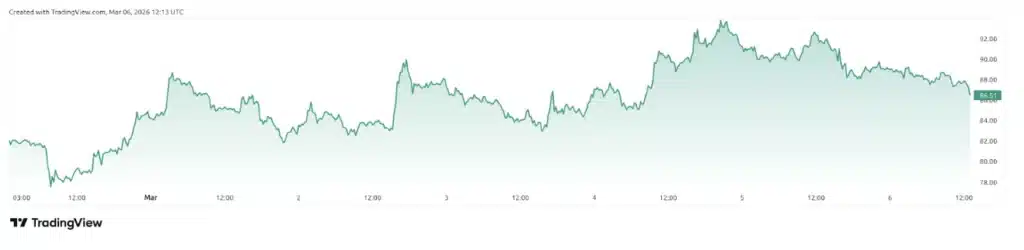
Solana (SOL) Market Performance: The news of the partnership between Solana and Western Union has caused an increase in the volume of SOL, which is considered by many traders to be the “Visa of the Blockchain” due to its ability to support industrial-scale payments.
Institutional Backbone: Crossmint and Anchorage Digital
To ensure the highest level of compliance and security, Western Union has partnered with Crossmint, which is an enterprise-grade Web 3 infrastructure company, along with Anchorage Digital Bank.
The former is responsible for providing the fundamental wallet and payment APIs, which enable developers and fintech companies to integrate USDPT into their existing systems. At the same time, the latter is responsible for issuing the stablecoin itself, thereby making it one of the first stablecoins issued by a bank, which is nationally chartered, thereby providing it with a huge ‘moat’ over other stablecoins, such as USDT issued by Tether or USDC issued by Circle.
Impact on the $700 Billion Remittance Sector
The global remittance market is a large market, with close to $700 billion being remitted every year across the globe. Western Union, which processes an estimated $100 billion to $150 billion of this amount, is currently being threatened by new market entrants in the fintech space, namely Wise and Remitly.
The launch of the USDPT is both an offensive and defensive strategy. By launching their own stablecoin, Western Union is breaking free from the fragmented and costly correspondent banking system. This will enable 24/7 money movement without depending on bank holidays and international clearinghouse hours.
Western Union (WU) Stock Analysis: Investors have begun to reassess the value of Western Union as a “fintech growth play” instead of simply a legacy cash company. The stock has gained renewed interest as the Digital Asset Network is expected to increase the company’s unit economics by allowing it to hold less “treasury float” to pre-fund accounts worldwide.
Competition in the Stablecoin Space
Western Union is not alone, as other giants have also entered the market with their stablecoins. For example, PayPal has also entered the market with its PYUSD stablecoin, and MoneyGram has also successfully entered the market with USDC on the Stellar network. The difference is, of course, the size of the giants, as although both MoneyGram and PayPal are strong players in the online market, the 360,000 “off ramps” of Western Union into rural Africa, Asia, and Latin America cannot be beaten.
Suggested: How to Launch a Stablecoin?
Regulatory Compliance and the “GENIUS Act”
The launch is also accompanied by the GENIUS Act (2025) initiative, which is a set of strict regulations and guidelines for regulated payment stablecoins. The USDPT is backed 1:1 with high-quality liquid assets such as US Treasury Bills, and the company is also committed to providing monthly third-party attestations to ensure trust among the millions of unbanked and underbanked consumers who will be using the platform.
Conclusion: The Future of Global Money
The launch of the USDPT on the Solana network is a historic moment for the cryptocurrency and blockchain industry, as the power of Web3 is now matched with the power of “Old Finance.” If this initiative is successful, it is likely to change the way money is transferred globally and create a new standard for the future of money transfer.
Malcolm Clarke, Vice President of Digital Assets at Western Union, said, “We are building the infrastructure for the next century of global payments. We want to make sending money across the ocean as easy as sending a text message, without compromising the reliability our customers have trusted us with for over 170 years.”
For further updates on the USDPT launch and regional availability, please visit the official Western Union Digital Asset portal.
Disclaimer: BFM Times acts as a source of information for knowledge purposes and does not claim to be a financial advisor. Kindly consult your financial advisor before investing.
What is Western Union’s USDPT stablecoin?
USDPT is a U.S. dollar-pegged stablecoin launched by Western Union on the Solana blockchain to enable faster and cheaper global remittance payments.
Why did Western Union choose Solana for the USDPT stablecoin?
Solana offers high-speed transactions and low fees, making it suitable for large-scale cross-border money transfers.
How will USDPT impact the global remittance market?
USDPT aims to connect blockchain transfers with Western Union’s 360,000+ cash pickup locations worldwide, potentially reducing costs and settlement time.