
Decentralized Finance (DeFi) has significantly changed how individuals interact with capital. At the heart of this new world are decentralized lending platforms. These are platforms that enable individuals to lend or borrow digital assets in a decentralized manner. At the heart of this new world are Aave and Compound.
- 1. The Emergence of DeFi Lending Platforms
- 2. Technical Architecture: How They Work
- 3. Aave vs Compound Interest Rates
- 4. Feature Comparison: Innovation vs. Stability
- 5. Risk Management and Security
- 6. Governance Tokens: AAVE vs. COMP
- 7. Which One to Use: Aave vs. Compound
- 8. The Future of Decentralized Lending Protocols
- 9. Conclusion
To determine which of these two titans offers the best DeFi lending platform, it is necessary to conduct an in-depth analysis of each platform’s mechanics. This Aave vs Compound comparison will seek to establish the reasons why these platforms are the gold standard in DeFi lending. It will also establish which of the two platforms is the best.
Related: What Is DeFi? A Beginner’s Guide to Decentralized Finance
1. The Emergence of DeFi Lending Platforms
In order to establish the Aave vs Compound comparison, it is necessary to establish the problem that these platforms have solved. The traditional banking system is based on intermediaries who dictate the interest rates and demand unnecessary documentation. In most cases, they even deny services to individuals they do not like.
The process is based on an algorithmic money market. In this case, the lender contributes to the liquidity pools by depositing assets. This enables them to earn interest. On the other hand, borrowers are able to access assets in the liquidity pools by providing collateral, which is always more than the loan amount.
Compound: The Pioneer of Algorithmic Rates
Compound Finance is a protocol that introduced the concept of liquidity pools. It was launched in 2018. The protocol introduced the concept of “cTokens,” which represent the amount deposited by the lender. The deposited assets earn interest. The protocol is renowned for its simplicity and institutional-grade security. It focuses on a small set of high liquidity assets.
Aave: The Innovator of DeFi Features
Aave, formerly known as ETHLend, is a protocol that entered the DeFi scene with a different approach. It focused on the concept of quick innovation and a large variety of assets. Aave introduced revolutionary features such as flash loans, rate switching, and a large variety of assets.
2. Technical Architecture: How They Work
Both of these platforms are built on Ethereum, but have grown much since then. The “yield-bearing” concept of both of these platforms is similar but not exactly the same.
Compound cTokens
Upon depositing cryptocurrency into the Compound protocol, users are able to receive a token, for instance, cETH or cUSDC. The token received is a claim of the deposited assets. The exchange rate of the deposited assets to the received token increases over time. This increases the composability of the protocol, allowing users to leverage the deposited assets.
Aave aTokens
In a similar manner, the Aave protocol uses aTokens, for instance, aUSDC. The difference lies in the fact that aTokens have a 1:1 value to the deposited assets. The balance of the deposited assets increases over time. This implies that depositing 1,000 USDC results in 1,000 aUSD.
3. Aave vs Compound Interest Rates
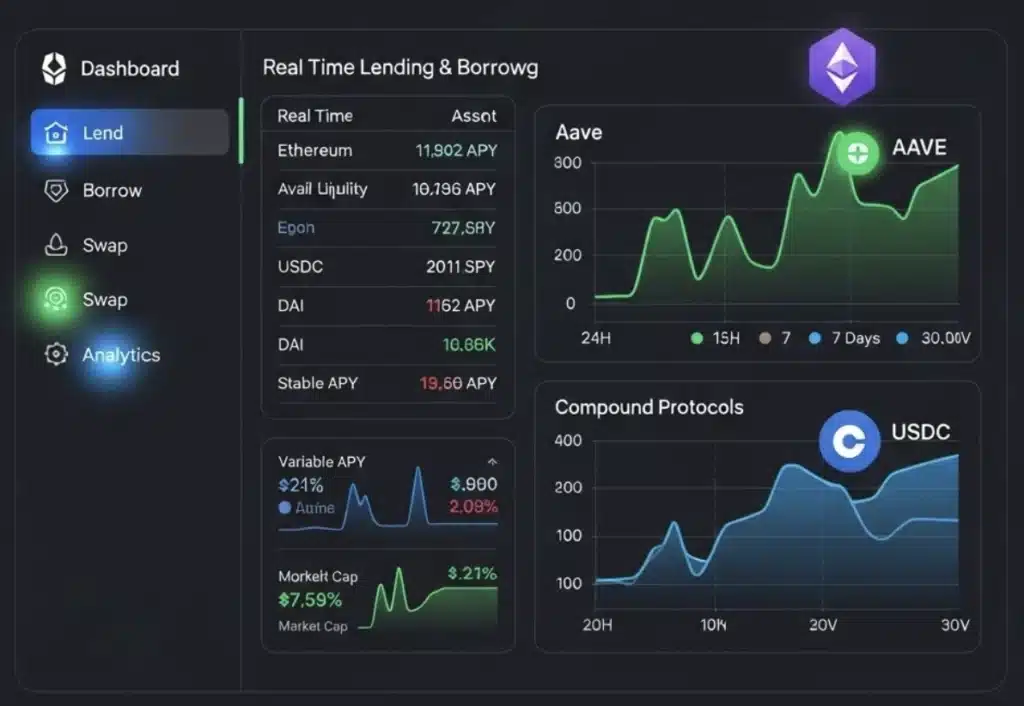
The most important factor for users is the yield. As these are decentralized lending protocols, Aave vs Compound interest rates are based on supply and demand, also known as the utilization ratio.
Interest Rate Models
If all are borrowing, hence reducing the pool, higher interest rates are charged to encourage deposits and debt repayment. On the other hand, lower interest rates are charged in a situation where the pool is sufficiently funded.
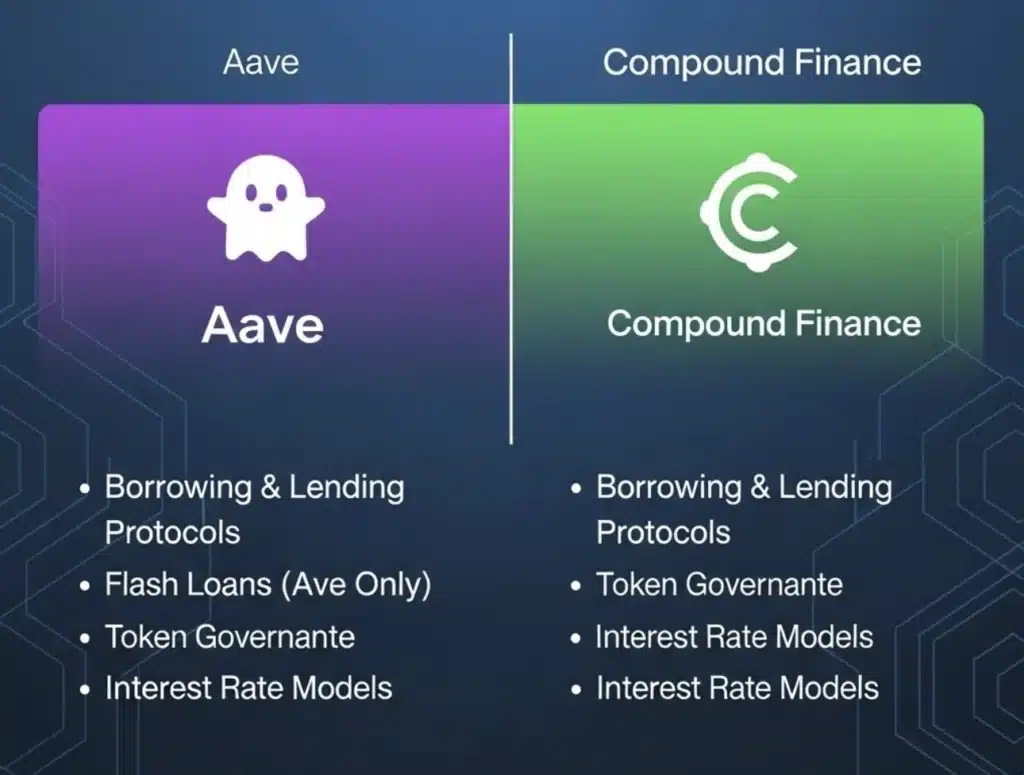
- Compound: Compound offers more consistent interest rates compared to Aave. Compound utilizes a ‘kinked’ model of interest rates, which offers stability in interest rates before they are suddenly increased once a set threshold is reached.
- Aave: Aave offers two types of interest rates: Variable and Stable Borrowing.
- Variable interest rates change according to market conditions.
- Stable interest rates behave like a fixed-rate loan for users who fear market volatility in the short term.
Aave has historically offered better interest rates for stablecoins, while Compound sometimes offers better interest rates for major coins like ETH due to its conservative parameters.
Suggested: What Are DeFi Protocols, and How Do They Work?
4. Feature Comparison: Innovation vs. Stability
In comparing Aave and Compound, the “best” one is often a personal preference, depending on whether one prefers a rich feature set or a simple interface.
Flash Loans
Aave is the clear winner when it comes to flash loans. A flash loan is a type of uncollateralized loan that must be paid back in the same blockchain transaction. This is used by developers and seasoned traders to execute complex trades and liquidations. This is not a feature that Compound prioritizes.
Multi-Chain Expansion
Aave has also been much quicker to expand its presence beyond the Ethereum blockchain. Aave can be found on the Polygon, Avalanche, Arbitrum, Optimism, Base, and many more blockchains. This makes Aave the best crypto lending platform if one wants to avoid the high gas fees on the Ethereum blockchain.
Compound, on the other hand, stuck to the Ethereum blockchain much longer. Although Compound V3, also known as Comet, is expanding its presence to Arbitrum and Polygon, this is much smaller in scope than Aave.
Asset Diversity
Aave has a list of dozens of assets, from less popular DeFi tokens to various stablecoins. Compound, meanwhile, has a more rigorous listing process, with a focus on assets with large market caps and high liquidity. If you want to lend less popular altcoins, Aave is likely your only choice.
5. Risk Management and Security
The most important “feature” of DeFi is security, and both Compound and Aave are two of the most tested and proven projects in the field.
The Safety Module (Aave)
The “Safety Module” is a feature unique to Aave, wherein the holders of the AAVE token have the option to lock up their tokens to act as a safety net. In the event of a “Shortfall Event” (i.e., the failure of a large number of liquidations), up to 30% of the staked tokens can be sold to cover the shortfall.
Cautious Governance (Compound)
Compound’s approach to security is based on its governance and simplicity of code. By having fewer assets and fewer “moving parts,” Compound makes itself less vulnerable to hackers. Compound’s governance is famously rigorous, with some people even joking that it takes longer to implement governance decisions than with Aave, which many people view as a positive.
6. Governance Tokens: AAVE vs. COMP
Both platforms are governed through a Decentralized Autonomous Organization (DAO).
- AAVE Token: For voting on AIPs and staking in the Safety Module to earn rewards. AAVE has a strong “value accrual” mechanism due to its security and fee-sharing potential.
- COMP Token: The pioneer in the concept of liquidity mining. Users can vote on changes such as the addition of new markets and changes to the factors used in the calculation of collateral. Although COMP started the DeFi summer craze in 2020, its actual use is in voting and not in insurance.
7. Which One to Use: Aave vs. Compound
There is no winner in the Aave vs. Compound debate. Instead, there are the “best use cases” for each.
Aave:
- You wish to use the Layer 2 networks, like Polygon and Base, to reduce gas fees.
- You require access to a wide variety of altcoins.
- You are a seasoned trader interested in flash loans and stable borrowing rates.
- You wish to have the extra security provided through the Safety Module.
Compound:
- You wish to use a simple interface and “set it and forget it.”
- You are an institutional lender and wish to use a conservative and battle-hardened lending protocol.
- You work with the major coins like ETH, USDC, and WBTC on the Ethereum mainnet.
- You wish to use a lending protocol that values stability over new features.
Also Read: Custodial vs Non-Custodial Wallets Explained
8. The Future of Decentralized Lending Protocols
In the future, the Aave vs. Compound debate will be settled as both platforms continue to evolve and grow. Aave is working on “Aave Arc,” a permissioned version designed for institutions. Aave also released its stablecoin, GHO. Compound is working on its V3, which eliminates the “pooled” capital risk model and instead adopts a more siloed approach.
9. Conclusion
In the end, the winner in the Aave vs. Compound battle is the user. Both platforms offer the best in non-custodial financial services, previously reserved for the elite.
Aave is the powerhouse of innovation, providing more assets, more chains, and more complex financial instruments.
Compound is the bedrock of reliability, providing a streamlined, ultra-secure experience for users who want the pure essence of a decentralized money market.
Whether you are looking to find the best Aave vs. Compound rates or the safest crypto lending platforms, both protocols represent the best in what DeFi has to offer. By understanding your personal risk tolerance and the intricacies of each, you can use these decentralized lending protocols to leverage your crypto holdings and the future of finance.
Disclaimer: BFM Times acts as a source of information for knowledge purposes and does not claim to be a financial advisor. Kindly consult your financial advisor before investing.
What is the main difference between Aave and Compound?
Aave offers advanced features like flash loans and flexible interest rates, while Compound focuses on simpler lending with algorithm-based interest rates.
Which platform is more popular for DeFi lending, Aave or Compound?
Aave generally leads in total value locked (TVL) and features, making it one of the top DeFi lending platforms.
Is Aave or Compound better for beginners?
Compound is often easier for beginners, while Aave is preferred by advanced users seeking more DeFi tools and strategies.