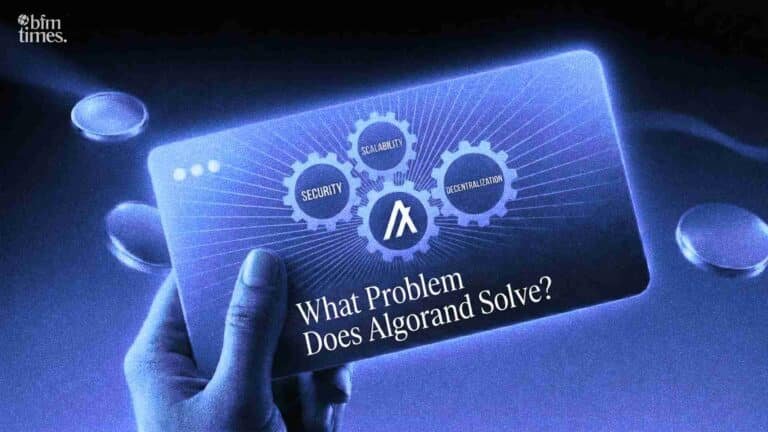
The majority of classic blockchains have a problem with the so-called Blockchain Trilemma, a term used by Vitalik Buterin, which implies that a decentralized network can deliver two out of three qualities: security, scalability, and decentralization.
Algorand addresses this through a special consensus mechanism known as Pure Proof of Stake (PPoS), which supports high-speed transactions and strong security without massive energy consumption or centralized control as in older systems.
Technical Depth and The Three Pillars.
To see how Algorand addresses these issues, we need to consider how it addresses the three opposing demands of the trilemma:
- Scalability without Congestion: Algorand has high throughput, based on a cryptographic sortition process. This randomly and secretly picks a small number of users to suggest and vote on blocks. Since the selection is almost instant, the network can handle more than 6,000 transactions per second with a finality of about 3.3 seconds.
- Decentralization by Inclusion: In contrast to the Delegated or Bonded Proof of Stake models, Algorand has only one ALGO to be involved in consensus. No whales or expert miners with monopoly power. All token owners stand equal opportunity of being chosen by the system, and the power is retained by the whole society.
- Security by Randomness: The validator selection is a secret, so an attacker is never aware of whom to attack until a block has already been committed to the ledger. This renders the network virtually resistant to targeted attacks or censorship.
History and Contemporary
Algorand was created by Turing Award winner Silvio Micali to be the infrastructure of the future of finance. By 2026, the network is shifted to a Pure On-Chain Democracy. This roadmap will make sure that all governance votes and protocol changes can be implemented directly on the blockchain, eliminating the need to have off-chain committees.
Moreover, Algorand has worked on “Agentic Commerce,” which offers the low-cost and high-speed rails that AI agents and institutional tokenized assets need to run without the friction of high gas fees or network forks.
In 2026, Algorand was quoted as an exemplary blockchain for Quantum Resistance, causing the price to rally over 45% in a single month.
Frequently Asked Questions
Does Algorand have forks?
No. Algorand is mathematically constructed to never fork because of its special consensus protocol. It is essential for financial institutions and NFT creators who need to have finality in transactions immediately and permanently.
What is its comparison to Proof of Work?
Proof of Work (as with Bitcoin) consumes large quantities of electricity to secure the network, but Algorand is carbon-neutral. It can attain the same security with a fraction of the energy by not using computational work, but using stake.
How can ALGO help solve these problems?
The participation tool is the ALGO token. Users by owning ALGO give the network the stake needed to secure it. It is also the vehicle of transaction fee, which is always low (around 0.001 ALGO), irrespective of the network traffic.
Disclaimer: BFM Times acts as a source of information for knowledge purposes and does not claim to be a financial advisor. Kindly consult your financial advisor before investing.