




- Visa now accounts for 72% of all payments made via crypto cards, and MasterCard is the second-largest player with a 28% market share.
- In the absence of any crypto-specific payment channel, decentralized spending is again choosing centralized partners. Preference for fiat money-based settlement by vendors is the main driver of growth for Visa and MasterCard.
- The myth of spending your crypto discreetly might be at risk, as Visa is an AML-compliant institution in most countries. For those seeking to avoid any tax liabilities, the crypto card path seems closed.
Suggested: Crypto Debit Card vs Crypto Credit Card: Which Should You Use?
Visa Captures 72% of Crypto Card Spending Volumes
A report by Paymentscan highlights that as much as 72% of global crypto card volumes are processed by Visa, the payment channel giant, underscoring the card giant’s entry into the crypto card market.
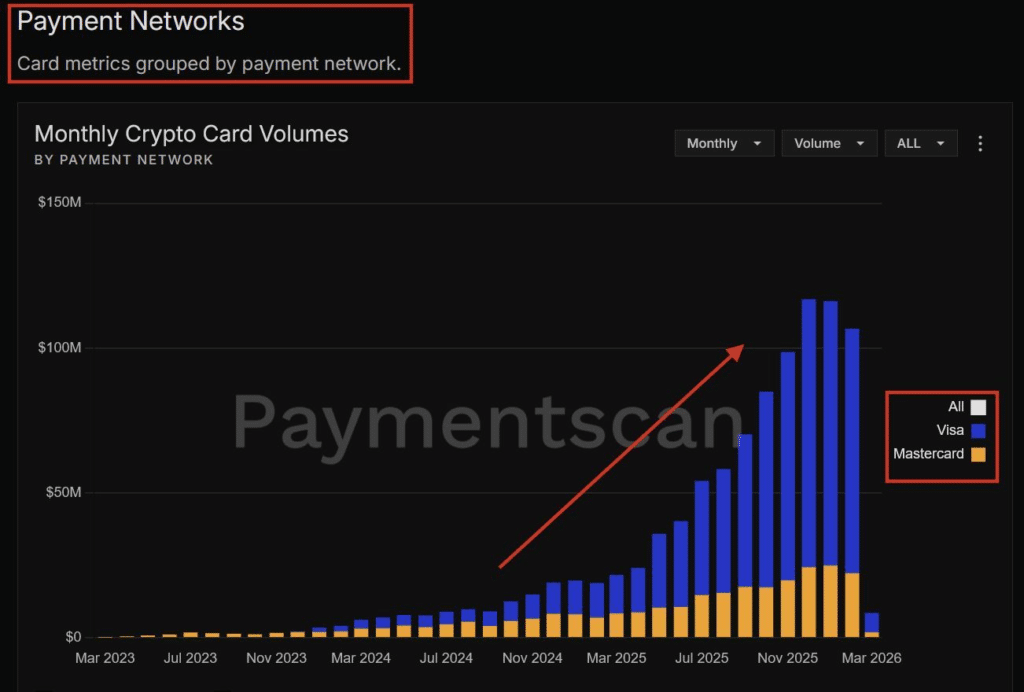
There has been a sharp rise in crypto card payments in the last couple of years, from a mere $20 million market size in 2024 to over $110 million in early 2026. The sharp rise is associated with the proliferation of crypto cards, which allow users to spend their crypto directly without first selling it on an exchange and then transferring the funds to bank accounts.
Crypto cards are available in both credit card and debit card forms, which makes it easy to spend crypto from wallets.
Related: MetaMask Card Launched: Features, Benefits & Full Details Explained
Second Largest Player is Mastercard at 28%
After Visa, the remaining 28% is fully dominated by MasterCard, the second-largest payment channel in traditional markets.
There is no other player in the market currently because payment infrastructure is a very capital-intensive business. Further, there is a need to convert cryptocurrencies, a highly volatile asset class, into fiat money, which is then processed for payment to businesses. All of these must be executed within 2-3 seconds at a near 100% succeess rate.
Lack of Crypto-Specific Payment Channels
As of now, there is no crypto-specific payment infrastructure that allows people to spend crypto directly without going through traditional financial infrastructure.
As a result, most crypto-based payments are being routed directly through traditional finance giants like Visa and MasterCard.
Other payment processors, such as RuPay, American Express, and Diners Club, do not offer such an equivalent.
Beware, If You Wanted to Avoid Tax by Directly Spending Crypto
For those wanting to spend crypto directly and avoid tax liabilities, there is some bad news. Most payments processed through channels like Visa, MasterCard, and all other traditional channels are AML compliant, which means all the payment data is being captured by authorities that may also include tax authorities like the IRS.
As a result, there could be increased scrutiny on those spending crypto directly via cards, assuming zero tax liability,
Frequently Asked Questions
Which crypto cards are available with Visa?
Coinbase Card, Crypto.com Card, Binance Card, KuCard (KuCoin), etc.. are a few Visa supported crypto cards.
Which crypto cards are available in MasterCard?
MetaMask, Bybit Card, Blip Card, BitPay, Wirex, etc., are a few cards that support MasterCard.
Disclaimer: BFM Times acts as a source of information for knowledge purposes and does not claim to be a financial advisor. Kindly consult your financial advisor before investing.