


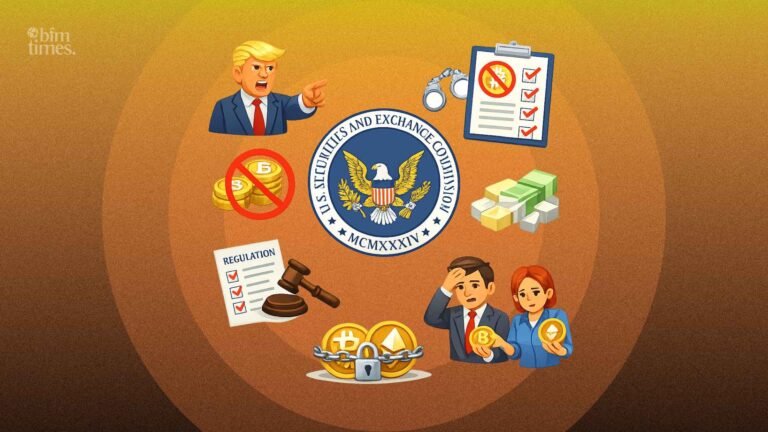
The change in administration to the second Trump administration in January 2025 was a historic shift in how the SEC would view digital assets going forward. Moving away from the enforcement-heavy approach taken in the prior years, the SEC, under the leadership of Paul Atkins and Mark Uyeda, has taken a number of foundational steps in changing how securities regulations are implemented.
- 1. The “Crypto 2.0” Task Force and the End of “Regulation by Enforcement.”
- 2. The Landmark Token Taxonomy (March 2026)
- Digital Commodities (Bitcoin, Ethereum, Solana)
- XRP and the “Transaction Unit” Analysis
- 3. Regulation of Memecoins and NFT Projects
- 4. Commodity Regulation and the CFTC Partnership
- 5. Staking and Mining Guidelines
- 6. Stablecoins and the GENIUS Act (July 2025)
- 7. The U.S. Strategic Reserve Impact
- Conclusion
This report outlines in detail the new regulatory framework and how it applies to digital assets such as Bitcoin, Ethereum, Solana, XRP, NFTs, and memecoins.
Related: SEC–CFTC Crypto Regulation Framework Signals a New Era for Digital Asset Oversight
1. The “Crypto 2.0” Task Force and the End of “Regulation by Enforcement.”
One of the first actions taken by the SEC in this new era was to establish the “Crypto 2.0” Task Force, headed by SEC Commissioner Hester Peirce. The purpose of this task force was to replace retroactive enforcement actions with clear and definitive guidelines.
- Rescission of SAB 121: One of the first significant steps taken by the SEC in this new era was to rescind Staff Accounting Bulletin No. 121. This rule required banks to list their customers’ digital assets as a liability on their own balance sheets, thus preventing banks from ever providing custody services for digital assets.
- Dismissal of Major Litigation: In the early part of 2025, the SEC began to move to dismiss or substantially settle a number of high-profile civil cases. These cases included the Coinbase, Binance, and Ripple (XRP) cases. This marked the beginning of the “clean slate” approach to industry participants.
Suggested: Paul Atkins Debuts “SEC Project Crypto”: Absolute Rules for 2026
2. The Landmark Token Taxonomy (March 2026)
In concert with the CFTC, the SEC has released a joint “Landmark Interpretation on Crypto Assets.” This document is the definitive list of the ways in which the SEC regulates the various types of tokens.
Digital Commodities (Bitcoin, Ethereum, Solana)
The SEC has officially designated the major decentralized networks as digital commodities.
- Bitcoin (BTC): Officially reaffirmed as a commodity, without securities law oversight of the secondary trading of the asset.
- Ethereum (ETH): Officially moved into the digital commodity category, specifically calling out the fact that the transition from Proof of Work to Proof of Stake does not, in itself, classify the token as a security.
- Solana (SOL): In the wake of the BTC and ETH rulings, the Solana token has officially been classified as a digital commodity, thereby clearing the way for the approval of Solana ETFs.
XRP and the “Transaction Unit” Analysis
Instead of the judicial determination that the XRP itself is not a security, the SEC has adopted the “transactional unit” analysis. This means that the SEC regulations apply to the way in which the asset is offered (such as through an institutional fundraise) and not to the asset itself when it is traded on exchanges.
3. Regulation of Memecoins and NFT Projects
With the new “Digital Collectibles” category, the SEC has retreated almost entirely from the meme and NFT markets.
- The Collectibles Exemption: The SEC has determined that “digital assets that are designed to be used for personal enjoyment, collection, or cultural expression” fall into this category. This includes almost every NFT and meme asset (such as Dogecoin and Shiba Inu).
- Utility vs. Speculation: Unless the NFT is backed by a promise of profits from a future business venture, the SEC does not consider it an investment contract. This is great news for large brands wanting to enter the digital collectibles space.
4. Commodity Regulation and the CFTC Partnership
One of the key components of the Trump-era strategy was “Regulatory Harmonization.”
- Primary Oversight: The CFTC is the primary oversight body for “Digital Commodity” spot markets and derivatives.
- The SEC’s Narrow Scope: The SEC is only concerned with “Tokenized Securities,” which includes traditional securities such as stocks and bonds that have been represented on the blockchain.
- Generic Listing Standards: The SEC approved generic listing standards for commodity-based trust shares in late 2025.
5. Staking and Mining Guidelines
The SEC released new guidelines that state that participating in these activities is not a securities transaction.
- Staking as a Service: The operators of nodes and liquid staking providers are considered to be giving a technical or ministerial service. As long as the provider of the service is not guaranteeing a return on investment that is independent of the rewards given out by the protocol, then the SEC is not considering this a security.
- Protocol Mining: The SEC no longer has jurisdiction over the mining of Proof of Work (PoW) tokens, thus ending the debate on whether mining pools are investment contracts.
6. Stablecoins and the GENIUS Act (July 2025)
Although the SEC previously claimed jurisdiction over stablecoins, the passage of the “Guiding and Establishing National Innovation for U.S. Stablecoins Act” (GENIUS Act) moved the responsibility to the Treasury and banking regulators.
- Non-Security Status: The payment stablecoins of the “permitted issuers” are now legally excluded from the definition of a security.
- Secondary Market Clarity: The SEC released a staff statement saying they would not bring enforcement actions on platforms trading stablecoins as long as they comply with the requirements set out in the GENIUS Act.
7. The U.S. Strategic Reserve Impact
President Trump’s executive order on creating a “Strategic Bitcoin Reserve” and a “Digital Asset Stockpile” (which includes Ethereum, Solana, and XRP) had significant downstream impacts on U.S. regulations.
- Official Recognition: By holding these assets as “reserve assets” of the United States, there is a sense in which these assets have been officially sanctioned as legitimate financial instruments and not “unregistered securities.”
- Custody Rule Harmonization: The SEC Division of Investment Management issued no-action letters for state-chartered trust companies to act as “qualified custodians” for these reserve assets.
Also Read: AI News Today: Can AI Really Replace Coders with Non-Tech Professionals?
Conclusion
The change in SEC regulations during the Trump era signals a fundamental shift in regulatory policy from “enforcement” to “taxonomy.” In declaring Bitcoin, Ethereum, and Solana legitimate commodities and NFTs and memecoins legitimate collectibles, the SEC has established a two-tier regulatory system. While vigilant for fraud and “tokenized securities” (traditional assets on blockchain), they are, for the most part, stepping aside and allowing market forces to dictate the direction and success of the broader cryptocurrency ecosystem, leaving commodity regulation to the CFTC. This new era gives legitimacy and regulatory certainty to the cryptocurrency market that many investors had been waiting for.
Disclaimer: BFM Times acts as a source of information for knowledge purposes and does not claim to be a financial advisor. Kindly consult your financial advisor before investing.
What is the new SEC crypto regulation framework for 2025 to 2026?
The SEC introduced a framework classifying crypto assets like digital commodities, collectibles, tools, stablecoins, and digital securities.
Are all cryptocurrencies considered securities under SEC rules?
No, most cryptocurrencies are not considered securities unless they are sold as investment contracts with profit expectations.
What major changes did the SEC make after 2025?
The SEC clarified NFT status, reduced enforcement focus, and worked with the CFTC to provide clearer and more flexible crypto regulations.