Key Insights
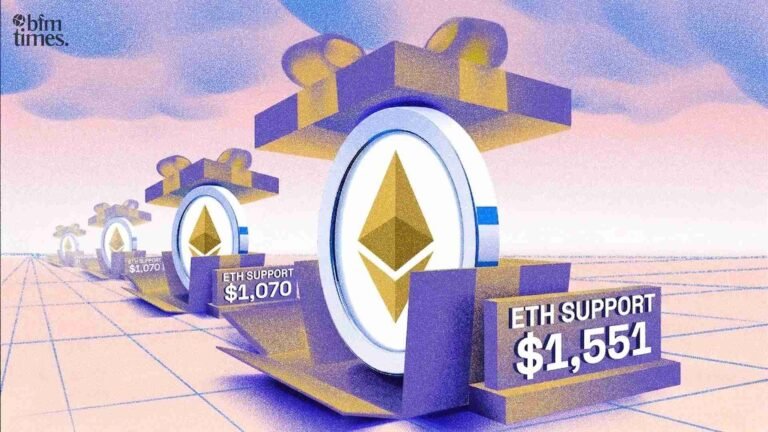
- According to analyst Ali Charts’ analysis of Ethereum, the most important support levels are $1,551 and $1,070 in case Ethereum does not leave its current multi-year trading range.
- Ethereum is trading around the $2,060 mark and is failing to hold its own psychologically at the $2,000 level as the rest of the market sells off.
- Increasing oil prices (more than $100/barrel) and geopolitical tensions with Iran have been pushing capital out of risky assets such as ETH and into so-called safe havens.
- Although prices have not been rising, the Ethereum Foundation has recently started staking operations to the tune of close to $100 million to finance its operations through yield and not market sales.
- Immediate resistance is at $2,150 and $2,400, and failure to reclaim these levels will most likely lead to the probability of testing the lower supports identified by Ali Charts.
Ethereum Struggles to Maintain Its Position at $2,000 as Technical Indicators Suggest Deep Support Floors Are at $1,551 and $1,070
The Ethereum (ETH) market is embarking on an era of high-stakes price discovery. As the leader of decentralized finance (DeFi) has been busy consolidating in early 2026, a new technical analysis wave indicates that the bottom could be significantly lower than anticipated by many retail investors.
- Ethereum Struggles to Maintain Its Position at $2,000 as Technical Indicators Suggest Deep Support Floors Are at $1,551 and $1,070
- The Crumbling of the $2,000 Battleground
- Knowing the Support Levels of Ali Charts
- Context: What Is Going on with Ethereum?
- Technical Forecast and Analysis
- Frequently Asked Questions
Famous technical analyst Ali Charts has recently published a weekly ETH chart, pointing to a structural channel that has determined the movement of the asset over the years. Based on the analysis, the next significant “buy the dip” opportunities or disastrous floors are at $1,551 and $1,070 in case Ethereum abides by the limits of this channel.
The Crumbling of the $2,000 Battleground
Ethereum is currently trading at an average of $2,060 as of April 3, 2026. This figure is not merely a number, but a psychological “line in the sand,” which has been tested twelve times since 2021. The existing weakness is preceded by a 5% drop in the last week, which is also reflected by the fall of Bitcoin to $65,834. The mood in the market has changed to extreme caution.
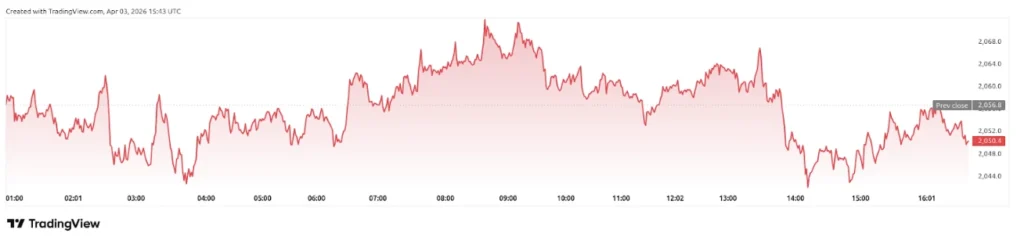
According to the data provided by platforms such as TradingView and CoinMarketCap, the price activity is being determined by “macro-shocks,” even though the fundamentals of the ETH network are still strong. The recent speech of President Trump about Iran has caused the price of Brent crude oil to skyrocket above $106 a barrel, and inflation fears have caused the cryptocurrency markets to lose their liquidity, which is typically a drain on the markets.
Knowing the Support Levels of Ali Charts
According to the technical roadmap given by Ali Charts, the present level of $2,000 is a thin thread. In case the channel structure is true, a breakdown at a level of less than $1,800 may cause a rapid drop to the first key support at $1,551.
Traditionally, the $1,500 area has served as a massive accumulation point by institutional “whales.” Nevertheless, in case of a deterioration of the global economic conditions—that is, in case the Strait of Hormuz is closed—the floor of the worst-case scenario of $1,070 is reached. This would be in line with the bear market lows of 2022 and would be a full reset of the existing bull market.
Context: What Is Going on with Ethereum?
Competitors such as AlphaPepe and other new meme coins are experiencing a huge volume of presales, but Ethereum is experiencing what some analysts refer to as a structural identity crisis.
- Layer-2 Cannibalization: The effectiveness of Layer-2 scaling systems such as Arbitrum and Base has reduced the cost of transactions on the mainnet by a large margin. This has been beneficial to users but has decreased the burn rate of ETH, slowing down the deflationary story behind the 2024-2025 rally.
- Staking Dynamics: The Ethereum Foundation staked another 46.64 million ETH in a significant move that was announced by Arkham Intelligence today. The Foundation will be shifting towards a yield-based funding system, which will help it to minimize its dependence on selling ETH on the open market, which would enable it to have long-term price stability.
- Institutional Outflows: Net outflows in Spot Bitcoin ETFs were almost $174 million this Wednesday alone. With the outflow of the institutional money tide, Ethereum tends to experience the outflow more than Bitcoin because of its smaller market value and greater volatility.
Technical Forecast and Analysis
Traders are now considering the Relative Strength Index (RSI), which is at a neutral level of 41. This is an indication that Ethereum is yet to be oversold, but the bears have the momentum. To turn the bearish momentum, ETH must close above the resistance cluster of $2,150 on a daily basis.
Assuming that it can recover, the logic of the channel implies that it can shift back to the range of $3,200. But until such a breakout takes place, the most realistic price gravity points as indicated by Ali Charts are $1,551 and $1,070.
Also Read: Ethereum’s Economic Zone and The List of Problems it Directy Solves for Crypto
Frequently Asked Questions
What is a technical analysis trading channel?
A trading channel is a price area within which the price of an asset moves between two parallel lines: a resistance level (ceiling) and a support level (floor). These channels are used by analysts to forecast the potential price bounce or breakdown.
Why are $1,551 and $1,070 considered “support levels”?
These prices are in historical regions where selling pressure has been less compared to the buying pressure. Should ETH decline to these levels, analysts believe that large investors will place limit orders, which will possibly halt the decline in price.
What impact will oil prices have on Ethereum?
Cryptocurrencies are now considered to be risk-on assets. Inflation and economic instability are indicated when oil prices increase because of conflict (as is the case with the current Iran tensions). When investors want to transfer their funds to a safe asset such as gold or US Treasuries, they tend to sell their risky assets, such as ETFs.
Does the Ethereum Foundation sell its ETH?
Historically, yes. But as of April 3, 2026, the Foundation has shifted to a funding model that is based on staking only. This implies that they are spending the interest they have received on staking their ETH on developers and grants, instead of selling the underlying ETH in the market.
What is the upgrade of the “Glamsterdam”?
The next major upgrade of the Ethereum network is called Glamsterdam, and it is scheduled to take place in June 2026. It is concerned with Proposer-Builder Separation (PBS), which is expected to decentralize the network and make it more efficient. The expectation of this event has seen many investors buying the dip now.
Disclaimer: BFM Times acts as a source of information for knowledge purposes and does not claim to be a financial advisor. Kindly consult your financial advisor before investing.