Key Insights
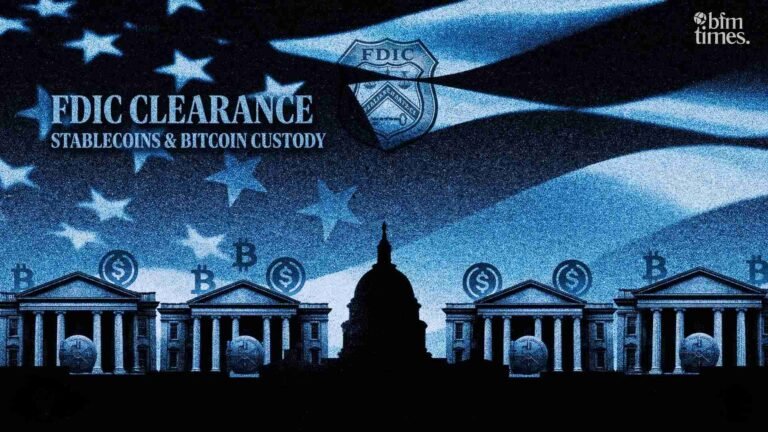
- The FDIC Board of Directors approves a prudential standard allowing FDIC-supervised financial institutions to issue payment stablecoins through subsidiaries.
- The regulation states that tokenized deposits – or the digital representations of conventional banking money – will receive identical treatment as conventional deposits and will be fully covered by insurance offered by the government as long as they can be classified as such.
- Payment stablecoin issuers are required to maintain 1:1 reserves consisting of high-quality liquid assets, specifically cash and U.S. treasury bills.
- Multi-national companies like JPMorgan Chase and BNY Mellon are expected to accelerate their digital asset operations to meet new standards.
- Although the deposits themselves can be insured under the FDIC, the payment stablecoin itself is not covered under FDIC insurance; nevertheless, the reserve itself should be highly safe and liquid.
A New Chapter for U.S. Banking: The GENIUS Act Implementation
This rule being approved represents the second major step in complying with the requirements of the GENIUS Act, passed into law in July 2025. The FDIC is trying to introduce the speed of blockchain technology into the protection of the regulated banking perimeter by creating a strict structure of Permitted Payment Stablecoin Issuers (PPSIs).
The suggested regulation covers four key pillars, which include reserve assets, redemption protocols, capital requirements, and risk management. The banks have a standardized playbook on how to hold private keys and how to manage the liquidity of digital assets without falling into the trap of federal examiners for the first time.
The 1:1 Reserve Mandate
According to the new rules, any bank subsidiary that issues a stablecoin should demonstrate that all the digital dollars in circulation are collateralized 1:1 by qualified assets. These assets are limited to:
- U.S. Currency (Physical and Digital).
- Balances at Federal Reserve Banks.
- U.S. Treasury securities that have a maturity of 93 days or less.
- Other highly liquid and low-risk instruments that are authorized by the FDIC.
More importantly, the rule does not allow any form of ‘rehypothecation’—lending out the reserves—so that the holders are guaranteed to redeem their tokens in cash at any time within two business days.
Tokenized Deposits vs. Stablecoins: The Insurance Divide
Among the most important explanations in the April 7 announcement is the difference between tokenized deposits and stablecoins.
Tokenized Deposits are records on a blockchain that a customer has a claim on their bank. The FDIC has assured that they will be considered as technology-neutral deposits. Assuming you have $250,000 in a tokenized account at a bank such as BNY Mellon, that money is insured by the FDIC in the same way as a conventional checking account.
Payment Stablecoins, on the other hand, are liabilities of a bank subsidiary. The FDIC clearly indicated that these tokens are uninsured. Rather, the consumer safety depends on the 1:1 reserve requirement and the so-called bankruptcy-remote nature of the subsidiary.
Market Response: Wall Street Accelerates
The financial markets have been shaken by the regulatory clarity. JPMorgan Chase, via its Kinexys platform (previously Onyx), and BNY Mellon have already started to scale their digital asset custody offerings. According to industry observers, the capability to offer Bitcoin custody and stablecoin issuance enables these banks to offer a full-stack digital wealth service that previously belonged to crypto-native exchanges such as Coinbase or Kraken.
Bitcoin and Market Data
Following the announcement, BTC experienced a steady rise due to increased confidence from institutions. At the time of writing, BTC was priced at about $98,450, up by 0.33% in the days following the FDIC letter on April 8, 2026. According to analysts at TradingView and CoinMarketCap, there has been a flight to quality, where investors are shifting money into bank-regulated digital assets.
Background: The GENIUS Act is Important
Before the GENIUS Act, the U.S. crypto market was a ‘Wild West’ of competing guidance from the SEC, CFTC, and other banking regulators. The Guiding and Establishing National Innovation for U.S. Stablecoins Act was aimed at eliminating this confusion.
The U.S. government wants to keep the dollar dominant in the digital era by requiring that stablecoins be issued by regulated financial institutions. The deadline of full implementation on July 18, 2026, is now less than four months away, and this puts a lot of pressure on the FDIC and the OCC to complete these operating standards.
Also Read: Hacker Mints $80 Million Worth of Fake Stablecoins and Swaps Them For ETH
Frequently Asked Questions
Does my Bitcoin at the bank have FDIC insurance?
No. FDIC insurance only covers deposits in U.S. dollars. Although the bank has been given the green light to offer custody of your Bitcoin, the government does not guarantee the value of the Bitcoin itself. In case the price of Bitcoin falls to zero, the FDIC will not reimburse you.
What is the difference between a ‘stablecoin’ and a ‘tokenized deposit’?
A stablecoin is a novel form of digital asset that is issued by a bank subsidiary, intended to be used to make payments, and is not always insured. A tokenized deposit is just your current bank balance, transferred to a blockchain, to enable quicker transfers; it still has a $250,000 insurance cover.
What is the reason why banks must use subsidiaries?
A risk-management strategy is the so-called subsidiary model. It helps to avoid the direct impact of the volatility of the crypto market on the core balance sheet of the bank. In case of a technical breakdown of the stablecoin subsidiary, the deposits of the parent bank are not at risk.
What is the time frame to recover my money in a stablecoin?
The new FDIC rule requires ‘Permitted Payment Stablecoin Issuers’ to satisfy redemption requests within two business days.
Am I able to earn interest on bank-issued stablecoins?
Generally, no. The GENIUS Act includes a ban on yield payments to payment stablecoin holders to avoid their classification as unregistered securities. These tokens are not investment vehicles but payment and settlement tokens.
Disclaimer: BFM Times acts as a source of information for knowledge purposes and does not claim to be a financial advisor. Kindly consult your financial advisor before investing.