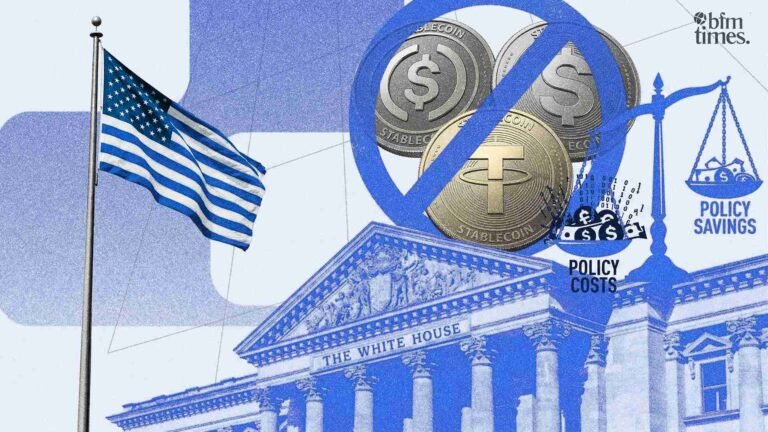
Key Insights
- Banning stablecoin rewards would increase total bank lending by just 0.02%, or $2.1 billion nationwide.
- The prohibition would cost households approximately $800 million in lost benefits and interest earnings.
- Most stablecoin reserves already circulate within the banking system via Treasuries and repo agreements, meaning they aren’t “lost” to the economy.
- Of the tiny 0.02% increase in lending, 76% would occur at large financial institutions, not local community banks.
- Even under “worst case” conditions, lending gains would top out at 4.4%, a figure the report labels as fundamentally unrealistic.
A landmark report released today by the White House Council of Economic Advisers (CEA) has concluded that prohibiting yields on stablecoins would do almost nothing to increase traditional bank lending, while simultaneously stripping consumers of nearly a billion dollars in financial benefits.
The study, titled “Effects of Stablecoin Yield Prohibition on Bank Lending,” arrives as Congress debates the CLARITY Act, a piece of legislation that could strictly limit the ability of digital asset platforms to pass through interest to their users. According to the CEA, a total ban on these yields would boost bank lending by a marginal 0.02%, equivalent to roughly $2.1 billion. In contrast, the move would result in a net welfare loss of $800 million for consumers who would lose access to competitive returns.
Why the Yield Ban Fails to Move the Needle
The core argument for banning stablecoin yields has long been the fear of “deposit flight.” Banking lobby groups have warned that if digital assets like USDC or USDT offer interest rates comparable to high-yield savings accounts, customers will drain their traditional bank accounts. This, they argue, would starve banks of the capital needed to provide mortgages and small business loans.
However, the CEA report suggests these fears are quantitatively small. The economists found that the relationship between stablecoins and banks is not a zero-sum game. Because stablecoin issuers like Circle and Tether back their tokens with liquid assets, those dollars don’t leave the financial ecosystem. Instead, they flow into U.S. Treasuries, money market funds, and reverse repo agreements.
“The money reshuffles; it doesn’t disappear,” the report states. By tracking the flow of funds, the CEA demonstrated that when a user moves money from a bank to a stablecoin, the issuer often buys Treasuries. The dealers and counterparties on the other side of those trades then deposit that cash back into the banking system, essentially neutralizing the effect on aggregate lending capacity.
The Lending Breakdown: Community vs. Large Banks
One of the most politically sensitive aspects of the stablecoin debate is the impact on community banks. Proponents of a yield ban often claim it is necessary to protect small, local lenders. The CEA findings directly challenge this narrative.
The report estimates that community banks (those with assets under $10 billion) would see a lending boost of only 0.026%, or about $500 million. The vast majority of any additional lending capacity—roughly 76%—would flow to the nation’s largest “too big to fail” institutions. This suggests that a yield ban would do more to protect the profit margins of Wall Street giants than to help Main Street borrowers.
Legislative Context: The CLARITY Act and the GENIUS Act
This report must be timed appropriately since the current crypto market is dealing with the implications of the GENIUS Act, which became law in July 2025. This act required that all stablecoins be backed one-to-one, as well as preventing issuers from giving out any interest payments directly.
Nevertheless, there is a “loophole” through which interest payments can be made via revenue sharing from third parties. The proposed CLARITY Act would plug this loophole.
Industry leaders have been quick to point to the CEA report as evidence that the CLARITY Act’s yield restrictions are a solution in search of a problem. Paul Grewal, Chief Legal Officer at Coinbase, noted that concerns about deposit flight should not be conflated with the broader pressures the U.S. banking system is facing.
“A yield prohibition would do very little to protect bank lending, while forgoing the consumer benefits of competitive returns on stablecoin holdings,” the CEA report concludes, effectively siding with the tech sector in one of the year’s most contentious regulatory battles.
Also Read: Hacker Mints $80 Million Worth of Fake Stablecoins and Swaps Them for ETH
Frequently Asked Questions
What is a stablecoin yield?
Stablecoin yield refers to the interest or rewards a user earns for holding a digital asset pegged to the U.S. dollar. These rewards are typically funded by the interest the issuer earns on the “reserves” (like Treasury bills) that back the coin.
Why do some people want to ban these yields?
Traditional banks and some regulators argue that if stablecoins pay high interest, people will move their money out of bank deposits. Since banks use those deposits to fund loans, they argue this “flight” reduces the availability of credit for the general public.
Does the White House report support the crypto industry?
While not an “endorsement” of crypto, the report uses economic modeling to show that the specific threat of “deposit flight” is exaggerated. It suggests that the current regulatory focus on banning yields may be counterproductive and harmful to consumer welfare.
What is the CLARITY Act?
The CLARITY Act is pending legislation in the U.S. Senate that would provide a comprehensive regulatory framework for stablecoins. The debate over whether it should include a total ban on “yield-like” rewards is currently the primary obstacle to its passage.
What happens if the yield ban is passed?
According to the CEA model, consumers would lose approximately $800 million in annual benefits. Bank lending would see a tiny increase (0.02%), but the report suggests this gain is so small that it would likely be offset by other economic costs, such as higher borrowing costs for the federal government.
Disclaimer: BFM Times acts as a source of information for knowledge purposes and does not claim to be a financial advisor. Kindly consult your financial advisor before investing.