Key Insights
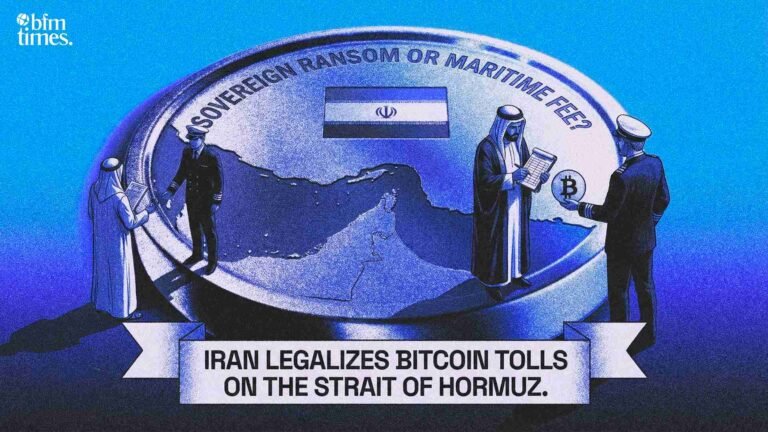
- Iran has formally started to insist that oil tankers passing through the Strait of Hormuz will pay a $1 per barrel fee in Bitcoin or Chinese Yuan.
- Ship operators are required to send cargo manifests to Iranian authorities and pay in digital assets within seconds of approval or face traceability or confiscation.
- A fully loaded Supertanker (VLCC) now faces a Bitcoin toll of about 2 million dollars per transit, as about 20 percent of the world’s oil flows through this chokepoint.
- Analysts see this as a geopolitical toll mechanism to circumvent U.S. correspondent banking and formalize evasion of sanctions in the ongoing two-week ceasefire.
- Traffic has been grounded, and daily transits have plummeted to as few as four vessels in recent days as companies look to get a clear picture of the legality of the payments.
The Islamic Republic of Iran has successfully transformed the most vital maritime Strait in the world into a source of cryptocurrency revenue in a move that has shocked the energy and digital asset industries.
By April 9, 2026, according to reports by the Financial Times and maritime intelligence agencies, the Islamic Revolutionary Guard Corps (IRGC) is currently implementing a Strait of Hormuz Management Plan. According to this plan, any non-empty vessel that is transporting oil is required to pay a tariff of $1 per barrel. In the case of a Very Large Crude Carrier (VLCC) with 2 million barrels, this would be a payment of 2 million dollars in Bitcoin that is immediately settled.
Hamid Hosseini, a representative of the Iranian Oil, Gas and Petrochemical Products Exporters Union, informed the reporters that the system is speedy and secure. Vessels receive just a few seconds to pay the toll in Bitcoin, so the money cannot be tracked or seized by enemy forces, Hosseini said. This protocol is the first instance of a sovereign state formally incorporating a decentralized cryptocurrency as a condition of entry into a shipping lane on a global scale.
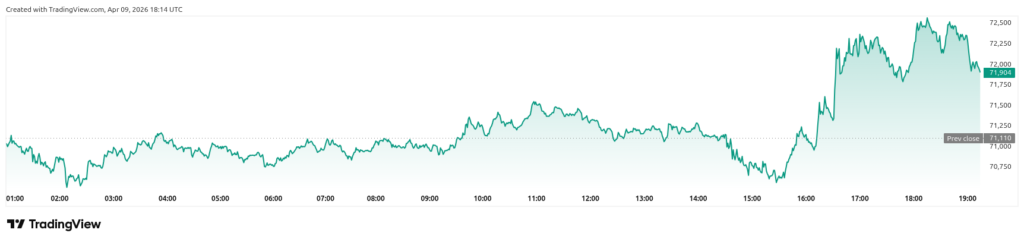
The Market Reaction and Price Action
The news of the “Crypto Toll” has added a layer of extreme volatility to the Bitcoin market. While the move provides a massive use case for Bitcoin as a “censorship-resistant” medium of exchange, it has also sparked fears of a regulatory crackdown from Western nations that view the toll as illegal.
Mechanical Engineering of the Toll
The IRGC Navy, in charge of the northern passage by the Larak Island, has adopted a strict digital workflow for all commercial traffic. Shipping firms must send cargo information to Iranian officials long beforehand. A payment address is given after the cargo has been confirmed to be non-military. When the Bitcoin is received, a VHF-broadcast passcode and an IRGC escort are issued to the vessel.
This process, according to EOS Risk, a maritime intelligence group, is so labour-intensive that it has reduced the efficiency of the strait. The current transits are only about 10 to 15 ships per day, as compared to the 135 daily transits that were being recorded before the recent regional escalations.
Legal Standing and Geopolitical Friction
U.S. Secretary of State Marco Rubio has already described the toll as illegal and dangerous, indicating that the international community should not give in to this maritime extortion. The U.S. is in a complicated dilemma, however. As a two-week ceasefire is underway, any action to militarily prevent the toll collection may lead to a full-scale war.
According to blockchain analytics service provider TRM Labs, this is a calculated development of the long-standing evasion policy of sanctions by Iran. Through Bitcoin, the IRGC transfers its income beyond the SWIFT banking system.
The Strategic Environment: 10 Years in the Making
The introduction of a Bitcoin toll is not a sharp turn but the result of years of institutional preparation. In 2021, Iran legalized cryptocurrency mining and is building its own national digital currency infrastructure to mitigate the impact of energy sanctions.
About 20 percent of the daily oil and liquefied natural gas (LNG) is transported through the Strait of Hormuz. By turning the on-off switch of this supply on and off and linking it to digital assets, Tehran has developed a financial instrument that is virtually unfreezeable by the U.S. Treasury in real time.
The Hormuz Toll represents another cost on an already growing list of costs to the global shipping industry. The Hormuz Surcharge is likely to be transferred to the gas pumps of consumers in the rest of the world, between higher insurance rates in war zones and today, the compulsory crypto charges.
Frequently Asked Questions
Is it legal for Iran to charge this toll?
Under the United Nations Convention on the Law of the Sea (UNCLOS), ships have the right of “transit passage” through international straits. But Iran claims that it is offering security services and environmental monitoring that warrant the fee. The majority of Western jurists believe that the toll is a contravention of international maritime law.
Is it possible to sanction shipping companies to pay the Bitcoin toll?
This is the main issue of international operators. The act of paying the toll might be technically considered as giving material assistance to a sanctioned organization (the IRGC). Instead of taking the risk of the legal repercussions of paying, many companies are now idling their ships in the Persian Gulf.
What is the reason to use Bitcoin over Stablecoins such as USDT?
Whereas Iran uses stablecoins to make smaller transactions, the deep liquidity and non-sovereign character of Bitcoin make it the asset of choice when it comes to settling transactions in the millions of dollars. It enables the Iranian government to have a reserve asset that is not under the control of any one company that may freeze the funds but appreciates.
What will become of a ship that declines to pay?
Persian Gulf Iranian state media and radio broadcasts have been explicit. Any ship that tries to pass without an Iranian permit or without paying the necessary digital payment will be destroyed.
And is this restricted to U.S. ships?
No. The fee is imposed on all commercial tankers, but vessels associated with the U.S. or Israel are said to be completely denied transit, whether they want to pay the Bitcoin fee or not.
Disclaimer: BFM Times acts as a source of information for knowledge purposes and does not claim to be a financial advisor. Kindly consult your financial advisor before investing.