Key Insights
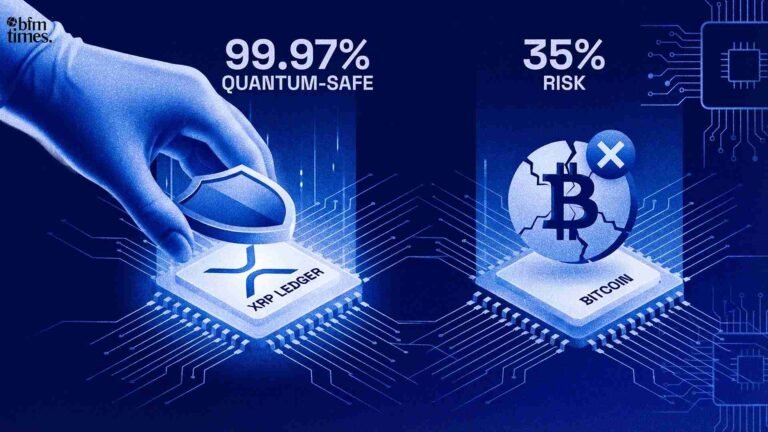
- According to recent on-chain audits, 0.03 percent of the entire XRP supply is now exposed to quantum-based attacks on the so-called Shor algorithm.
- Conversely, about 35 percent of the Bitcoin supply, including the mythical 1.1 million BTC belonging to Satoshi Nakamoto, is left vulnerable because of the old address formats.
- XRPL utilizes an account-based system, which supports the Signing Key Rotation mechanism, allowing for refreshment of security credentials without moving the money out of the accounts.
- 2.4 billion tokens in approximately 300,000 XRP accounts are intrinsically secure since they have never made a transaction, and their public key has not been published to the blockchain.
Also Read: XRP Ledger Tests Post-Quantum ML-DSA Signatures First
Deep Dive: The XRP Ledger is winning the Quantum Resistance Race over Bitcoin
With the specter of quantum computing looming over the digital asset industry, a new wave of cryptographic analysis has ignited a raging debate between the XRP and Bitcoin communities. The XRP Ledger seems to be structurally immune to the so-called quantum apocalypse in a way that the Bitcoin network is not, according to a series of reports published this week by blockchain security experts and XRPL validators.
The essence of the problem is the exposure of the public keys. An attacker could theoretically derive a private key given a visible public one in a future where quantum computers are powerful enough to execute Shor’s algorithm. In the Bitcoin network, numerous early wallets, such as those of the anonymous developer Satoshi Nakamoto, are in the Pay-to-Public-Key (P2PK) format, exposing the key publicly. It has been estimated that as many as 6.9 million BTC, or about 35 percent of the circulating supply, are in this vulnerable category.
XRP, though, is a very different statistical profile.
The 0.03% Factor
An audit shared by prominent XRPL researcher Vet reveals that the ‘surface area’ for a quantum attack on XRP is almost negligible. The statistics indicate that there are about 300,000 XRP accounts with a total of 2.4 billion XRP that have never transacted out. Since these accounts have not been funded yet, their public keys have never been shared with the ledger, and thus they cannot be seen by quantum decryption devices.
There are nearly no dormant vulnerable XRP whales, Vet pointed out in a recent technical briefing. The analysis revealed that there were only two large, dormant accounts (not used in more than five years) with exposed public keys, representing a tiny 0.03% of the total supply.
Architectural Superiority: Key Rotation
In addition to the numbers, the XRP Ledger has a native functionality that is not available in Bitcoin: Signing Key Rotation. On the Bitcoin network, when a user wishes to increase their security, they have to physically transfer their funds to a new address. This process creates a ‘vulnerability window’ in the memory pool (mempool) where the public key is exposed for about 10 minutes before the transaction is finalized.
In the XRPL, users are able to rotate their signing key and leave the funds in the same account. It is the cryptographic version of replacing the locks on a house without necessarily relocating all the furniture to a new house. This is what enables the network to switch to post-quantum signatures (such as the CRYSTALS-Dilithium standard that is already being tested on the XRPL AlphaNet) with much less friction than Bitcoin.
Current Market Sentiment
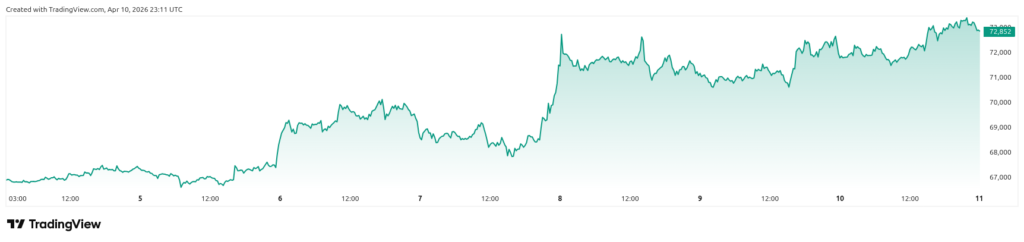
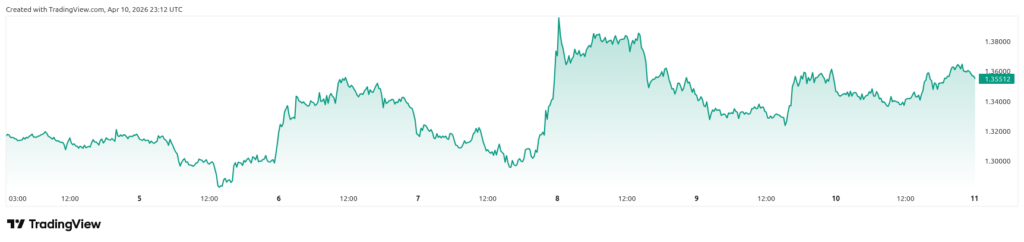
The news comes at a time of relative stability for both assets. Bitcoin is currently trading in a consolidation range since its recent surge, as of April 10, 2026, whereas XRP has been holding a high level of support, supported by the growing institutional interest in its future-proof architecture.
Technical Background: The Science of the Threat
To see the difference, one should consider how these blockchains conceal their secrets. Both employ Elliptic Curve Cryptography (ECC) to encrypt money. However, Bitcoin’s early adoption meant that many coins were ‘locked’ using methods that didn’t fully realize the eventual threat of Shor’s algorithm.
The upgrade process of Bitcoin is notoriously slow, and it needs a wide agreement among miners. Although some developers, such as StarkWare, have proposed solutions such as Quantum-Safe Bitcoin (QSB), based on GPU-intensive proof-of-work puzzles, they are often expensive to compute.
The XRP Ledger is a validator-consensus model that has traditionally been faster at implementing protocol amendments. As the AlphaNet is already testing ML-DSA (Module-Lattice-Based Digital Signature Algorithm), the ledger is positioning itself as a safe haven for institutional capital that cannot take the risk of a 35% supply vulnerability.
Frequently Asked Questions
Am I in danger of losing my Bitcoin?
No. There are no quantum computers that can break modern ECC encryption. It is estimated that such machines are at least 5 to 10 years away. The threat is theoretical at the moment, but the 35 percent exposure is a risk of the future that will have to be mitigated by upgrading the network.
Why is the exposure of XRP so low?
XRP Ledger is not UTXO-based, but account-based. Also, the manner in which XRP addresses are created implies that the public key is not disclosed until you sign your first outgoing transaction. Millions of XRP investors who are buying and holding their investments are essentially invisible to quantum attackers.
Will Bitcoin correct this?
Yes, but it is difficult. New signature schemes would require a soft fork or hard fork to implement in Bitcoin. Moreover, the Bitcoins that are in lost wallets or controlled by Satoshi cannot be transferred to the safer types of addresses by their owners, so 35% of the supply can be at risk permanently, unless the network implements a burn or migrate policy, which would be a very controversial solution.
What is Key Rotation?
This is an XRPL feature that enables an account to swap its master password (private key) without altering the account address. This enables smooth security updates.
What is meant by AlphaNet in the above article?
AlphaNet is the developer test network for the XRP Ledger. In this network, new, revolutionary features like quantum-resistant signatures are tested and subsequently voted on by the validators on the mainnet.
Disclaimer: BFM Times acts as a source of information for knowledge purposes and does not claim to be a financial advisor. Kindly consult your financial advisor before investing.