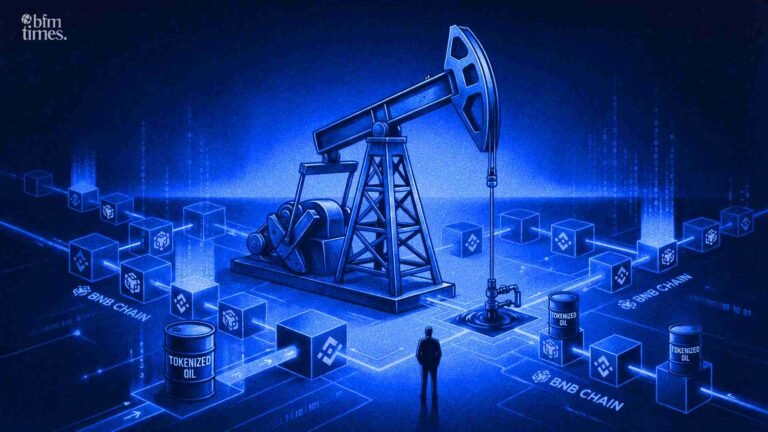
Institutional giants and sovereign funds have long been the playground of the global energy market. To the typical retail investor, direct exposure to crude oil used to be complicated through the use of complicated brokerage accounts, large capital requirements, and knowledge of the complex futures market. Nevertheless, the emergence of Real World Asset (RWA) tokenization is fundamentally altering this situation. With the introduction of the price of Black Gold to the BNB Chain, investors can now easily trade assets tied to oil as they would trade a meme coin on a decentralized exchange.
- The History of Energy as a Digital Asset.
- Why Choose BNB Chain for Oil Trading
- Searching for the Appropriate Tokenized Oil Assets
- Step-by-Step Guide to Trading Tokenized Oil
- 1. Establish and Finance a Web3 Wallet
- 2. Enter a Supported Trading Platform.
- 3. Connect and Authorize
- 4. Execute the Trade
- 5. Monitor and Manage Risk
- Risks and Critical Considerations
- The Future of Energy on the Blockchain
- Frequently Asked Questions
Also Read: BNB Price Prediction (2026-2030)
This article will discuss the mechanics of tokenized oil, why the BNB Chain is a good place to store these assets, and provide a step-by-step guide on how you can begin trading today.
The History of Energy as a Digital Asset.
The concept of tokenizing ownership or price exposure to physical crude oil and storing it as a digital token on a blockchain is known as tokenized oil. In contrast to the old-fashioned paper oil or futures contracts, which expire and must be rolled over, tokenized oil is usually a perpetual representation of the underlying commodity.
There are generally two ways oil is tokenized. The first is asset-backed tokens, in which the token is literally backed by a barrel of oil in a professional storage facility. The second is synthetic or derivative tokens, which follow the real-time price of benchmarks such as Brent or West Texas Intermediate (WTI) with decentralized oracles. Both models are also becoming popular on the BNB Chain as a subset of the overall $7 billion tokenized commodities market.
Why Choose BNB Chain for Oil Trading
The BNB Chain (previously Binance Smart Chain) has become a force behind RWA projects due to several technical and economic factors:
- Minimal Transaction Costs: Trading commodities involves high-frequency movements and rebalancing. The BNB Chain has gas fees that are a fraction of those on the Ethereum mainnet, which is affordable to smaller retail traders.
- Deep Liquidity: The BNB chain is among the most crowded crypto ecosystems and hosts a vast amount of stablecoins (USDT and FDUSD), which are also the most liquid pairs for oil tokens.
- Institutional Infrastructure: Services like Matrixdock and Ondo Finance have started emerging in the BNB Chain ecosystem to leverage both userbase and institutional quality infrastructures.
Searching for the Appropriate Tokenized Oil Assets
Before starting your trading activity, it would be necessary to determine which assets exist. By 2025, this area will become vastly populated.
Among the most notable ones is the United States Oil Tokenized Fund (USOon) by Ondo Finance. The token offers economic exposure just like owning the United States Oil Fund (USO) ETF. Although it was initially popular on Ethereum, its growth to the BNB Chain has enabled users to trade it through different decentralized protocols.
The other interesting event is the introduction of Crude Oil Perpetual Contracts that can be accessed via the Binance Web3 Wallet. These are commonly supported by third-party decentralized exchanges (DEXs) such as Aster, which run on the BNB Chain. These contracts enable 24/7 trading without the constraints of the normal market hours.
(To add a live chart, go to TradingView, type in USO or WTI, and use the Take a Snapshot feature to save the current price action.)
Step-by-Step Guide to Trading Tokenized Oil
When you are prepared to trade on the BNB Chain, here are the steps to trade the oil-linked assets safely.
1. Establish and Finance a Web3 Wallet
To begin with, it is necessary to establish and finance a Web3 wallet. You will require a wallet that supports the BNB Chain. The typical options are the Binance Web3 Wallet, Trust Wallet, or MetaMask. After the installation, make sure that you have a small portion of BNB to pay gas fees and a sufficient amount of USDT or USDC to trade.
2. Enter a Supported Trading Platform.
Go to a site where there are RWA or commodity tokens.
- In the case of Spot Trading: DEX, such as PancakeSwap, or a dedicated RWA portal, such as Ondo Global Markets.
- To use Derivatives/Futures: Click on Binance Web3 Wallet and find the section of perpetuals or DApps. Go to search: Aster or CL (Crude Oil ticker).
3. Connect and Authorize
You will need to connect your wallet when using a DEX or a specific platform. Most platforms will require you to “Enable” or “Approve” the use of your stablecoins before you can execute a swap. When trading in perpetuals, you may be required to sign a single message to enable Secure Auto Sign to trade more efficiently.
4. Execute the Trade
Find the oil ticker (e.g., USOon/USDT or CLUSDT).
- Market Orders: These are carried out at the prevailing market price.
- Limit Orders: These enable you to place a certain price at which you wish to buy or sell, which helps control entry points in high volatility.
5. Monitor and Manage Risk
In contrast to the traditional oil markets, which are closed on weekends, tokenized oil on the BNB Chain is traded 24/7. Monitor your tokens with the help of such tools as DexCheck or CoinMarketCap. Geopolitical events can influence oil prices, so keep up with the news of the energy industry around the world to predict price fluctuations.
Risks and Critical Considerations
Although the idea of democratizing oil trading is thrilling, it is associated with certain risks, which all traders should be aware of:
- Oracle Risk: Tokenized assets are based on price feeds (oracles) such as Chainlink to represent the actual oil price in the real world. If the oracle goes wrong, the token can’t have its value determined by the real asset.
- Counterparty Risk: As a token owner, one is expected to trust the entity issuing the token and have enough oil and insurance. Always request proof of reserve audit (PoR).
- Regulatory Framework: At the moment, the framework regarding tokenized commodities has not been fully developed yet. Some tokens may be restricted according to the law in some jurisdictions (e.g., the United States).
The Future of Energy on the Blockchain
The on-chaining of the energy sector is just starting. The BNB Chain is opening the door to more advanced applications, beyond mere trading. We are seeing the rise of Green Oil tokens, in which the carbon credits related to production are also tokenized, and B2B settlement tokens that enable energy companies to pay their suppliers with oil-backed digital assets.
The deeper the liquidity and the higher the number of institutional players who transfer their inventory to the ledger, the smoother the trading in oil will be, as with any other digital transaction, which will be a hedge against inflation and a diversified asset class in the modern crypto portfolio.
Frequently Asked Questions
Will I be able to redeem tokenized oil in physical barrels?
This is solely at the discretion of the issuer. Other institutional-grade platforms can be physically redeemed in case the user has a very high minimum (e.g., 10,000+ barrels) and successfully passes KYC/AML verification. To the overwhelming majority of retail traders, these tokens serve as price exposure and are settled in stablecoins.
Is tokenized oil trading available 24/7?
Yes. This is among the main benefits of trading on the BNB Chain. Although the traditional markets (such as the NYMEX) have definite opening and closing hours, the decentralized platforms and on-chain perpetual contracts enable trading 24/7.
What is the difference between a “Perpetual” oil contract and a “Spot” oil token?
A Spot token (such as USOon) is a direct ownership or an ETF-tracked position that you can keep in your wallet indefinitely. A perpetual contract is a derivative that enables you to leverage (borrowed money) to bet on whether oil will increase or decrease in price. In perpetuals, there are funding rates to be paid or received every few hours to keep the contract price in line with the spot price.
Is there any KYC to trade oil on the BNB Chain?
It depends on the platform. Purely decentralized exchanges (DEXs) such as PancakeSwap typically do not need KYC. More specific RWA platforms that handle regulated securities or physical assets (such as Ondo or Matrixdock) may, however, need to be verified to guarantee adherence to international financial regulations.
Why do I know that the token is supported by oil?
Trustworthy issuers provide regular third-party audits and use ‘Proof of Reserve’ (PoR) technology. This can include a decentralized oracle network, such as Chainlink, that ensures the presence of the physical collateral in off-chain vaults and broadcasts that information directly onto the blockchain to be viewed by anyone.
Disclaimer: BFM Times acts as a source of information for knowledge purposes and does not claim to be a financial advisor. Kindly consult your financial advisor before investing.