


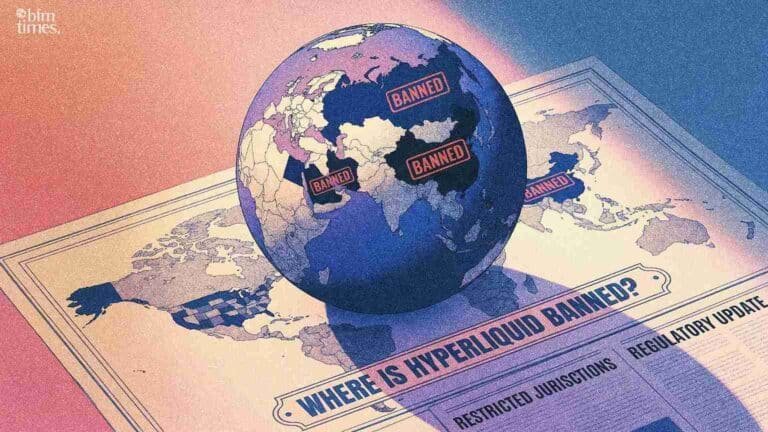
Hyperliquid is prohibited mainly in the United States, the Canadian province of Ontario, and a number of OFAC-restricted jurisdictions, applying to users who are in or are citizens of these restricted areas.
Regions and Countries Banned
Hyperliquid has a rigorous list of prohibited jurisdictions to adhere to global regulatory standards and anti-money laundering (AML) policies. Although the service can be used in roughly 190 regions, the following jurisdictions are punished:
- North America: United States and Ontario, Canada.
- Middle East: Iran and Syria.
- Asia: North Korea.
- Caribbean: Cuba.
- Eastern Europe: Crimea, Donetsk and Luhansk (regions within Ukraine).
Restrictions generally apply to any “Restricted Person” – a definition that applies to citizens or residents of the areas even if they don’t live there. The exchange employs front-end geo-blocking to block users from these areas from accessing the trading platform.
Why These Bans Make Sense
These bans stem mainly from a lack of specific regulatory approvals for operating in highly regulated jurisdictions such as the U.S. Given that Hyperliquid facilitates perpetual futures and leveraged trades with 50x leverage, it is regulated by some of the strictest financial regulators like the Commodity Futures Trading Commission (CFTC) in the United States (US) and the Ontario Securities Commission (OSC) in Canada.
Being a decentralized exchange where there’s no standard KYC (Know Your Customer) process available, Hyperliquid has no easy way to verify the legitimacy of these high-risk financial instruments. The protocol tries to protect itself from any legal issues or even prosecution by blacklisting such jurisdictions.
Key Points to Consider
The key thing to consider here is that while Hyperliquid is indeed a decentralized protocol, the web interface acts as a centralized channel which can be blocked. It’s the user’s responsibility to ensure compliance with the local laws regarding derivative financial instruments.
While a user may bypass the restriction by using a VPN or other circumventing technologies, they might still be violating the Terms of Use. Moreover, as more regulations are placed on DeFi (Decentralized Finance) in 2025 and 2026, it is possible the list of banned countries will grow if other countries introduce more strict capital controls or licensing regimes for on-chain perpetual exchanges.
Disclaimer: BFM Times acts as a source of information for knowledge purposes and does not claim to be a financial advisor. Kindly consult your financial advisor before investing.