

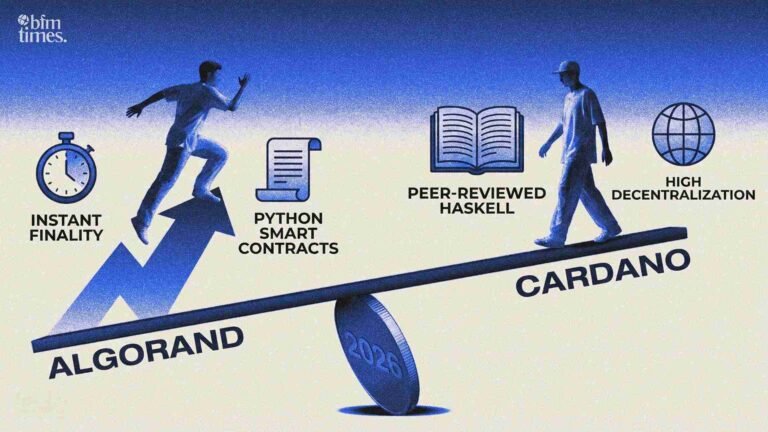
Both Cardano and Algorand are well-known Layer 1 blockchains that are intended to enable smart contracts, decentralized finance, and secure digital assets. Both employ energy efficient proof of stake mechanisms, but differ in their philosophy. Cardano focuses on a peer-reviewed, academic development model and high security. Algorand is a high-speed, instant finality, and institutional efficiency system with a unique lottery-based consensus.
Technical Architectures and Consensus Mechanisms.
The greatest distinction is in the manner these networks arrive at a consensus. Cardano is based on the Ouroboros protocol. In early 2026, Cardano started the implementation of the Ouroboros Leios upgrade that separates the functions of block endorsement and block production to considerably increase throughput. This enables Cardano to scale without compromising its high Nakamoto Coefficient, which is an important measure of decentralization.
Algorand uses Pure Proof of Stake (PPoS). This system was developed by MIT professor Silvio Micali and randomly and secretly chooses a small group of stakeholders to verify each block. This leads to extremely rapid block times, typically less than three seconds, and offers immediate finality. In contrast to Cardano, where a transaction may need multiple confirmations to be settled, an Algorand transaction is considered settled immediately after it is added to a block.
Development Environments and Smart Contracts.
These two platforms cater to two distinct groups of developers. One platform is Cardano, which operates using the extended UTXO architecture, similar to Bitcoin but with support for smart contracts. Its primary programming language is Plutus, which is Haskell-based. Functional programming languages, which have found favor in applications requiring high assurance code, such as aviation and medicine, are prevalent in this case.
The other platform is Algorand, operating using an account-based architecture similar to that of Ethereum. Although it supports TEAL at a lower level, it gained massive popularity by allowing its users to develop smart contracts using Python. This ease of use has seen it become a popular option in quick application development and financial institutions seeking to connect existing systems with blockchain technology.
History and Philosophy.
Charles Hoskinon established Cardano with the belief of gradual, step-by-step advancement that was proven through scholarly studies. Its roadmap is separated into such eras as Shelley and Voltaire, which are devoted to governance and decentralization.
Algorand was launched with a focus on solving the “blockchain trilemma” without compromising on performance. It has long positioned itself as the Future of Finance, and has established a partnership with central banks and other global payment providers, who appreciate its fork-resistant nature and carbon-neutral footprint.
Frequently Asked Questions
What is the network with the lowest transaction cost?
Both networks are very cheap in comparison with the early blockchains. Nevertheless, Algorand tends to have lower charges, which are usually a fraction of a cent. Cardano charges are a bit higher, but predictable and low for the majority of users.
Are NFTs supported by these blockchains?
Yes, they both have strong NFT ecosystems. Cardano considers NFTs as native assets that do not need complex smart contracts to be minted. Algorand has Algorand Standard Assets (ASA), which can be minted and transferred instantly.
Is it possible to bet on both platforms?
Yes. Cardano enables users to stake ADA in stake pools without locking the tokens. Algorand has a staking model that is governance-based, with users staking ALGO over a specified time to vote on protocol modifications and receive rewards.
Disclaimer: BFM Times acts as a source of information for knowledge purposes and does not claim to be a financial advisor. Kindly consult your financial advisor before investing.