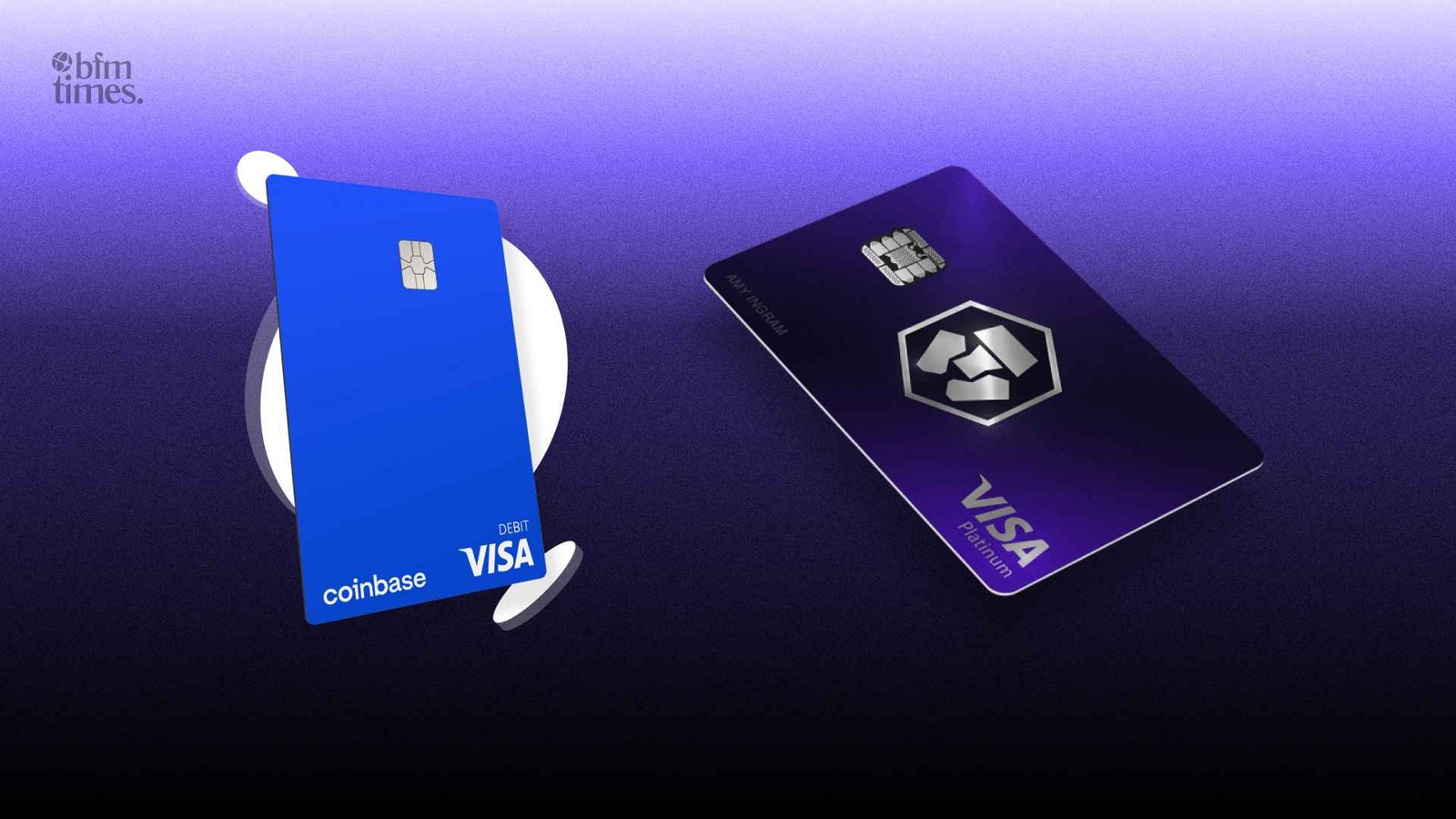
When deciding between the Coinbase Card vs Crypto.com Card, one of the reasons is that you are probably seeking out an easy way to spend crypto and get a reward. Both cards give cashback, are accepted in all countries, and are controlled through apps, but they operate at very different speeds internally.
- Who Each Card Is Best For (TL;DR)
- Coinbase Card vs Crypto.com Card
- How the Cards Work: Funding, Conversion & Spending Mechanics
- Rewards & Net Value: Cashback, Token Rewards & Perks (Crypto Cashback Cards)
- Fees & Costs: Coinbase vs Crypto.com Fees
- Net Rewards Worked Example
- Card Tiers & Access Requirements: Free vs Staked/Metal Tiers
- Availability & Regional Differences: Where Each Card Works
- Security, Support & User Experience: App Controls & Fraud Protection
- Travel & Lifestyle Perks: Subscriptions & Lounge Access
- Real-World Use Cases
- 1. Frequent International Traveler
- 2. Everyday 30-Year-Old Spender
- 3. Large CRO Holder (Long-Term HODLer)
- Pros & Cons
- How to Choose
- Conclusion
This detailed comparison of Coinbase Card vs Crypto.com Card compares rewards, staking, fees, local availability, security, and value in 2026. No matter what type of card user you are, casual spender, frequent traveler, or long-term token holder, this guide will assist you in knowing which card structure suits your spending profile, without any hype or marketing propaganda.
Related: Everything To Know About Coinbase, The Largest Crypto Exchange In The US
Who Each Card Is Best For (TL;DR)
Easy to use, no lockups:
→ Coinbase Card
Better cashback (if one can afford to put money on CRO):
→ Crypto.com Card
Better among the travelers who want lounge amenities (higher levels):
→ Crypto.com Card (staked tiers)
Most suitable for flexible spend-from-fiat configuration:
→ Coinbase Card
Coinbase Card vs Crypto.com Card
| Feature | Coinbase Card | Crypto.com Card | Notes |
| Card Type | Visa debit (linked to Coinbase balance) | Visa prepaid debit | Both widely accepted |
| Funding | Spend crypto or fiat (USD/EUR/GBP supported regions) | Prepaid top-up (crypto or fiat wallet) | Different spending flow |
| Rewards | Rotating crypto rewards (up to ~4% historically; typically 1–4%) | Tier-based CRO cashback (0%–5% depending on staking) | Varies by region & promo |
| Staking Required | No | Yes (for meaningful rewards tiers) | CRO lock-up required |
| Annual Fee | $0 | $0 (but staking required for perks) | |
| ATM Fees | Free up to the monthly limit (region-specific), then % fee | Free up to tier-based limit, then 2% | |
| FX Fees | Standard Visa FX; spread applies on crypto liquidation | Visa FX rates; spread when topping up from crypto | |
| Mobile Wallet | Apple Pay & Google Pay (supported regions) | Apple Pay & Google Pay (supported regions) | Region dependent |
| Top Perk | No lock-in, flexible rewards | Higher cashback + lounge (higher tiers) |
How the Cards Work: Funding, Conversion & Spending Mechanics
The key in the Coinbase Card vs Crypto.com Card decision is to figure out the mechanics of spending.
Coinbase Card Flow
The flexibility of the Coinbase crypto debit card review is frequently mentioned.
- Connected directly to your Coinbase account.
- You decide what to spend on which asset.
- Transformation into crypto is done automatically.
- You can even spend fiat (USD, EUR, or GBP, depending on the region).
- Payments are made in the form of rewards that are paid in the crypto of choice.
Key implication:
In most countries, any crypto transaction is a taxable disposal. In addition, at the time of purchase, crypto converts at a spread.
Pros:
- No staking required.
- No need to preload.
- Intuitive and clean app experience.
Cons:
- Conversion spreads reduce effective rewards.
- Rewards are cyclical and can be changed.
Crypto.com Card Flow
The comparison of Cryptocurrency Visa by Crypto.Com is closely focused on the mechanism of stakes.
- The card operates as a prepaid.
- Fiat or crypto top-up.
- Cashback paid in CRO.
- Increased levels of cashback involve a CRO lock-up (a 6-month lock-up is common).
Historically, the staking levels are:
- 0% (no stake)
- 1-2% (entry stake)
- 3-5% (higher-tier metal cards)
Key implication:
Capital is bound up with CRO and open to market fluctuations.
Pros:
- Higher potential cashback.
- Travel perks are offered at premium levels.
Cons:
- Lock-up risk.
- Staked capital opportunity cost.
Suggested: Best Platforms for Crypto Staking in 2026: Top Places to Earn Crypto Rewards
Rewards & Net Value: Cashback, Token Rewards & Perks (Crypto Cashback Cards)
Compared to crypto cashback cards, the headline percentages are deceptive.
Coinbase Card Rewards
- The rewards go about 1 to 4 percent in rotating crypto.
- No staking required.
- Automatically paid in a choice of crypto.
- Subject to change.
Important:
Conversion spreads (often ~0.5%–2%) may reduce effective return.
Crypto.com Card Rewards
Tier-based structure (2026 typical structure; varies by region):
| Tier | CRO Stake Required | Cashback |
| Midnight Blue | None | 0% |
| Ruby Steel | Moderate CRO stake | ~1% |
| Royal Indigo/Jade | Higher stake | ~2–3% |
| Icy White/Frosted Rose | Significant stake | ~4–5% |
Higher tiers may include:
- Spotify/Netflix reimbursement
- Lounge access
- Higher ATM limits
The trade-off:
You assume CRO price risk and capital lock-up.
Fees & Costs: Coinbase vs Crypto.com Fees
Here is where the comparison between Coinbase and Crypto.com fees is necessary.
Coinbase Card Fees
- No annual fee
- Crypto liquidation spread
- ATM free up to the limit
- A potential two percent charge above the free ATM limit.
- The replacement fee depends on the region (diversified)
Crypto.com Card Fees
- No annual fee
- No FX markup (Visa rate applies)
- ATM free up to the tier limit
- 2% beyond limit
- Crypto-to-fiat spread during top-up
Key difference:
- Coinbase charges at the time of crypto conversion per purchase.
- Crypto.com levies on the topping up of crypto.
Net Rewards Worked Example
Table 2: Net Rewards Comparison (Annual)
Scenario A: $6,000 Annual Spend (No Travel Perks)
| Metric | Coinbase Card (2% avg reward) | Crypto.com (2% tier; CRO staked $4,000 equiv) |
| Gross Rewards | $120 | $120 |
| Estimated Spread Costs (~1%) | -$60 | -$60 (top-up) |
| Staking Opportunity Cost (5% alt yield) | $0 | -$200 |
| Net Estimated Benefit | ~$60 | -$140 |
Scenario B: $12,000 Annual Spend + Travel Perks Tier
| Metric | Coinbase Card (2%) | Crypto.com (4% tier; $40k stake equiv) |
| Gross Rewards | $240 | $480 |
| Spread Cost (~1%) | -$120 | -$120 |
| Staking Opportunity Cost (5%) | $0 | -$2,000 |
| Net Estimated Benefit | ~$120 | Negative unless CRO appreciates |
This emphasizes the main fact in the Coinbase Card vs Crypto.com Card comparison: staking changes the calculation radically.
Card Tiers & Access Requirements: Free vs Staked/Metal Tiers
Coinbase:
- Single structure.
- No metal tiers.
- No lockups.
Crypto.com:
- Tiered.
- 6-month CRO staking lock.
- Metal cards at higher tiers.
- Capital is subject to market risk.
Staking can work better in the case of the appreciation of CRO. In case it falls, effective cashback may become negative.
Availability & Regional Differences: Where Each Card Works
United States
- Coinbase Card is available
- Crypto.com Card available.
- Reward structures differ slightly.
UK & EU
- Both are available.
- Coinbase accepts GBP/EUR expenditure.
- Crypto.com has a historically stronger EU presence.
Asia/Middle East
- Greater APAC presence of crypto. Com.
- The availability varies often; check in-app.
Both cards support:
- Apple Pay (supported regions)
- Google Pay
- Contactless Visa payments
Security, Support & User Experience: App Controls & Fraud Protection
Both cards offer:
- Instant card freeze via app
- PIN change
- 2FA login
- Transaction notifications
Coinbase advantage:
- Flawless exchange integration.
- Cleaner UI for beginners.
Crypto.com advantage:
- Dedicated card tab.
- Obvious top-up wallet segregation.
They both run on Visa rails and have normal dispute protection (by region).
Travel & Lifestyle Perks: Subscriptions & Lounge Access
Crypto.com (higher tiers):
- Spotify rebate (lower levels in the past)
- Netflix rebate (mid tiers)
- LoungeKey access (better levels)
- Increased ATM limits
Coinbase:
- No subscription perks
- Focused purely on rewards
When comparing the Coinbase Card vs Crypto.com Card, the benefits will only be important if you appreciate such services and already use them.
Real-World Use Cases
1. Frequent International Traveler
Cashback and lounge access may help Crypto.com win at higher levels, provided staking costs are reasonable.
2. Everyday 30-Year-Old Spender
Coinbase can be simpler:
- No lockup
- Decent cashback
- Easier tax tracking
3. Large CRO Holder (Long-Term HODLer)
Provided that you are already holding CRO on a long-term basis, staking higher levels could enhance total yield.
Pros & Cons
Coinbase Card
Pros
- No staking required
- Simple UX
- Flexible crypto selection
- No annual fee
Cons
- Fee on all crypto transactions.
- Rotating rewards
- No premium travel perks
Crypto.com Card
Pros
- Higher potential cashback
- Travel perks
- Metal tiers
- Prepaid control
Cons
- CRO lock-up
- Opportunity cost
- Rewarding based on token value.
How to Choose
In comparing Coinbase Card vs Crypto.com Card, the question is:
- Would I feel safe tying up money in CRO?
- Do I value lounge access?
- How much do I spend annually?
- Which one is more important: simplicity or maximization?
- What region am I in?
To the majority of non-expert users, Coinbase is easy.
In the case of loyal CRO holders or heavy spenders, Crypto.com can provide greater upside at greater risk.
Also Read: How to Transfer Crypto Between Exchanges: Complete Crypto Exchange Transfer Guide
Conclusion
The actual distinction between the Coinbase Card vs Crypto.Com Card lies in the staking risk and ease. Coinbase is cleaner in case you like flexibility and no lockups. At the cost of more cashback and benefits, CRO, Crypto.com, will perform better, but the cryptocurrency company will not do it unless the numbers play in your favor.
Disclaimer: BFM Times acts as a source of information for knowledge purposes and does not claim to be a financial advisor. Kindly consult your financial advisor before investing.
Does it accept Apple Pay or Google Pay?
Yes, in supported regions.
Is staking CRO stopping me from spending it?
Yes. The lock-up period is already locked with staked CRO.
Are rewards taxable?
In many jurisdictions, yes. Consult a tax professional.
Is it one of the best crypto cards 2026 has to offer?
They are both often listed as some of the best crypto cards in 2026 comparisons, but you will have to use them depending on your needs.