


Key Insights
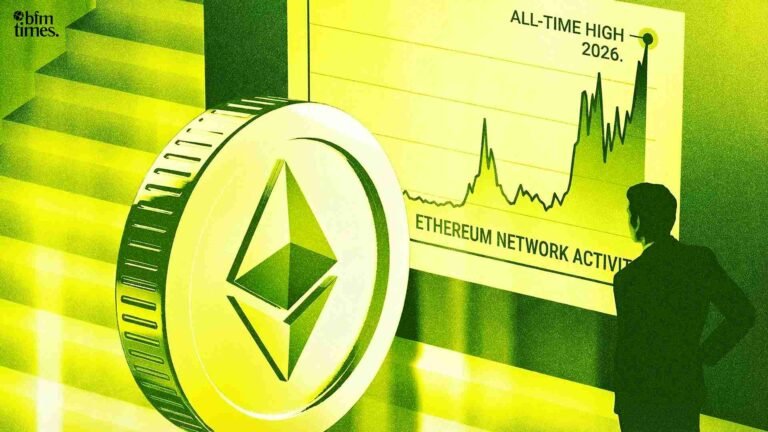
- The seven-day average number of transactions in Ethereum has recovered to reach 1.3 million transactions, which is the same record as its all-time high in early February 2026.
- The daily active addresses are near 2 million addresses, way above the previous high during the bull run in 2021.
- More than 30% of the total ETH supply, approximately 85 billion dollars, is currently staked, indicating high confidence by long-term investors.
- The supply of stablecoins in the Ethereum mainnet has reached an all-time high of $180 billion, offering massive liquidity to decentralized applications.
- The interoperability at Layer 2 and the unprecedented rate of RWA tokenization are the factors driving this surge.
Also Read: Grayscale Thinks Ethereum and Solana Have Compelling Buying Prices Now
Institutional Shift Sparks New Record on Ethereum Network Activity
The Ethereum (ETH) network traffic has recently experienced a record-breaking level of transaction activity. The most recent statistics provided by CryptoQuant show that the 7-day moving average of transactions has surpassed 1.3 million again. This is the highest recovery since mid-February 2026, a fact that proves that the network is in a new phase of growth after a short period of consolidation in March.
This wave is founded on the principle of institutional usefulness, as compared to the previous waves, where speculative investment in retail had been at the center of all actions in the market. Development in DeFi and integration of traditional financial assets will provide a more reliable platform for growth in the ecosystem.
The Usage and Price Dilemma
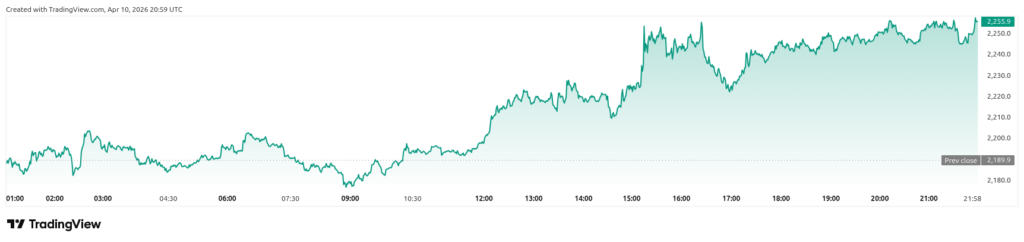
The information provided offers an interesting case study for market analysis. The reason being, while the blockchain is experiencing unprecedented traffic, the cryptocurrency Ether (ETH) has been fairly stable within its price range of $2,100 to $2,250. According to CryptoQuant analysts, this is referred to as a “valuation gap.”
“The use of Ethereum is changing, and it is evident,” said a senior on-chain analyst. “In 2021, transactions were high, fees were high, and there was retail frenzy. Today, 1.3 million transactions are occurring at a much lower cost of gas due to the Fusaka upgrades and Layer 2 efficiency. The network is becoming more robust, although the price has not yet fully responded to the influx of capital.”
Live charts on platforms such as TradingView indicate that the ETH/USD pair is testing local resistance, but smart contract calls have soared to more than 40 million a day. This implies that users are not just doing simple transfers but are now interacting with complex decentralized protocols.
Scaling and Stablecoin Dominance
One of the main facilitators of this activity is the fact that Ethereum is the settlement layer of stablecoins. The overall supply of stablecoins on the network, comprising USDT, USDC, and the institutional JPM Coin, has reached $180 billion.
In addition, the “Glamsterdam” protocol upgrade is affecting the way developers are implementing smart accounts. These applications enable users to engage with the blockchain as easily as they would with a normal mobile banking application. This has lowered the barrier for millions of new users, with the number of daily active addresses approaching 2 million.
Contextual Analysis: Why 2026 is the Year of Utility
This increased activity can be attributed to a multi-year scaling roadmap. These upgrades are referred to as “The Surge,” and they are meant to enable the network to accommodate 100,000 transactions per second using rollups.
RWA and Institutional Adoption
2026 has been marked by a significant increase in Real World Asset (RWA) tokenization. This has been facilitated by major financial institutions such as BlackRock and Standard Chartered. By April 2026, tokenized U.S. Treasuries and real estate on Ethereum will have a value exceeding $20 billion.
Ethereum-based Layer 2s, including Base and Arbitrum, are now being used by traditional finance (TradFi) players to settle trades. Such migration gives a steady base of high-value transaction volume that cushions the network against the volatility of purely speculative cycles.
Staking as a Macro Asset
The network structure has also been altered by the emergence of the staking economy. Ethereum has already created a “risk-free rate” in the digital asset ecosystem with 36 million ETH staked. Staked ETH is becoming a superior asset in the eyes of institutional investors as compared to traditional bonds, as it provides security rewards and can appreciate in price.
Frequently Asked Questions
What does high activity and a flat price mean?
Price and network activity do not necessarily move in tandem. The present usage is motivated by the utility of DeFi and reduced gas costs. Historically, sustained high network usage eventually results in price escalation since the underlying value is too high to be overlooked by the market.
How does this compare to the 2021 bull run?
In 2026, the level of transactions is much more efficient and higher. Although the highest point in 2021 was 1.1 million transactions per day, they were frequently too costly for many. The current 1.3 million average can be achieved with a significantly lower cost, allowing for more sustainable growth.
What is the role of Layer 2 solutions in this data?
The 1.3 million number is mainnet transfers, but overall ecosystem activity, including Layer 2s, is significantly greater. The final proofs of Layer 2s are resolved on the Ethereum mainnet, which helps to stabilize the increase in the CryptoQuant data.
Is the network decentralized enough now that so much ETH is staked?
Even though big players have a significant share, there have been several updates made by the community to promote staking by individuals. The validator set is more diversified by April 2026, but it is still important for developers to monitor stakeholderhttps://www.blackrock.com/corporate diversification.
What could be the next milestone to reach?
The next milestone to reach is the “Glamsterdam” upgrade that is scheduled to take place in June 2026. Through this, throughput and account abstraction will be optimized, thus driving the number of transactions even higher.
Disclaimer: BFM Times acts as a source of information for knowledge purposes and does not claim to be a financial advisor. Kindly consult your financial advisor before investing.