


Bitcoin is the gold standard of decentralized finance, and it is not devoid of occasional friction. A stuck transaction is one of the most frequent frustrations for users. You send it, the coins are out of your available balance, but the receiver only gets a pending message hours or even days later. In a world where we demand instant gratification, a delayed payment can be like the online version of a letter in the mail.
Luckily, Bitcoin is a deterministic and transparent system. No transaction is truly lost; it is just awaiting a miner to find it profitable enough to add to a block. You can reclaim your money by knowing how to track these payments and how to charge more Bitcoin as fees to encourage confirmation.
Determining the Bottleneck through Blockchain Explorers
Diagnosis is the initial step toward solving a stuck transaction. You should understand why the network is not responding to your request. Each Bitcoin transaction is given a special Transaction ID (TXID), a 64-character alphanumeric code. This is available in your wallet’s transaction history.
After obtaining the TXID, visit a blockchain explorer like mempool.space or Blockstream.info. These tools serve as a window into the mempool, the digital waiting room where transactions await confirmation. You can enter your TXID in the search bar, and the explorer will show you the cause of the delay. Often, the status will read “Unconfirmed” or “Pending.” The fee rate is the most important data to seek, typically measured in satoshis per virtual byte (sat/vB). When your fee is much less than the existing market rate displayed on the homepage of the explorer, miners will continue to give preference to other users who pay more.
The Replace By Fee Strategy for Senders
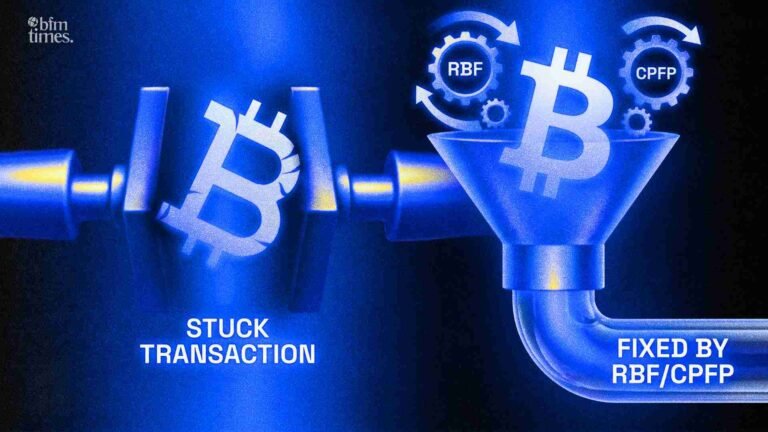
In case you are the sender of the Bitcoin, the most effective method to unstick the transaction is through a feature known as Replace By Fee (RBF). This protocol enables you to republish an identical transaction but with a much higher fee attached. Since miners have an economic incentive to maximize their revenue, they will notice the increased fee on the new version and will opt to mine it over the old, lower-fee version.
RBF requires your wallet software to support it, and the feature must have been enabled when you first sent the transaction. This is built into popular wallets such as Electrum, Sparrow, and most modern mobile wallets. You simply find the pending transaction, and in the options, there will be an “increase fee” or “bump fee” selection; then you select a new sat/vB rate that corresponds to the current high-priority recommendation in your block explorer. The more Bitcoin you add as fees, the higher you place your transaction in the queue.
Child Pays for Parent for Receivers and Senders
What would you do when your wallet does not have RBF, or when you are the one who is to receive the Bitcoin? A method that can be applied in such situations is Child Pays for Parent (CPFP). This technique is based on the fact that a miner cannot verify a new transaction (the child) when it is based on an earlier, unverified transaction (the parent).
You can make a new transaction, spending those unconfirmed coins to yourself or another address, as long as you have a pending incoming transaction. In making this child transaction, you add a substantial fee, which includes the expenses of both the parent and the child. With a very high fee on the child transaction, miners will be motivated to mine the stuck parent transaction so that they can get to the profitable child transaction that follows it. Although this technique requires you to send one more transaction and pay more in fees, it is an effective tool for those who do not have RBF at their disposal.
The Use of Third-Party Transaction Accelerators
In case the technical processes of RBF or CPFP are too complicated, one can use a third variant called a transaction accelerator. Big mining pools such as ViaBTC or Binance tend to run these services. They enable you to send your TXID to their own private queue.
Other accelerators have a fixed number of free slots each hour, and some must be paid in Bitcoin to get your transaction into the next block they mine. Even if it is a bribe to the specific mining pool, it will certainly be the simplest solution for those people who feel uncomfortable in manually managing the transaction inputs and outputs. However, do keep in mind that only the specific mining pool can mine the subsequent block, while both RBF and CPFP are broadcast throughout the entire network.
Avoiding Future Sticking Problems Using Dynamic Fees
The most suitable way to deal with a stuck transaction would be to avoid the issue in the first place. Dynamic fees are estimated by the majority of the existing Bitcoin wallets based on the current state of the mempool. These estimates may vary quickly during high volatility periods or network upgrades.
Before sending any significant amount of Bitcoin, it is best practice to check the “heat map” of the mempool. When the blocks are full, and the minimum charge to enter the next block is high, wait until a quieter time or manually set your charge to a high priority level. Always ensure that the “RBF” flag is checked in your wallet settings before you click send. This is to make sure that in case you miscalculate the fee requirements, you have an inbuilt safety net to inject more BTC as fees and fix the problem without panic.
Why does a Bitcoin transaction get stuck?
A transaction gets stuck when the fee is too low compared to the current network demand.
How can you fix a stuck Bitcoin transaction?
You can use methods like Replace By Fee (RBF) or Child Pays for Parent (CPFP) to speed up confirmation.
Can a stuck Bitcoin transaction be lost permanently?
No, transactions are not lost; they remain pending until confirmed or replaced.
Disclaimer: BFM Times acts as a source of information for knowledge purposes and does not claim to be a financial advisor. Kindly consult your financial advisor before investing.