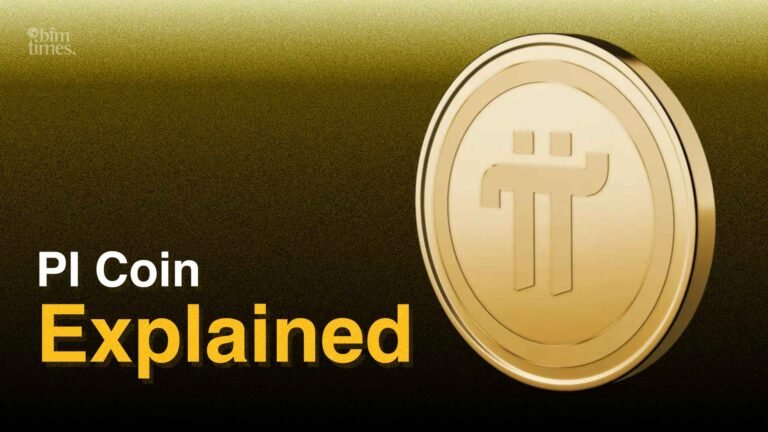
Being a novel mobile mining story and boasting a huge subscriber base, Pi Coin has become one of the most talked-about community-focused crypto ventures of the past six months. Originally available through smartphone mining, the token became available to wider interaction following a slow rollout to the mainnet. This in-depth review shows what Pi Coin is, how the Pi Network has developed, its tokenomics, its market trading environment, its decentralization controversies, and the steps to take that the intermediate reader needs to follow before they can think about any exposure. This article is an excellent, unbiased point of entry to a study of this distinctive project by covering both official records and real-life exchange data understandably.
- Pi Network explained
- Pi Network launch date & timeline
- Pi Coin tokenomics & supply model
- Pi coin price: market history & current snapshot
- Is Pi coin real? Decentralization & governance
- Pi coin future value & use cases
- Security, audits & known issues
- How PI trades & where: liquidity, CEX vs DEX
- Is Pi Coin a good investment? Practical risk checklist
- How to DYOR: verification checklist for Pi Coin and similar projects
- Quick facts & metrics
- Conclusion
Pi Network explained
Pi Network is a cryptocurrency initiative started in 2019 by Stanford PhDs Dr. Nicolas Kokkalis, Dr. Chengdiao Fan, and Vincent McPhillip, based on the concept of millions of users who could mine cryptocurrency through a mobile application without having specialized equipment. The basic innovation was to reduce the barriers to joining and create a massive community that was decentralized.
In comparison with the energy-intensive proof-of-work used in Bitcoin, Pi relies on a social consensus mechanism that is based on the Stellar Consensus Protocol and Federated Byzantine Agreement (FBA) to authenticate transactions and protect the network. This allowed users to add to the rate of mining by adding security circles of trusted friends in the application.
The development of the network was in big stages:
- Beta / Testnet: Early development and user-controlled testing.
- Enclosed Mainnet: A small live blockchain with balances still present but from which external ecosystem activity was curtailed.
- Open Mainnet: At this point, Pi is open to external connectivity, blockchain visibility, and trading on wider crypto markets (early activity at the end of 2025).
Pi Network launch date & timeline
The formal launch of the next phase of the network as an external connectivity network was widely covered in late 2025, and Pi Coin trading activity was recorded in most exchange trackers in the range of November to December 2025. This followed a number of years of beta and closed mainnet deployment.
Reported dates of exact milestones are:
- 2019: The phase of network foundation and beta is launched.
- 2021 to 2023: Testnet growth and community expansion.
- Late 2025: It has been reported as having open mainnet status and the ability to list more exchanges.
The open mainnet phase represented a major milestone with balances shifting and tradable PI tokens beginning to circulate on centralized exchange outlets, though to varying degrees of decentralization and supporting liquidity.
Pi Coin tokenomics & supply model
The supply model by Pi Coin does not follow the conventional model of Bitcoin issuance. Based on different community data and network documentation:
- Total supply cap: The maximum base capacity is 100 billion PI tokens.
- Distribution allocations: Community rewards (>65%), core team (~20%), foundation/ecosystem (~10%), liquidity, and other allocations (~5%).
- Circulating supply: Circulating supply consists of approximately 8.7-8.9 billion PI that have been moved to mainnet exchanges and made visible, out of the total number of tokens, by Q1 2026.
Notably, successful supply is dynamically related to the completion of migration: only the balance of users who completed know-your-customer (KYC) and on-chain wallet activation is completely migrated and tradable. This results in differences in migrated and non-migrated balances, which have a significant impact on usable circulating supply.
Pi coin price: market history & current snapshot
Pi Coin has begun reflecting exchange-listed pricing and market metrics since the beginning of open mainnet data being visible in late 2025.
Snapshot (circa Feb 2026)
- Price per 1 PI: approximately 0.1456 USD
- Circulating supply: 8.9 billion PI.
- Market capitalization: 1.29 billion USD.
- 24h trading volume: ~$9-10 million USD.
These numbers suggest a very speculative tradable market that is driven by exchange listing and local sentiment as opposed to deep decentralization or institutional flows.
Is Pi coin real? Decentralization & governance
The question “Is Pi coin real” often arises because of Pi’s unusual history of mobile mining and extended closed-network operation phase.
From a technical standpoint, Pi has actual token balances in a blockchain and price discovery in exchanges. However:
- Decentralization assertions: Pi is looking at social consensus and not the wide diversity of validators at this point; at this point, it is important to have large independent operation of nodes outside early guardianship.
- Governance: On-chain governance structures are in their infancy as compared to existing networks such as Ethereum.
Practically, “real” implies presence and usefulness in interactions within the ecosystem, but Pi is early in comparison with long-established decentralized systems, and systems of government are changing.
Pi coin future value & use cases
The future Pi coin value is predicted to be different. There are massive user bases and mobile accessibility as long-term growth drivers and low realized on-chain activity not related to exchange speculation. Third-party writer forecasts of prices show different pictures, but these would not be financial advice; it would be sentiment and differences in methodology.
PI aims at fueling on the utility side:
- Peer-to-peer interactions of the Pi Network system.
- dApp development through community.
- Socially linked identity verification.
Value accrual lies on actual use rather than speculation, which is a crucial point of long-term positioning.
Security, audits & known issues
The security profile of Pi is an amalgamation of design goals and open-ended questions:
Consensus security: FBA-inspired solutions are not as heavy as proof-of-work/stake but need to have community and node robustness.
Audits: CertiK (or other third-party) public audit reports are not as commonly cited as with more established blockchain protocols.
KYC strategy: The roadmap by Pi emphasizes comprehensive KYC to transfer balances that enhance the integrity of identities but increase the scrutiny of privacy and centralization.
Conflicts known and experienced include risks of centralization of the network at the initial stages of early node dispersion and dependence on core team governance before the wide-scale validator independence.
How PI trades & where: liquidity, CEX vs DEX
Pi Coin is bought and sold on centralized exchanges such as Bitget, OKX, Gate, and others, trading as PI/USDT.
Such places offer liquidity pools, although in a smaller form compared to mature assets like BTC or ETH. Native decentralized exchange trading and more on-chain liquidity remain unproven until more people adopt them and move their contracts to them.
Is Pi Coin a good investment? Practical risk checklist
More importantly, analyzing the opportunity and the obvious risks is critical to determining whether Pi Coin is a good investment:
Pros
- Huge local and international innovator hub.
- Unique mobile onboarding.
Cons
- Focal supply and migration demands.
- Thin liquidity depth compared to large listed assets.
- At the beginning, there is a restraint on decentralization.
- Regulatory uncertainty.
Risks to assess
- Risks of liquidity on less-traded CEXs.
- Diluting price token unlock schedules.
- Validator independence, precedent governance centralization.
This part is not suggestive but a contextual analysis.
How to DYOR: verification checklist for Pi Coin and similar projects
To do your own research (DYOR):
- Confirm the token contract explorer.
- Check confirmed in various market trackers.
- Evaluate venues and decentralized pool liquidity depth.
- Read the audit report and consensus documents.
- Examine the formal roadmap and migration statistics.
- Compare with other similar community tokens.
Quick facts & metrics
Pi Coin Quick Facts
| Token name | Ticker | Chain / Standard | Contract address | Open Mainnet launch | Total supply | Circulating supply | Market cap |
| Pi Coin | PI | Pi Blockchain | N/A / evolving | Late 2025 reported | 100B max | ~8.9B | ~$1.29B |
Market & Liquidity Snapshot
| Current price | 24h volume | 7d % change | Top exchanges | Notable liquidity/pools | Notes |
| ~$0.1459 USD | ~$9-10M | Mixed trend | Bitget, OKX, Gate | Lower depth vs majors | IOU markets & native may differ |
Conclusion
Pi Coin is an interesting development in the history of crypto: A community-centric token that has mass mobile onboarding and trade information that is emerging on various exchanges. Although Pi Network explains the history and tokenomics of the network, as well as its present presence in the market, the reader must exercise a measured apprehension of the present state of decentralization, liquidity level, and risks of real-world implementations. Full DYOR and careful consideration are a must prior to any kind of involvement.
Disclaimer: BFM Times acts as a source of information for knowledge purposes and does not claim to be a financial advisor. Kindly consult your financial advisor before investing.