
The hype, the headlines, and short-term price fluctuations are not enough to find out which is the best crypto to purchase at any time in the market. The crypto market is volatile, yet fundamentals remain the drivers of long-term value: adoption, tokenomics, on-chain activity, commitment of developers, and real-life applications.
- How We Selected the Best Crypto to Buy Now
- Market Context: Macro and Crypto Indicators
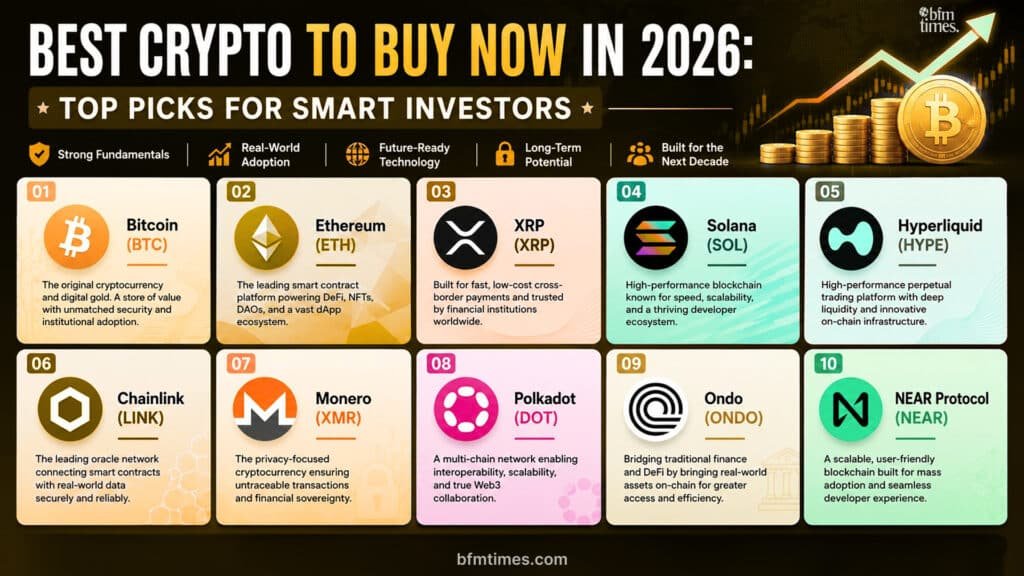
- Top 10: Best Crypto to Buy Now
- 1. Bitcoin (BTC): Digital scarcity with next-generation network security.
- 2. Ethereum (ETH): Crypto smart-contract
- 3. Solana (SOL): L1 consumer crypto.
- 4. Chainlink (LINK): Decentralized oracle infrastructure.
- 5. Polygon (POL): Ethereum scaling ecosystem.
- 6. Avalanche (AVAX): Institutions blockchain.
- 7. Cosmos (ATOM): Interoperability layer.
- 8. Arbitrum (ARB): Ethereum layer-2 scaling
- 9. Optimism (OP): Layer-2 public goods.
- 10. Render (RNDR): Decentralized GPU compute
- Top 10 Crypto at a Glance
- Best Altcoins to Buy: Categories to Consider
- High Potential Crypto: Metrics to Watch
- Trending Cryptocurrencies: Short-Term Catalysts
- Market Structure Deep Dive: Why Fundamentals Matter More Than Price
- Tokenomics Explained: Why Supply Mechanics Shape Long-Term Returns
- On-Chain Metrics That Actually Matter (And Which Ones Don’t)
- Liquidity & Market Depth: The Hidden Risk Factor
- Sector Rotation: How Capital Flows Between Crypto Narratives
- Long-Term vs Tactical Positions: Two Different Mindsets
- Volatility Management: Surviving Without Overtrading
- Global Adoption & Regulation: Why Jurisdiction Matters
- Editorial Insight: What Most “Top Crypto” Lists Miss
- How to DYOR: Checklist Before Buying
- Risks and Regulatory Considerations
- Conclusion
This guide features a research-based Top-10 list of the best crypto to buy currently, which is a result of a systematic analysis of fundamentals, liquidity, ecosystem quality, and risk concerns. It targets investors who already have a rudimentary understanding of the nature of crypto and require a more rational, evidence-based system of decision-making.
How We Selected the Best Crypto to Buy Now
We are interested in long-term survival and achievable upside as opposed to hypothetical versions. All assets were assessed on a similar framework:
Selection criteria
- Principles: Concrete use case, product market fit, and adoption.
- Objects: Supply, emissions, staking, unlocks.
- On-chain metrics: Transaction growth, TVL (where applicable), and active addresses.
- Developer metric: Ecosystem contribution, GitHub commits.
- Liquidity & exchange listings: Presence in centralized and decentralized major exchanges.
- Roadmap & execution: History of delivery versus promise.
- Regulatory exposure: Compliance posture and jurisdiction risk.
This list of the best crypto to buy today accepts only those assets that scored well on a number of dimensions.
Market Context: Macro and Crypto Indicators
The macro crypto market in early 2026 is influenced by a number of important factors:
- The dominance of Bitcoin is still high, which is an indication of wary rotation of capital.
- The interest of the institutions persists in the form of ETF-linked products and custody solutions.
- In certain areas, regulatory clarity has grown, as opposed to others, which are fragmented.
- On-chain action depicts selective expansion and not extensive speculative excess.
This space is more welcoming to the best cryptocurrencies that have good fundamentals, are heavily liquid, and are sustainable ecosystems instead of narrative-based tokens.
Top 10: Best Crypto to Buy Now
1. Bitcoin (BTC): Digital scarcity with next-generation network security.
Overview
The first decentralized digital asset is Bitcoin, which is a store of value and a settlement layer.
Why it’s on the list
- Optimal liquidity and institutional penetration.
- Good on-chain security and hash rate.
- The entire best crypto asset benchmark.
Tokenomics & metrics
- Market cap: ~$900B
- Max supply: 21 million BTC
- Circulating supply: 19.6 million BTC.
On-chain & ecosystem signals
- Constant long-term accumulation of the holders.
- Fast hash rate and network security.
Risks/bear case
- Weaker growth than emerging assets.
- Macro sensitivity
Investment view
Low-risk anchor asset; appropriate for a conservative allocation.
2. Ethereum (ETH): Crypto smart-contract
Overview
The most popular smart-contract platform that runs DeFi, NFTs, and Web3 infrastructure is Ethereum.
Why it’s on the list:
- Dominating the developer ecosystem.
- Layer-2 scaling adoption
- Deflationary mechanics post-EIP-1559
Tokenomics & metrics
- Market cap: ~$420B
- Staking yield: ~3 to 4% (variable)
- No fixed max supply
On-chain & ecosystem signals
- Strong developer activity
- Large transaction settlement through layer-2s.
Risks/bear case
- Threat of alternative layer-1s.
- Stakeholder regulatory scrutiny.
Investment view
Core holding among top cryptocurrencies.
3. Solana (SOL): L1 consumer crypto.
Overview
Solana specializes in high-speed and low-cost transactions that are consumer-oriented.
Why it’s on the list:
- Vigorous NFT and DeFi revival.
- Increasing institutional equipment.
- Active developer ecosystem
Tokenomics & metrics
- Value: ~$85B
- Inflationary with staking rewards
On-chain & ecosystem signals
- High daily transactions
- Developing active addresses.
Risks/bear case
- Past network outages
- Centralization concerns
Investment view
Medium risk, high growth crypto to be invested in.
4. Chainlink (LINK): Decentralized oracle infrastructure.
Overview
Chainlink offers secure chain data feeds to smart contracts in blockchains.
Why it’s on the list:
- Mission-critical infrastructure
- These are commonly implemented throughout DeFi.
- Growing CCIP adoption
Tokenomics & metrics
- Market cap: ~$18B
- The staking process came in with gradual unlocks.
On-chain & ecosystem signals
- Good company alliances.
- High integration count
Risks/bear case
The token value capture is in development.
Investment view
Wireless infrastructure to invest in.
5. Polygon (POL): Ethereum scaling ecosystem.
Overview
Polygon provides several scaling systems for Ethereum, such as zk-based systems.
Why it’s on the list:
- Enterprise partnerships
- Strong developer adoption
Tokenomics & metrics
Market cap: ~$12B
On-chain & ecosystem signals
- Growing zk adoption
- Active developer community
Risks/bear case
Intense layer-2 competition
Investment view
Mid-risk best altcoins to purchase.
6. Avalanche (AVAX): Institutions blockchain.
Overview
Avalanche has subnetting support, which can be configured to support enterprise and gaming requirements.
Why it’s on the list:
- Institutional pilots
- High flexibility
Tokenomics & metrics
Market cap: ~$15B
On-chain & ecosystem signals
Subnet activity growth
Risks/bear case
Asymmetrical adoption.
Investment view
Discriminatory exposure to infrastructural development.
7. Cosmos (ATOM): Interoperability layer.
Overview
Cosmos allows autonomous blockchains to interact.
Why it’s on the list:
- Strong inter-chain adoption
- Modular architecture
Tokenomics & metrics
Market cap: ~$10B
Risks/bear case
Value accrual debate
Investment view
Long-term ecosystem bet.
8. Arbitrum (ARB): Ethereum layer-2 scaling
Overview
Arbitrum is one of the popular optimistic rollups of Ethereum.
Why it’s on the list:
- High TVL
- Active DeFi ecosystem
Tokenomics & metrics
Market cap: ~$9B
Risks/bear case
Token unlock pressure
Investment view
Increased volatility, expansionist.
9. Optimism (OP): Layer-2 public goods.
Overview
Optimism is based on sustainability in ecosystem incentives.
Why it’s on the list:
- Superchain strategy
- Strong governance model
Risks/bear case
Competitive L2 landscape
Investment view
Cherry-picking in trending cryptocurrencies.
10. Render (RNDR): Decentralized GPU compute
Overview
Render offers distributed AI and metaverse workload GPU rendering.
Why it’s on the list:
- Real-world demand drivers
- Emerging AI computing narrative.
Risks/bear case
Niche adoption risk
Investment view
High-risk, high-potential crypto allocation.
Top 10 Crypto at a Glance
| Rank | Token | Ticker | Market Cap | Circulating Supply | 24h Volume | 7d % | Why Consider | Risk Level |
| 1 | Bitcoin | BTC | ~$900B | 19.6M | High | +2% | Store of value | Low |
| 2 | Ethereum | ETH | ~$420B | ~120M | High | +3% | Smart-contract leader | Medium |
| 3 | Solana | SOL | ~$85B | ~440M | High | +6% | High throughput | Medium-High |
| 4 | Chainlink | LINK | ~$18B | ~587M | Medium | +4% | Oracle infra | Medium |
| 5 | Polygon | POL | ~$12B | ~10B | Medium | +2% | L2 scaling | Medium |
| 6 | Avalanche | AVAX | ~$15B | ~365M | Medium | +1% | Subnets | Medium |
| 7 | Cosmos | ATOM | ~$10B | ~390M | Medium | +2% | Interoperability | Medium |
| 8 | Arbitrum | ARB | ~$9B | ~1.3B | Medium | +5% | L2 DeFi | High |
| 9 | Optimism | OP | ~$8B | ~1B | Medium | +4% | Superchain | High |
| 10 | Render | RNDR | ~$7B | ~380M | Medium | +7% | GPU compute | High |
Best Altcoins to Buy: Categories to Consider
- Layer-1s: Solana, Avalanche
- Layer-2s: Arbitrum, Optimism, Polygon
- DeFi infrastructure: Chainlink
- Compute & AI: Render
These segments are the current areas of focus of innovation and adoption.
Best Crypto to Invest Now: Allocation and Risk Management
Sample allocation
- Conservative: 60% BTC/ETH/ETH, 30% large-cap altcoins, and 10% speculative.
- Balanced: 40% BTC/ETH, 40% altcoins, and 20% high-risk.
- Aggressive: 25% BTC/ETH, 45% altcoins, 30% speculative.
Balancing should be done regularly and not overexposing individual stories.
High Potential Crypto: Metrics to Watch
- Active addresses
- Developer commits
- Token unlock schedules
- Exchange inflows/outflows
- TVL growth
Trending Cryptocurrencies: Short-Term Catalysts
- Network upgrades
- ETF or institutional flows
- Major exchange listings
- Regulatory announcements
These are not promises but facilitators.
Market Structure Deep Dive: Why Fundamentals Matter More Than Price
The anchoring fallacy is one of the largest errors that retail investors make in seeking the best crypto to invest in because they base their decisions on the latest price action. Although momentum is important, best crypto markets are not organized like conventional equities. Some tokens are only able to make a sharp rise and not have the relevant rises in usage, and others quietly accrue value as network effects that appear in on-chain data only months later.
Important structural aspects that distinguish sustainable leading cryptocurrencies and insignificant hype cycles are:
- Value accrual mechanisms: Does the token capture fees, secure the network, or allow real influence governance?
- Sustainable incentives: Staking and emissions should ensure that there is not too much growth in users.
- Network stickiness: It is the switching costs to developers and users that are more important than the short-term narratives.
Historically, assets that have good fundamental performance have a tendency to perform well over entire market cycles, despite their poor performance at some point in the speculative period.
Tokenomics Explained: Why Supply Mechanics Shape Long-Term Returns
The concept of tokenomics is commonly discussed but seldom properly looked into. To investors considering investing in best crypto in the current situation, it is important to understand how supply works.
Key tokenomic variables to analyze
- Circulating vs. max supply: This is because when the circulating supply is low with huge future unlocks, price performance is suppressed.
- Emission schedule: Inflationary assets must have permanent demand to dilute.
- Burn mechanisms: In Ethereum, there is a deflationary pressure introduced by Fee burns as observed in Ethereum after EIP-1559.
- Staking lockups: An increased liquid can be reduced by an increase in staking, but with the effect of amplified sell pressure on unlocks.
As an example, layer-2 tokens such as ARB and OP are characterized by high usage indicators, although continuous unlocking schedules are a short- to mid-term risk indicator. By comparison, the fixed supply and predictable issuance of Bitcoin cannot be equated in terms of its transparency.
Under such dynamics, it becomes possible to distinguish between the truly high-potential crypto assets and structurally weak ones.
On-Chain Metrics That Actually Matter (And Which Ones Don’t)
On-chain data is mighty, yet it can be utilized only when used appropriately. Raw counts of transactions or wallets may not be relevant when it is fueled by bots or incentives.
High-signal on-chain indicators
- Active addresses (not absolute number, trend)
- Value settled (not counted) of transactions.
- Long-term holder behavior
- Inflows and outflows of exchange.
- TVL quality (organic, incentive-driven).
Low-signal or misleading metrics
- Vanity wallet growth
- Short-term spikes of airdrop farming.
- Retention-free incentivized TVL.
For the best altcoins to buy, it is common to enhance the quality of on-chain before the price rises, typically when the market is undergoing consolidation.
Liquidity & Market Depth: The Hidden Risk Factor
The liquidity in trending cryptocurrencies is usually disregarded, yet it is important in terms of the execution risk.
Investors can be exposed to even basic strong projects:
- Slip in market stress.
- Limited exit liquidity
- Thin order books manipulation of prices.
When assessing liquidity:
- Check the spot and volume of derivatives.
- Examine the concentration of exchange.
- Monitor DEX vs CEX balance
With the BTC and ETH being the only assets that can be characterized as liquid enough, smaller-cap tokens should be subjected to more stringent position sizing and risk management.
Sector Rotation: How Capital Flows Between Crypto Narratives
Crypto markets operate by cyclical rotation patterns. These flows can be used to understand when exposure to the leading cryptocurrencies should be timed.
Typical rotation cycle:
- Bitcoin accumulation
- Ether and large-cap altcoins.
- Layer-1 & Layer-2 ecosystems
- Sector stories (DeFi, NFTs, AI, gaming).
- Broad speculative excess
- Back to BTC/stablecoin capital flight.
By early 2026, there will be a selective rotation into infrastructure and scaling solutions, but not a general meme-driven speculation, based on capital flows.
Long-Term vs Tactical Positions: Two Different Mindsets
All the assets in a best crypto to buy list are not to be treated equally.
Long-term core positions
- Bitcoin
- Ethereum
- Self infrastructure tokens.
These have the advantage of multi-year adoption patterns.
Tactical or satellite positions
- Emerging layer-2s
- Sector-specific games (AI, gaming)
- Tokens with upcoming catalysts
Dividing portfolios into core and tactical investments decreases the impact of the emotional bias and enhances the risk-adjusted performance.
Volatility Management: Surviving Without Overtrading
Cryptocurrency volatility cannot be avoided, and uncontrolled volatility kills capital.
Practical tools:
- Volatility-based position sizing, not conviction-based.
- Staged purchases as opposed to lump sum purchases.
- Periodical realignment back to the target allocation.
- There should be no leverage unless it is risk-managed.
To the majority of investors, it is not to buy at the top or sell at the bottom, but to continue to invest in sound best crypto that will stand the test of time and not leave them at the hands of market volatility.
Global Adoption & Regulation: Why Jurisdiction Matters
Regulatory clarity is becoming more relevant in determining the top cryptocurrencies that institutional capital may be interested in.
The most important regulatory factors:
- Institutional custody regulations.
- Staking classification
- Treatment as Securities vs. Commodities.
- Cross-border compliance
The long-term benefits of adopting a proactive approach to regulators or even design projects, which are more compatible with compliance-related limitations, are likely to be realized even at the cost of seemingly slower development in the short run.
Editorial Insight: What Most “Top Crypto” Lists Miss
A lot of ranking articles are very much concerned with projections of prices or hype in the short run. What they often miss:
- Token unlock schedules
- Developer retention
- Economic sustainability
- Stability in times of crisis.
The guide has been purposefully focused on fundamentals as well, which makes it more suitable for readers wanting to find the best crypto to buy based on their medium to long-term investment horizon.
How to DYOR: Checklist Before Buying
- Verify token contracts
- Review audits
- Check liquidity depth
- Understand token unlocks
- Assess regulatory risk
Risks and Regulatory Considerations
Best Crypto assets face:
- High volatility
- Custody risk and counterparty risk.
- Altering the tax and regulatory environment.
Evaluate jurisdiction-related rules always.
Conclusion
The selection of the best crypto to buy is not based on anticipating the next spike in the short term, but rather, on selecting those networks that have a long-lasting value, good economic construction, and increased real-world usage. Bitcoin and Ethereum remain the anchors of the market, and an exclusive group of altcoins offers exposure to the innovation in aspects of scalability, interoperability, and decentralized infrastructure.
The fundamentals are even more important as best crypto becomes more established. Those investors employing on-chain analysis with systematic risk management and long-term thinking can be in a better position to overcome volatility and pursue actual growth.
Disclaimer: BFM Times acts as a source of information for knowledge purposes and does not claim to be a financial advisor. Kindly consult your financial advisor before investing.