


Cardano coin is a native digital asset of the Cardano blockchain, a research-based proof-of-stake network to ensure security, scalability, and sustainability. Cardano is based on peer-reviewed scholarly principles to address the structural problems experienced by earlier blockchains, such as energy wastefulness, a shortage of scalability, and a decentralized governance structure.
- What is Cardano?
- Origin & Research-Driven Model
- Layered Architecture (Settlement + Computation)
- Proof of Stake with Ouroboros
- Cardano coin history & evolution
- Cardano price: historical trends & market context
- ADA coin use cases: what people build and use today
- Cardano vs Ethereum: Key Differences
- Cardano tokenomics & staking model
- Is Cardano a good investment? Risk profile & DYOR checklist
- How to buy & store ADA safely
- Cardano ecosystem snapshot
- Callout: How ADA staking works in 3 steps
- Callout: Hydra scaling explained simply
- Conclusion
This educational resource is a description of what Cardano is, the functioning of the network, and where it is applied in real life. You will also discover factual background on Cardano coin , a feasible ADA coin application, a clear-cut Cardano vs. Ethereum comparison, realistic dangers, and an organized DYOR checklist. It is aimed at giving a one-page, citable reference to the learners, developers, and long-term researchers, free of hype and speculation.
What is Cardano?
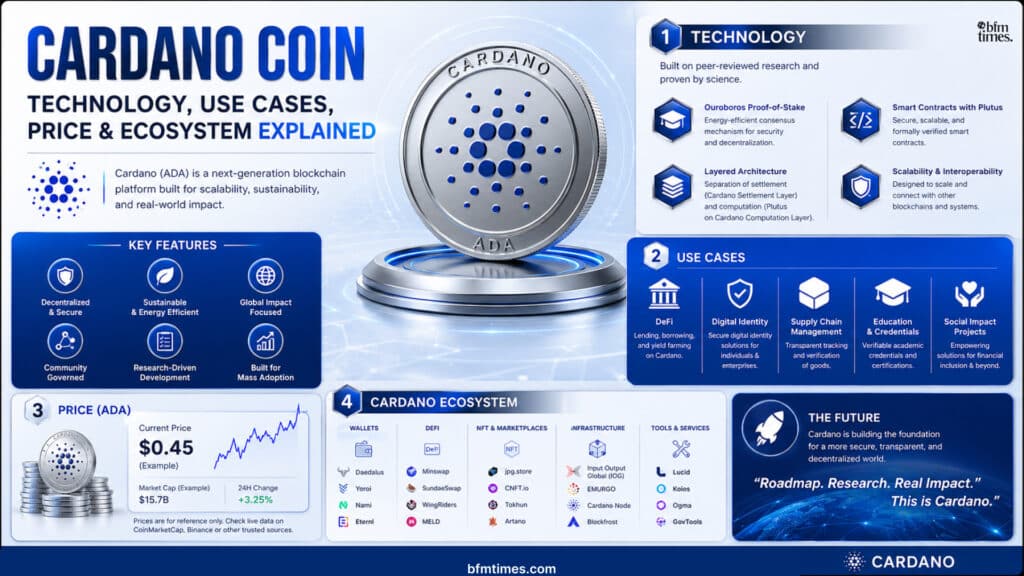
Cardano is a third-generation blockchain system that is developed based on formal methods and research. Its fundamental design is aimed at scaling, interoperability, and sustainability, three aspects that previous networks did not hit in balance.
Origin & Research-Driven Model
The development of Cardano coin was research-focused. The protocol focuses on:
- Cryptographic studies that are peer-reviewed.
- Critical review of protocol elements.
- Modular upgrades that avoid hard forks
The given methodology retards feature rollout; however, the long-term goal is to decrease systemic risk and technical debt.
Layered Architecture (Settlement + Computation)
Cardano divides the main functions into two layers:
- Settlement layer: Processes transactions and ledger balances.
- Computation layer: Runs smart contracts and applications.
This multi-level implementation permits upgrades to a single layer without disturbing the other, giving it higher flexibility and maintenance.
Proof of Stake with Ouroboros
Proof of stake that is implemented in Cardano is Ouroboros. Network security is done not by miners but by validators (stake pools), who are chosen in proportion to the size of their stake in ADA. This design limits energy usage and facilitates decentralization on a large scale.
Cardano coin history & evolution
The Cardano coin project is being developed in sequence; each phase is dedicated to the addition of protocol functionality.
Major Network Eras
- Byron: Low-end ADA transfers, no frills.
- Shelley: Staking decentralization.
- Goguen: Implementation of smart contracts.
- Basho: Work on scalability and performance.
- Voltaire era: Systems of on-chain governance and treasury.
The purpose of each era was to add certain capabilities and be backward compatible.
Evolution of the Ecosystem
In the course of time, Cardano coin has grown to be not just a payment network but a programmable blockchain that supports:
- Smart contracts
- Decentralized finance (DeFi)
- NFTs and token issuance
- Credential structures and identity.
Such a gradual rollout scheme contrasts with networks that started with a more comprehensive but less formally verified feature set.
Cardano price: historical trends & market context
Multi-cycle volatility characteristic of large-cap crypto assets has affected the Cardano price. Price movements have traditionally shown:
- Larger crypto market cycles.
- Announcements on network upgrades.
- Developer ecosystem growth
- Macro liquidity conditions
Market Context, Not Predictions
Instead, one should consider the performance of Cardano coin in the market in the form of:
- Long-term adoption trends
- Custodial savings rates.
- Developer activity growth
- Ecosystem usage metrics
The macro-environment and sentiment drive short-term price changes more than the upgrades of individual protocols do.
ADA coin use cases: what people build and use today
Simple payments are not the only cases of using ADA coins. ADA is the fuel of the network, its governance tool, and its staking asset.
1) Staking & Governance
The holders of ADA can assign to stake pools and engage in network security at the expense of staking rewards. Government structures enable the holders to vote on protocol changes and funding proposals.
2) DeFi & Financial Tools
Cardano coin supports the use of decentralized finance applications, such as:
- Lending protocols
- Decentralized exchanges
- Yield-generating products
3) NFTs & Digital Assets
The native token system in Cardano coin has been used by creators to mint NFTs with no smart contracts and with less attack surface and complexity.
4) Identity & Emerging-Market Solutions
Projects on Cardano coin explore:
- Decentralized identity
- Checking of academic credentials.
- Blockchain pilots in the public sector.
- Supply-chain tracking
These business-oriented applications make Cardano coin stand out from meme-driven ecosystems.
Cardano vs Ethereum: Key Differences
The comparison between Cardano and Ethereum shows that there are two philosophies in their design.
| Feature | Cardano | Ethereum |
| Consensus | Proof of Stake (Ouroboros) | Proof of Stake |
| Smart contracts | Plutus | Solidity |
| Scalability approach | Layered design + Hydra | Rollups + L2 networks |
| Average fees* | Lower on the base layer | Higher on the base layer |
| Developer ecosystem size* | Smaller | Larger |
| Governance model | On-chain treasury & voting | Off-chain governance |
Key Takeaways
- Ether has the potential for more developers and a network effect.
- Cardano is focused on formal verification and slower, research-driven upgrades.
- Ethereum’s scalability relies heavily on Layer-2 rollups, while Cardano integrates scaling more directly into protocol design.
There is no strict better or strict worse between the two models, as they represent various trade-offs between the speed of innovation and formal rigor.
Cardano tokenomics & staking model
Supply Mechanics
There is a limited maximum supply in Cardano, and the emissions reduce with time. New ADA is released on staking rewards.
Staking Rewards & Decentralization
- Any stakeholder is able to assign ADA to a pool of stakeholders.
- Delegation does not need lock-ups.
- Incentives are based on pool performance and protocol parameters.
The decentralized pool model reduces validator concentration risk compared to fixed-validator networks.
Is Cardano a good investment? Risk profile & DYOR checklist
The statement “Is Cardano a good investment?” is inappropriate to respond to universally. Crypto assets have overlaying risks.
Technology Risk
- The smart contract model is different than Ethereum, which generates learning curves for developers.
- Upgrades in the protocols are more difficult because of research review processes.
Adoption Risk
- The larger ecosystems are lagging in developer and use adoption.
- Enterprise pilots are not always going to work into sustained on-chain activity.
Market Risk
- Cryptocurrency markets are very unstable.
- All large-cap assets are exposed to liquidity conditions.
DYOR Checklist
- Scan activity and ecosystem development.
- Track on-chain usage trends
- Learn about staking and governance.
- Determine individual risk tolerance and time horizon.
How to buy & store ADA safely
Exchange vs Self-Custody
- Transactions are convenient.
- In self-custody, one has control over private keys.
Wallet Options & Staking
Cardano can support a variety of wallets:
- Mobile wallets are in daily use.
- Long-term storage hardware wallets.
- Supported wallet supported staking.
Best practices include:
- Recovery phrases are offline backed up.
- Hardware wallet usage for larger balances
- Long-term holdings should not be subjected to custodial staking.
Cardano ecosystem snapshot
Cardano Coin Quick Facts
| Token | Ticker | Consensus | Launch year | Total supply | Circulating supply | Market cap | Staking participation | Snapshot date |
| Cardano | ADA | Proof of Stake | 2017 | 45,000,000,000 | 35,900,000,000 | $21.4B | ~62% of circulating supply | 09 Feb 2026 |
Cardano vs Ethereum
| Feature | Cardano | Ethereum |
| Consensus | Proof of Stake (Ouroboros) | Proof of Stake |
| Smart contracts | Plutus | Solidity |
| Scalability approach | Hydra + layered design | Rollups + L2 |
| Average fees | Lower base-layer fees | Higher base-layer fees |
| Developer ecosystem size | Smaller | Larger |
| Governance model | On-chain treasury & voting | Off-chain governance |
| Snapshot date | 09 Feb 2026 | 09 Feb 2026 |
Callout: How ADA staking works in 3 steps
- Choose a stake pool
- ADA delegate out of your wallet.
- Get rewards and retention of custody.
Callout: Hydra scaling explained simply
Hydra enables several transaction heads to transact off-chain concurrently to decrease congestion, with final settlement anchored on the main chain.
Conclusion
The Cardano coin is a long-term, research-based blockchain design. Its multi-layered architecture, proof-of-stake consensus, formal verification model, and emerging governance structure are designed to establish a sustainable base for decentralized applications.
Although the Cardano price is mirrored in the overall market cycles, the actual value of the network is the resilience of the protocol, ADA coin applications, and the development of the ecosystem. The Cardano vs. Ethereum controversy demonstrates trade-offs between fast iteration and systematic engineering. To researchers and builders, Cardano coin provides a technically different environment, which is best judged by incessant tracking of adoption, developer activity, and governance performance, instead of short-term market indications.
Disclaimer: BFM Times acts as a source of information for knowledge purposes and does not claim to be a financial advisor. Kindly consult your financial advisor before investing.