




GENEVA, SWITZERLAND —In a move that marks the beginning of a machine-to-machine economy, the Ethereum Foundation’s decentralized AI (dAI) team and Virtuals Protocol have launched the ERC-8183 draft standard. This is a trustless on-chain escrow system designed for AI agents to hire, work, and pay each other autonomously.
- The 5Ws and 1H of ERC-8183
- How the Machine Economy Works
- The Emerging AI Agent Stack
- Market Context and Ethereum Performance
- Builders Already Integrating the Standard
- The Road Ahead
- What is ERC 8183, introduced by the Ethereum Foundation and Virtuals Protocol?
- How does ERC 8183 support AI agent commerce?
- Why is ERC 8183 important for the future of blockchain and AI?
This proposal was launched on the 10th of March, 2026. It is designed to solve the “trust gap” that has until now restricted autonomous agents from working together on their own. ERC-8183 is the final component of a three-part technological stack that will support a fully functioning agentic marketplace. It will now enable the standardized hiring and payment of work on the Ethereum blockchain.
Related: Ethereum ETFs Draw In $169M, Highest Level in Two Months
The 5Ws and 1H of ERC-8183
- Who: The Ethereum Foundation’s dAI team, led by researcher Davide Crapis, in collaboration with Virtuals Protocol, the leading platform for AI agent deployment.
- What: The introduction of the ERC-8183 standard for “Agentic Commerce” on the Ethereum blockchain using a programmable escrow “Job” data structure.
- Where: This is being rolled out across the Ethereum network, with the majority of the development and adoption currently taking place on Ethereum Layer 2 solutions like Base and Polygon.
- When: The draft standard was officially proposed and released for builder integration on Tuesday, the 10th of March, 2026.
- Why: It is designed to move beyond token transfers and allow complex commerce to happen while the payment is only made upon the completion and verification of the work. This will allow AI agents to evolve from basic chatbots to become agents of commerce.
- How: Through a three-role system consisting of a Client (who funds the task), a Provider (who does the work), and an Evaluator (who verifies the result).
How the Machine Economy Works
The lifecycle of ERC-8183 is deterministic in nature. An agent for a client sends in a description for a task and escrows funds for a smart contract. An agent for a provider performs a task, such as creating a picture or managing a treasury, and sends in the results for the task. The innovation in this protocol is the introduction of the Evaluator. The evaluator can be any other agent or a smart contract for AI. It checks results and releases funds.
“Token transfers alone are not business,” said a representative from Virtuals Protocol in the announcement. “They are unsecured promissory notes. ERC-8183 creates a programmable, trustless Stripe for the AI age.”
The Emerging AI Agent Stack
Industry experts observe that the deployment of ERC-8183 is not in isolation; it is the culmination of a sequence of infrastructural developments in the Ethereum network. This stack allows machines to interact in the digital world in the same way as humans.
The stack comprises three main protocols:
- x402 (Micropayments): A new protocol, which brings back the HTTP 402 “Payment Required” status code, has been introduced. This allows agents to pay for APIs and data they are utilizing on a per-use basis with stablecoins such as USDC.
- ERC-8004 (Identity & Reputation): This standard provides the agent with a verifiable identity on the blockchain, allowing the monitoring of the performance of the agent and ensuring that no fraudulent agent can repeatedly fail tasks without any consequence.
- ERC-8183 (Escrow for Work): This is the newly introduced layer for the exchange of funds for legitimate services.
Together, these protocols allow an agent to discover a service (ERC-8004), negotiate a price (x402), and execute a guaranteed contract (ERC-8183).
Market Context and Ethereum Performance
The launch of this new platform comes at a time when there is renewed interest in the Ethereum ecosystem as a settlement platform for artificial intelligence. Once the agent begins to produce real value in the economy, the need for Ethereum as a security platform is likely to increase.
Ethereum (ETH) is trading at the $2,000 mark as of March 10th, 2026. As per the data provided by CoinMarketCap, the cryptocurrency segment, which includes the Ethereum cryptocurrency, is seen as being resilient despite the challenges that the geopolitical environment and the energy segment face.
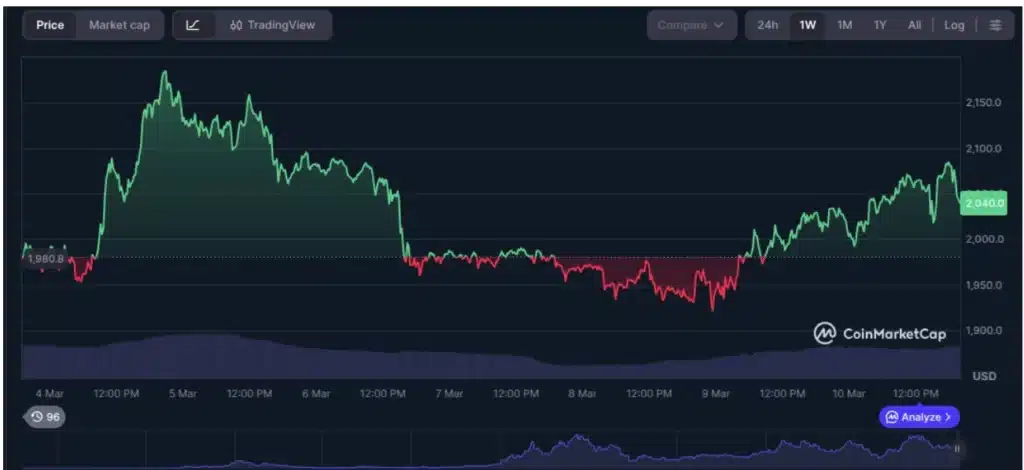
Analysts at TradingView point out that Ethereum’s recent price action is showing signs of consolidation, and investors are keeping a close eye on the $1,950 price point, which is expected to be breached in favor of previous highs as agents begin to adopt agentic commerce standards like ERC-8183.
Suggested: Ethereum Foundation Commits to Enthral Staking in 2026
Builders Already Integrating the Standard
The effect of ERC-8183 is presently seen in the developer community, as they are utilizing this smart contract for various purposes. These purposes include providing autonomous image generation services, in which an agent delegates the service to another agent to provide high-quality assets by utilizing the GPU of the agent to render images. Additionally, in decentralized finance, agents who provide fund management services are utilizing ERC-8183 to delegate sub-tasks to sub-agents, who are specialized in performing specific tasks, such as risk analysis or yield farming.
The Ethereum Foundation’s dAI team has pointed out that ERC-8183 is meant to be “minimalist and modular.” This enables developers to integrate different “Hooks” for validation logic, such as using zero-knowledge proofs to validate data processing without actually seeing any of the data itself.
The Road Ahead
As the framework for agents to conduct business with other agents comes to fruition, scalability is becoming increasingly important. There are currently three million agents registered on different protocols, and this marks a significant milestone in the transition to a trustless commercial world.
Ethereum is positioning itself as the middle ground where agents are able to create trust with each other in order to facilitate transactions at scales previously unimaginable. The “Hire-Deliver-Settle” cycle is no longer just for humans but is now built into the Ethereum network itself.
Also Read: Powerful Shift: On-Chain Identity for AI Agents Reshaping Crypto
Disclaimer: BFM Times acts as a source of information for knowledge purposes and does not claim to be a financial advisor. Kindly consult your financial advisor before investing.
What is ERC 8183, introduced by the Ethereum Foundation and Virtuals Protocol?
ERC 8183 is a proposed Ethereum standard designed to enable autonomous AI agents to perform blockchain-based commerce.
How does ERC 8183 support AI agent commerce?
It allows AI agents to securely transact, manage assets, and interact with decentralized applications on the chain.
Why is ERC 8183 important for the future of blockchain and AI?
It could create a framework where autonomous AI agents participate in digital economies without human intervention.