NEW YORK – Solana has recorded a historic milestone in February after it processed over $650 billion in on-chain stablecoin transfer volume. This is according to a research report published by Grayscale Investments. This is a new all-time high for Solana, with its previous record of $300 billion set in October of the prior year. Notably, this milestone has propelled Solana to the top of the pack as the most utilized blockchain platform for stablecoin transfers during the month, surpassing other major blockchains such as Ethereum and Tron on an adjusted basis. There has been a fundamental shift in the utilization of Solana from other assets to actual use cases such as high-frequency retail payments and decentralized finance.
- The Numbers Behind the Surge
- Why Solana is Winning the Payment Race
- Impact on the Broader Ecosystem
- The Future of On-Chain Finance
- At a Glance: 5 Ws and 1 H
- What record did Solana achieve with stablecoin transfers in February?
- Why is Solana’s stablecoin transfer volume important?
- What does rising stablecoin activity on Solana indicate?
Related: Solana Alpenglow Upgrade Finality Drops to 150ms in March 2026
The Numbers Behind the Surge
According to data provided by Allium and emphasized by Grayscale Head of Research Zach Pandl, Solana has recorded a milestone of over $650 billion in on-chain stablecoin transfer volume. Solana is dominating the digital dollar space, with Ethereum still boasting a larger supply of stablecoins. Solana has managed to emerge as the major “rail” through which stablecoins move.
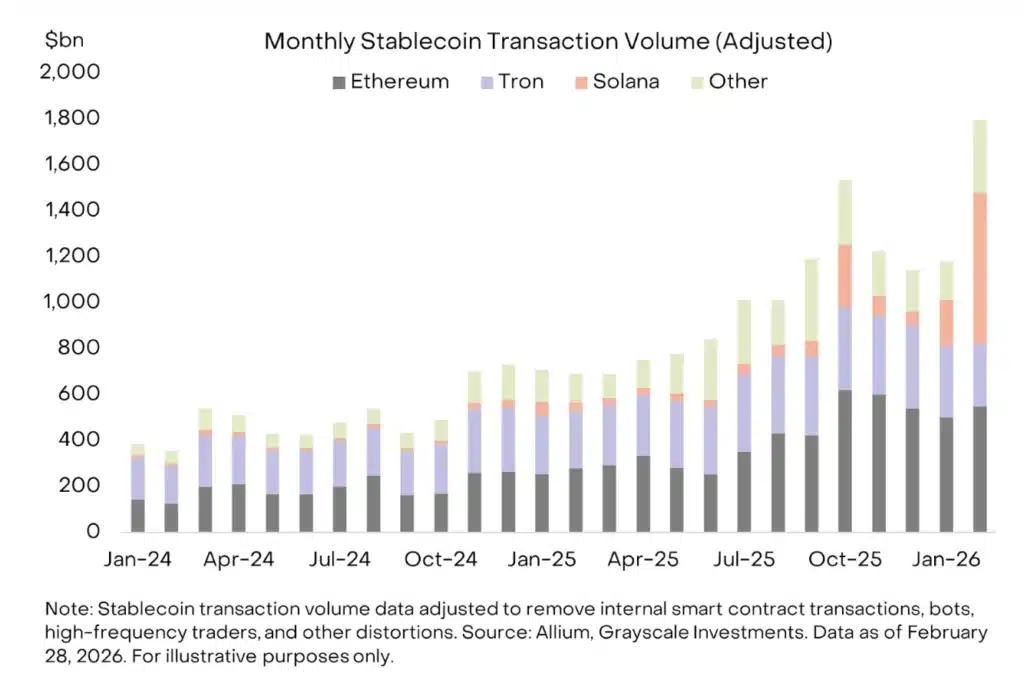
Specifically, the network has experienced a surge in the use of USD Coin (USDC) tokens. Today, Solana ranks second only to Ethereum for circulating USDC supply, thanks to Circle’s integration and its sub-cent transaction costs. In fact, the adjusted volume, which strips out bot trades and other internal smart contract activity, revealed that in February, the Solana network processed close to $660 billion, compared to Ethereum’s $551 billion and Tron’s $272 billion.
The increase is not only in terms of transaction volume but also in terms of total supply, which has now risen to $15.4 billion, a 12% increase over the last 30 days.
Why Solana is Winning the Payment Race
Experts have found several reasons for this record-breaking month for the Solana network, which differentiate it from others:
- Transaction Costs: With a cost of less than $0.001 per transaction, Solana supports microtransactions, which are small-scale transactions. This is not possible in Ethereum because of high gas fees.
- High Throughput: Solana has a high throughput capability, with thousands of transactions processed every second. It has the ability to settle each transaction immediately. Such an ability is crucial in a retail POS terminal or remittance service.
- Institutional Adoption: Major companies like Visa and Worldpay are increasingly looking to leverage the ecosystem of the Solana network for stablecoin transactions. The extension of the USDC stablecoin settlement on the Solana network by Visa last year has resulted in the current activity on the network.
- Shift from Speculation: Standard Chartered Bank has also pointed out that Solana’s on-chain activity is showing increasing maturity. “From being a memecoin trading hub, Solana is now showing a clear trend of increasing SOL-stablecoin pairs and B2B settlements.”
Impact on the Broader Ecosystem
Many large transactions also impact Solana’s value and usage. More stablecoin transactions increase fees and rewards.
“February was a breakout month,” Zach Pandl, a co-founder of Galois Capital and author of the Grayscale report, noted. “Solana is well-placed to capture market share in retail stablecoin payments. Today it is the category leader in terms of users, transaction volume, and transaction fees, arguably the three most important measures of blockchain activity.”
However, despite this high usage, there has been a minor disconnect between the SOL token price and on-chain metrics, which have remained in a consolidated range between $130 and $150 over this period. This is being interpreted as evidence of a “maturing” market where the development of utilities is beginning to outpace speculative price movements.
Suggested: Solana Rebounds After $82 Drop: Bulls Eye $90 Resistance as Volatility Grips Market
The Future of On-Chain Finance
This strong on-chain month is occurring as there is increased regulatory clarity regarding stablecoins in the US and Europe. The implementation of MiCA (Markets in Crypto-Assets) regulation in Europe has benefited compliant stablecoins like USDC, which is the leading stablecoin on the Solana blockchain.
With global stablecoin volumes set to reach $10 trillion annually, this strong on-chain month on Solana in February indicates it is no longer just considered a “fast” version of Ethereum but is instead considered a layer-one blockchain upon which the future of the global financial system will operate. If current trends are sustained, analysts are predicting that over $2 trillion in quarterly stablecoin volumes will be processed on Solana by the end of 2026.
Also Read: Western Union Solana Integration Signals Powerful Shift in Global Remittances
At a Glance: 5 Ws and 1 H
- Who: Solana Blockchain Network & Grayscale Investments (Reporting Body)
- What: A record-breaking $650 billion in stablecoin transfer volume
- Where: On-chain via the Solana Blockchain Network
- When: Throughout February 2024
- Why: Due to retail payment needs, low costs, and a move away from speculative use cases and into utility
- How: By utilizing high-throughput infrastructure and extensive integration of USDC and institutional payment systems
Disclaimer: BFM Times acts as a source of information for knowledge purposes and does not claim to be a financial advisor. Kindly consult your financial advisor before investing.
What record did Solana achieve with stablecoin transfers in February?
Solana recorded around 650 billion dollars in stablecoin transfer volume during February.
Why is Solana’s stablecoin transfer volume important?
High transfer volume highlights strong network activity and growing adoption for payments and DeFi.
What does rising stablecoin activity on Solana indicate?
It suggests increasing usage of the Solana blockchain for fast and low-cost financial transactions.