- India has emerged as the largest nation in terms of the number of net users adopting cryptocurrencies.
- India has an estimated 119 million people who own digital assets, a huge share of the world’s crypto population.
- The drivers of adoption include a youthful and technologically dynamic population, high remittance requirements, and the adoption of digital payment systems such as UPI.
- Retail trading is not the only type of institutional participation and decentralized finance (DeFi) that is on the rise in India.
- It has continued to be adopted despite a challenging tax regime, including a 30 percent flat tax on gains and a 1 percent Tax Deducted at Source (TDS).
In Depth: The Digital Revolution in the Subcontinent – Why India is Now the World Cryptocurrency Cradle
The world is undergoing a tectonic shift in its financial environment, with India emerging as the unquestioned leader in the application of cryptocurrencies. Recent industry reports and blockchain analytics data indicate that India is already surpassing all other countries to become the leading country in crypto integration.
- In Depth: The Digital Revolution in the Subcontinent – Why India is Now the World Cryptocurrency Cradle
- The Numbers Behind the Boom
- Visualizing the Growth
- The Catalysts: Youth, Technology, and Remittances
- Overcoming the “Tax Shadow”
- Background: An International Movement Toward Emerging Markets
- Frequently Asked Questions
It has over 119 million people with digital assets, which implies that it is not just in the market; it is defining its future. It is a significant step toward speculative interest in deep-rooted financial integration across the subcontinent.
The Numbers Behind the Boom
The number of 119 million owners is not just a statistic; it is nearly 9 percent of the country’s massive population. The United States is the country of grassroots adoption, as developed countries like the United States lead in total capital value. It is an indicator popularized by blockchain analytics companies to measure the rate at which a country’s wealth is being moved into crypto relative to the country’s purchasing power and the number of regular users.
In almost all subcategories of the Global Crypto Adoption Index, including retail centralized service value, institutional participation, and decentralized finance (DeFi) usage, India ranked first. This comprehensive lead shows that crypto in India has ceased to be a speculative activity of the wealthy and has become a tool for the masses. The fact that the number of daily transactions is an indicator that digital assets are being added to diversified portfolios of Indian households.
Visualizing the Growth
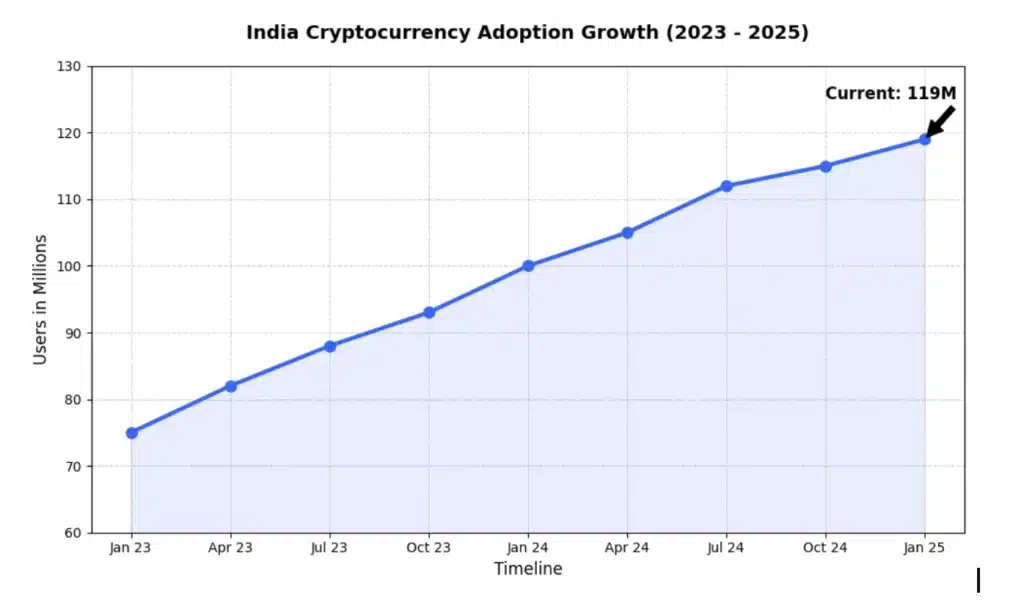
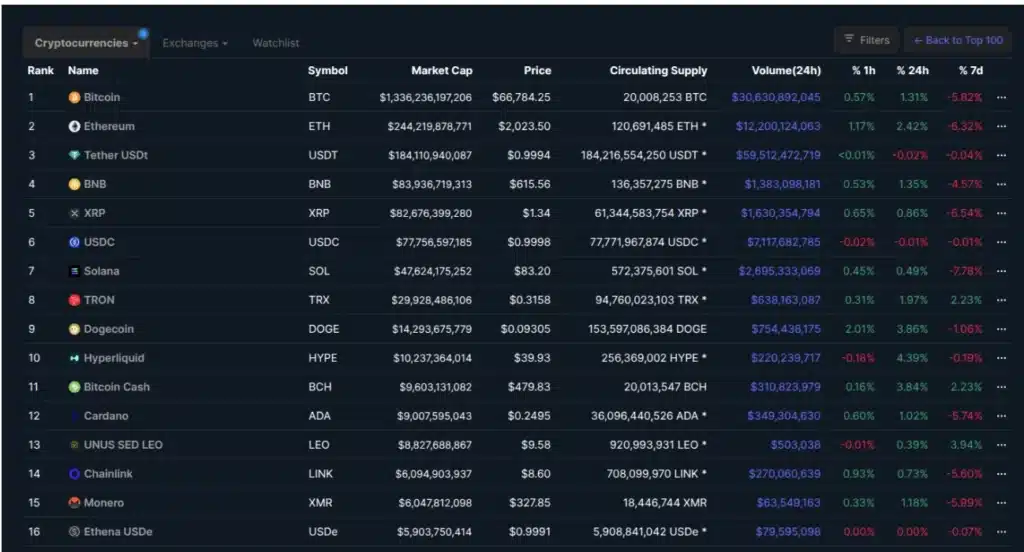
It is only necessary to look at the performance of the primary assets, i.e., Bitcoin (BTC) and Ethereum (ETH), on such sites as TradingView or CoinMarketCap to understand the scale of this movement. The volume of trades conducted using Indian IP addresses has been trending steadily upward through 2024 and into early 2025, often surging when world prices are volatile. This retail strength shows that Indian investors are beginning to consider crypto as an investment rather than a quick-turnover trade.
This has been a steady growth, particularly in times when the market performs poorly. Indian players have been found to buy more than investors in other markets, who usually withdraw their investments during crypto winters. This move suggests a rise in financial literacy and a recognition of the underlying blockchain technology beyond price action.
The Catalysts: Youth, Technology, and Remittances
India has several unique variables that have united to propel it to the top. The former is the demographic advantage. India boasts of a digitally native population (75% of the investor base is below 35 years old) that is mobile-first and finance-friendly.
Local exchanges like CoinDCX and WazirX have made it easy to enter the market for millions of first-time buyers. In addition, India has received the highest remittances in the world, with over 100 billion of the same being received annually. Such transfers are normally expensive and time-consuming via the conventional banking systems.
USDT and USDC are becoming good substitutes to cross-border settlements, providing a more convenient and affordable way for the Indian diaspora to remit funds back home. The users do not have to pay the traditional intermediary banks and, therefore, save a significant amount of money in fees, which is another reason why the use of digital versions of dollars should be encouraged.
Overcoming the “Tax Shadow”
The most surprising thing about Indian dominance is that it has taken place despite having one of the strictest tax policies in the world. In 2022, the Indian government proposed a flat tax rate of 30 percent on any gains made in crypto without the option to deduct losses. Also, a transaction tax of 1 percent TDS is imposed.
Although these actions led to a decline in trading volumes at domestic exchanges in the early stages, the 119 million ownership figure shows that underlying demand is not shaken.
Investors have matured, shifting to long-term holding (HODLing) or seeking decentralized protocols to control their portfolios. The fact that the market has continued to grow while being heavily taxed is a strong indicator to the world: Indian demand for digital assets is structural, and not cyclical.
Background: An International Movement Toward Emerging Markets
The emergence of India is part of a broader trend in which emerging markets are bypassing conventional financial systems. Other nations ranked in the top ten across different global indices include Nigeria, Vietnam, and Pakistan. These countries are similar: they have high mobile phone penetration, require inflation hedges, and have young populations keen on financial inclusion. Crypto in most of these areas is not a luxury, but a necessity to maintain wealth amidst the devaluation of local currency.
The situation in India is also worth mentioning since the country has the second-largest pool of Web3 developers in the world. This does not imply that the country is merely consuming crypto: it is developing the infrastructure. The “Made in India” stamp is now being used everywhere in the blockchain industry, from Polygon (a major Ethereum scaling solution) to other DeFi protocols. This combination of a huge number of users and a rich pool of engineering talent makes India a likely location for the next generation of internet finance.
Frequently Asked Questions
Is crypto legal in India?
In India, cryptocurrency is neither illegal nor regulated at present. Although it is not a legal tender, citizens are allowed to purchase, sell, and possess digital assets. But they have to meet tough tax reporting standards and Anti-Money Laundering (AML) regulations.
How is crypto taxed in India?
Digital assets are subject to a 30 percent flat-rate profits tax. Moreover, there is a 1 percent Tax Deducted at Source (TDS) on all transfer transactions above some limits. No deductions are being made at the moment regarding other crypto trades, expenses, or losses.
What are the most widespread cryptocurrencies in India?
Bitcoin is still the main investment for long-term investors. Nonetheless, Ethereum and other stablecoins (such as USDT) are very popular due to their use in DeFi and remittances. Bull market cycles also have high retail interest in memecoins and altcoins.
Why is India ranked better than the United States in adoption?
The ranking is based on a grassroots index. Although the U.S. has a larger total capital in the system, India has a greater degree of participation as compared to its population and economic size.
What is the stance of the RBI on crypto?
The RBI has not yet fully embraced private cryptocurrencies, but has instead developed its own Central Bank Digital Currency (CBDC), the e-Rupee, which is already undergoing mass pilot testing.
Disclaimer: BFM Times acts as a source of information for knowledge purposes and does not claim to be a financial advisor. Kindly consult your financial advisor before investing.