




Key Insights
- Price Target: Standard Chartered has a high conviction estimate of $500,000 per BTC by the end of 2030.
- The Gold Flip: This is based on Bitcoin potentially capturing 25% of gold’s total market capitalization as a digital reserve asset.
- Institutional Surrender: More than $1.7 billion in Bitcoin ETFs is held by Goldman Sachs, a notable fact giving Wall Street earlier reluctance.
- Personal Stakes: David Solomon, the CEO of the firm, came out publicly to declare that he owned some Bitcoin.
- Regulatory Catalyst: This is in addition to the upcoming ‘Clarity Act,’ which is expected to unlock 90% of the existing institutional capital waiting to enter the market.
The Road to $500,000: Geoff Kendrick’s Explanation of the ‘Digital Gold’ Standard
In an extraordinary revelation of Standard Chartered’s digital asset market outlook, the bank’s Global Head of Digital Assets Research, Geoff Kendrick, has unveiled precisely why $500,000 Bitcoin is not only possible but also inevitable.
- The Road to $500,000: Geoff Kendrick’s Explanation of the ‘Digital Gold’ Standard
- The Goldman Sachs Paradox: From “Speculative” to “Systemic”
- The Math of Scarcity vs. Institutional Inflow
- Context: The Evolving Regulatory Landscape
- Frequently Asked Questions
- How is Bitcoin supposed to get to $500,000 if it doesn’t have any smart contract utility?
- What does the ownership of Bitcoin by Goldman Sachs mean for the market?
- Is the personal ownership of Bitcoin by David Solomon significant?
- What are the main risks to the $500,000 price target?
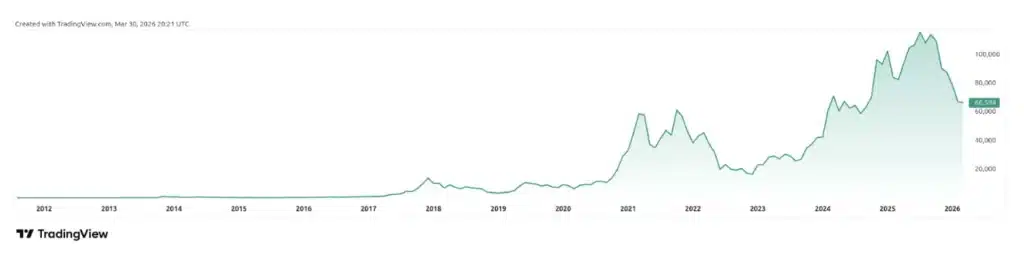
In an interview with Milk Road, Kendrick explained in detail why Standard Chartered is convinced of its 2030 Bitcoin price prediction. He attributes this conviction to the rebalancing of global portfolios. In other words, Bitcoin’s 5-fold appreciation from its current valuation is due to its adoption by institutions as a legitimate alternative to gold.
“If you look at the total market for stores of value assets, gold currently sits at approximately $14 trillion. As Bitcoin continues to mature and gain regulatory clarity, we expect it to capture at least a quarter of that market. When you divide that market share by the fixed 21 million supply, you arrive at $500,000 per coin.”
The Goldman Sachs Paradox: From “Speculative” to “Systemic”
Perhaps the most compelling proof of the accuracy of Kendrick’s prediction can be seen in the behavior of the very organizations that once snubbed the asset. Goldman Sachs, whose executives once referred to Bitcoin as a “speculative bubble” that had no “real use case,” has undergone a dramatic metamorphosis.
Recent regulatory filings show that Goldman Sachs currently indirectly holds approximately 13,741 Bitcoins through spot ETFs, valued at more than $1.7 billion at the most recent highs.
However, this is not merely a corporate shift, but a shift that reaches the very highest echelons of the bank’s executive floor. In a shocking revelation to the World Liberty Forum, Goldman Sachs CEO David Solomon admitted that he himself owns Bitcoin.
“I own a little bitcoin, very little,” Solomon confessed, describing himself as merely “an observer” seeking to understand the asset’s movements. This is a stark contrast to his declaration in 2024, in which Solomon stated that he could not identify a “clear use case” for the asset.
According to Kendrick, this is the final piece of the puzzle. “When the CEO of the world’s most prestigious investment bank admits to owning Bitcoin after years of skepticism, the ‘reputation risk’ for other institutions effectively vanishes.”
The Math of Scarcity vs. Institutional Inflow
The crux of the $500,000 prediction is encapsulated in what Kendrick calls the “Institutional Squeeze.” Unlike previous Bitcoin price surges fueled by FOMO among retail buyers, the current phase is distinguished by “sticky” institutional capital.
“We are seeing a sequencing effect,” Kendrick said. “First, it was the hedge funds, then the ETFs, and now we are seeing the first trickles of sovereign wealth funds and state pension funds.”
According to Standard Chartered’s study, even if global pension funds invest just 1% of their funds in Bitcoin, it could be enough to soak up all the liquid supply of Bitcoin in the market, creating a supply shock that could send prices vertical.
Context: The Evolving Regulatory Landscape
Such predictions emerge in an era where the United States government is adopting a more beneficial stance on digital assets. The changing regulatory environment in response to the current administration has paved the way for companies such as Goldman Sachs and Standard Chartered to include Bitcoin in their core business offerings.
While traditional government bonds have experienced fluctuating levels of investor confidence, Bitcoin’s “zero downtime” guarantee has made it an attractive hedge against systemic risk. “The infrastructure you can trust is the infrastructure that stays online,” said Kendrick, referring to Bitcoin’s 100% uptime since its inception.
Also Read: Bitcoin Market Update: The War to Take the 200-Week EMA
Frequently Asked Questions
How is Bitcoin supposed to get to $500,000 if it doesn’t have any smart contract utility?
Bitcoin’s “utility” is that it is decentralized and acts as a store of value. Standard Chartered considers it a “hard money” asset. It is not a platform for decentralized apps; it is in direct competition with gold. Its value is based on scarcity and security.
What does the ownership of Bitcoin by Goldman Sachs mean for the market?
The $1.7 billion worth of Bitcoin owned by Goldman Sachs through ETFs confirms Bitcoin as a legitimate investment asset. It sends a strong message to other “tier 1” banks that the regulatory environment for owning Bitcoin is favorable, which could lead to a “follow the leader” approach by other international banks.
Is the personal ownership of Bitcoin by David Solomon significant?
Yes, it is significant because for a CEO of a bank to admit to owning Bitcoin personally, especially for a bank that was criticized for owning Bitcoin, means that there is a significant cultural shift in the way professionals view Bitcoin.
What are the main risks to the $500,000 price target?
The main risks to the price of Bitcoin reaching $500,000 include a massive regulatory reversal, a catastrophic failure of the Bitcoin protocol, or the occurrence of a “black swan” event that reduces the liquidity of the market.
Disclaimer: BFM Times acts as a source of information for knowledge purposes and does not claim to be a financial advisor. Kindly consult your financial advisor before investing.