


Key Insights
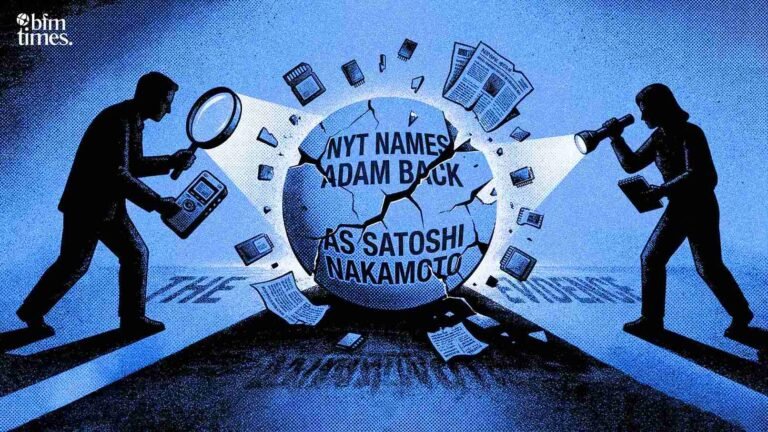
- On April 8, 2026, The New York Times released a 12,000-word investigative story by John Carreyrou and Dylan Freedman naming Blockstream CEO Adam Back as the most probable person behind the Satoshi Nakamoto pseudonym.
- The document uses the results of 18 months of stylometry, containing 325 individual spelling mistakes, which are characteristic of both Back and Satoshi, and an unusual absence of any activity by Back when Bitcoin was first being developed.
- Adam Back has categorically denied the allegations six times, including in a two-hour interview in El Salvador, saying that linguistic similarities were due to a common cypherpunk history and “confirmation bias.”
- MicroStrategy CEO Michael Saylor, among other industry figures, has denied the assertions, noting public email exchanges between Satoshi and Back as proof that they are distinct individuals.
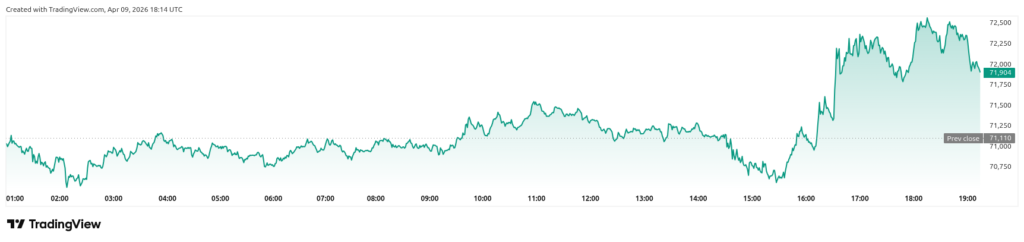
- Prices for Bitcoin have not been affected significantly after the news broke, since the community is confident that a mystery of 17 years can be unraveled only by means of cryptography; Bitcoin trades for more than $72,000.
The Search for Satoshi: Inside the 12,000-Word Investigation Naming Adam Back.
The longest-standing enigma in the digital era has been rekindled. The New York Times (NYT) has, after almost 20 years of speculation, published a colossal, one-year investigation on the identity of Satoshi Nakamoto, the pseudonymous developer of Bitcoin. The report, called The Man Behind the Curtain, directly points an accusing finger at 55-year-old British cryptographer and Blockstream CEO Adam Back.
Pulitzer Prize-winning journalist John Carreyrou, who revealed the Theranos scandal, and Dylan Freedman headed the investigation. The team examined a database of 134,308 posts of early cryptography mailing lists over 18 months, cross-linked with known writings of Satoshi. Although the report does not go as far as to assert the presence of a “smoking gun” cryptographic evidence, it is a web of circumstantial evidence that has divided the world of finance and technology.
The Case for Adam Back
The NYT report has three main pillars on which it bases its case, and these are linguistic analysis, technical overlap, and behavioral patterns.
Stylometry was used to compare the writing styles of 620 early cypherpunks by linguistic experts employed by the Times, such as Florian Cafiero. The report stated that Back was the nearest match. In particular, the analysis found 325 different “hyphenation tics” in the writing of Satoshi. The analysis revealed that Back made 67 of these rare mistakes, almost twice the number of such mistakes in the next best candidate. The obscure expressions like partial pre-image and burning the money, which were used by Satoshi in his early posts in the forums, were also common in the late 1990s in both private and public communications by Back.
The connection is technically based on Hashcash. Hashcash is a proof-of-work system invented in 1997 and the basis of the Bitcoin mining process. Although it was not a secret that Satoshi cited Back in the original Bitcoin white paper, the NYT report asserts that Back had described all five key features of Bitcoin in multiple posts to forums between 1997 and 1999, a decade before the launch of the network.
Perhaps the most interesting story aspect of the report is the Temporal Silence. Carreyrou observes that Back, an extraordinarily active poster on cryptography forums since 1992, had been unusually silent since the end of 2008 and April 2011. This is the ideal time frame during which Satoshi Nakamoto was active in the development and marketing of Bitcoin and then went off the radar.
Response of Adam Back: “I am not Satoshi.”
Adam Back has not taken long to disprove the allegations. Back has been forced to address the claims in a series of statements on X (previously Twitter) and in a filmed confrontation in El Salvador.
“I am not Satoshi,” Back wrote on April 8. He claimed that the similarities in language are due to confirmation bias and a common intellectual milieu. Since he was among the most talkative individuals on the cypherpunk mailing lists, Back argues that any search of the term(s) associated with electronic cash will statistically favor his name.
“I was early in laser focus on the positive societal implications of cryptography, online privacy, and electronic cash,” Back explained. The overlaps are due to shared cypherpunk intellectual spaces, not shared identity. The report is a conglomeration of coincidences and similar wording from individuals with similar experience and similar interests.
Back was reported to have visibly tensed during the two-hour interview with Carreyrou when shown the hyphenation data, but stood his ground in his denial. He also proposed that the enigma surrounding the identity of Satoshi is, in fact, a feature, rather than a bug for Bitcoin, since it does not allow the asset to be linked to the reputation or activity of one human creator.
Michael Saylor and the Crypto Community Push Back
The response of the larger Bitcoin community has been one of doubt, even hostility. At the forefront is Michael Saylor, the founder of MicroStrategy and a well-known Bitcoin proponent. Saylor took to social media to call the NYT report an “obvious error.”
“Stylometry is fascinating, but not evidence,” Saylor said. The current emails between Satoshi and Adam Back on record indicate that they were different people. No one can sign with the keys of Satoshi, and until then, all theories are merely narrative.
The argument by Saylor cites a series of emails that were released in past legal disputes, which reveal a 2008 correspondence in which Satoshi contacted Back to talk about the use of Hashcash in a new project. To make the theory of the NYT true, critics say, Back would have had to play a two-way game, writing emails to himself to leave a false trail to investigators in the future.
The technical assumptions of the report were also questioned by security researcher Robert Graham. Graham, having examined the original code of Bitcoin as well as the C++ projects known to Back, observed that the style of coding does not resemble them in the least.
Market Response and Statistics
The Bitcoin market has been very calm despite the explosive nature of the report. In the past, efforts to unmask Satoshi have generated short-term volatility, although the price of the asset has grown less sensitive to the identity of the creator as the asset matures.
As of the time of the article’s release, Bitcoin was at about $71,400, according to the data provided by CoinMarketCap and TradingView. After a short decline to $69,800 as the news went round, the price recovered to $72,700 in 24 hours.
According to analysts, the market will dismiss all claims of identity until the 1.1 million BTC in the original wallets of Satoshi (worth about $79 billion) start to move.
The Satoshi Search: Historical Context.
The New York Times investigation is only the latest in a long line of attempts to unmask the creator of the world’s first decentralized currency. The hunt has been marked by great drama and much disillusionment.
- Dorian Nakamoto (2014): Newsweek famously identified a Japanese American physicist in California as Satoshi. This assertion was soon disproved as Dorian Nakamoto claimed that he had no idea about Bitcoin and that he had misinterpreted the reporter’s questions.
- Craig Wright (2016 – 2024): Australian computer scientist Craig Wright took years to claim he was Satoshi. In May 2024, however, a ruling by a UK High Court ruled that Wright had lied extensively and forged documents to bolster his claim.
- The HBO Documentary (2024): Only two years ago, a documentary named Money Electric: The Bitcoin Mystery featured developer Peter Todd. Similar to Back, Todd refuted the allegation swiftly and was ultimately compelled to go into exile because of security reasons concerning the $79 billion wealth that the Satoshi wallets were linked to.
The NYT report admits these failures but claims that the thoroughness of their data analysis makes this investigation unique. They are targeting Adam Back, who was literally mentioned in the first paragraph of the Bitcoin white paper, and who was there at the pre-dawn of Bitcoin.
Also Read: Pentoshi: The Crypto Trader Who Turned Discipline Into Millions
Frequently Asked Questions:
Is there cryptographic evidence in the NYT report?
No. The report is solely based on circumstantial evidence, such as writing style (stylometry), time patterns of activity, and technical skill. There was no signing of messages with any private keys, and no coins of Satoshi-era wallets were transferred.
What is stylometry?
The statistical analysis of literary style is called stylometry. It examines the trends of sentence arrangement, the use of words, and even the use of punctuation to ascertain the authorship of the anonymous writings.
Why does it matter if Adam Back is Satoshi?
It is estimated that Satoshi Nakamoto has approximately 1.1 million BTC. If the owner were to be recognized, he or she would be one of the richest people on Earth. Moreover, since Adam Back is now the CEO of Blockstream, a firm extensively engaged in the development of Bitcoin, a verified identity might be a major regulatory and legal concern about market manipulation or material information to investors.
What do the emails between Satoshi and Back say to refute the theory?
In August 2008, Satoshi wrote to Adam Back requesting the correct citation for Hashcash. If Back were Satoshi, he would have been emailing himself. Although the NYT indicates that this was cover, the majority of the experts think that there were probably two distinct individuals working together remotely.
How did the Bitcoin price react?
The response was subdued. The price went down by a small margin of 2% but then went up to a high of $72,700 a day. This implies that the NYT report is not perceived as a conclusive or disruptive event in the market.
Disclaimer: BFM Times acts as a source of information for knowledge purposes and does not claim to be a financial advisor. Kindly consult your financial advisor before investing.