Key Insights
- According to a recent study conducted by researchers at Google in its Quantum AI division, the number of qubits needed to break ECDSA encryption on both Bitcoin and Ethereum below 256 bits has been reduced to fewer than 500,000.
- This 10X improvement by the end of early 2025 is enabled by AI models that have refactored quantum Toffoli gates, reducing the computational volume of spacetime needed to run Shor’s algorithm by a factor of 10X.
- Researchers simulated a live on-spend attack in which a quantum computer can extract a private key in about 9 minutes, which offers a narrow but feasible window to preempt the 10-minute block confirmation of Bitcoin.
- Although the block time of Ethereum is 12 seconds, and therefore real-time hijacking is not possible, it is estimated that more than 20 million ETH is at risk in at-rest accounts with previously-exposed on-chain public keys.
- The results have accelerated the testing of BIP-360 in the Bitcoin ecosystem and the deployment of the finalized post-quantum cryptography (PQC) standards of NIST in decentralized networks.
Also Read: Satoshi’s 2010 Prophecy: Why Bitcoin is Ready for the 2026 Quantum Leap
The Q-Day Countdown: How AI Has Now Put the Quantum Threat to the Front Door of Bitcoin
The hypothetical Q-Day, when quantum computers will be able to outsmart the encryption that secures the global economy, has just gotten much closer. This was due to the publication of a groundbreaking paper by the Quantum AI division of Google on March 31, 2026, which has made it possible for an attack on the secp256k1 elliptic curve to be around 20 times less than what was estimated in 2019.
Previously, it was believed that it would take around 10 to 20 million physical qubits in a quantum computer to break the 256-bit ECDSA keys of Bitcoin. Nevertheless, with the help of AI to optimize the process of compiling quantum circuits, scientists have shown that a machine with fewer than 500,000 physical qubits could be used to achieve the same outcome.
The AI Contribution to the 10X Reduction
The breakthrough is not due to more rapid hardware scaling, but to “compilational efficiency.” The complex gates needed to run Shor’s algorithm were refactored using AI models. The overall quantum resources required were reduced by discovering more efficient routes to perform these operations.
Researchers observed that such AI-based optimizations have transformed a brute-force problem into a sophisticated engineering objective. This is similar to the way that specialized ASICs previously transformed the mining of Bitcoin, except that the efficiency gains are going against the network’s security layer.
Live Market Impact and Transaction Risks
The most alarming finding is the on-spend attack. When a user transacts Bitcoin, his or her public key is disclosed to the network prior to the confirmation of the transaction in a block. Google’s team simulated a situation in which a quantum computer would intercept this key and extract the private key within about 9 minutes.
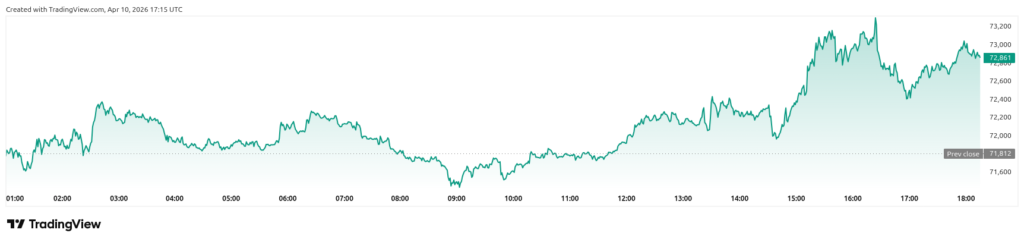
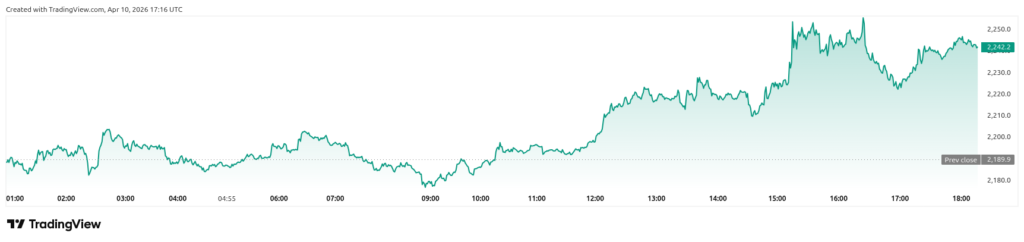
Since the average block time of Bitcoin is 10 minutes, a quantum attacker has an approximate 41% probability of front-running the user and looting the money before the valid transaction can settle. For a live view of the assets at risk, real-time market information can reveal the extent of the risk.
The Strategic Situation: A $600 Billion Weakness
Although there is still no hardware that can execute 500,000 physical qubits, the narrowing gap is compelling a radical change in the governance of blockchain. The most developed processor of IBM is the Hera, which has 156 qubits, but current roadmaps for fault-tolerant systems are speeding up.
About 6.9 million BTC (around one-third of the total supply) are already in addresses considered vulnerable. These are early Pay-to-Public-Key (P2PK) wallets and reused addresses with the public key already on the ledger. In these assets, a quantum computer will not have to race with a 10-minute clock; it can collect the information now and decrypt it when the hardware is ready.
Ether has another set of challenges. Although its 12-second block time renders live attacks virtually impossible even by the fastest quantum machines, its account model is structurally susceptible to so-called at-rest attacks. It has been estimated that the 1,000 richest Ethereum accounts have already revealed their public keys by making past transactions.
Frequently Asked Questions
Is my Bitcoin secure at the moment?
Yes. As of April 2026, no quantum computer exists with 500,000 qubits to perform this attack. Nonetheless, security specialists advise transferring money to address types that are quantum-resistant. To Bitcoin users, this involves switching to P2TR (Taproot) addresses and ultimately to the suggested BIP-360 ‘bc1z’ addresses.
What is BIP-360?
BIP-360 is a Bitcoin Improvement Proposal called Pay-to-Merkle-Root. It proposes a new address format that is quantum-resistant, in the sense that the public key is concealed even after a transaction has been committed. It eliminates the key path spending option available in Taproot, and all spends go through script paths, which are more robust to Shor’s algorithm.
Will a quantum breakthrough crash the crypto market?
Risk is usually priced into the market. Bernstein analysts recently pointed out that the threat is not new and the whole internet is encrypted with the same cryptography. Should a quantum computer crack Bitcoin, then it would crack the global banking system as well. This probably sets in motion a global move to post-quantum standards before a single Satoshi is stolen.
How does AI help the attacker?
The compilation problem of quantum computing is solved using AI. It finds methods to express complicated mathematical operations with fewer logical qubits. With lower mathematical overhead, AI enables smaller and less powerful quantum computers to solve problems that were previously believed to need large, million-qubit systems.
What is the timeline for ‘Q-Day’?
According to most hardware roadmaps by IBM, Google, and Quantinuum, the window of fault-tolerant quantum computing is 2029-2032. As the algorithmic part speeds up with AI, most researchers now think we have a nervous five years and not a comfortable decade to make the transition to quantum-resistant protocols.
Disclaimer: BFM Times acts as a source of information for knowledge purposes and does not claim to be a financial advisor. Kindly consult your financial advisor before investing.