Key Insights
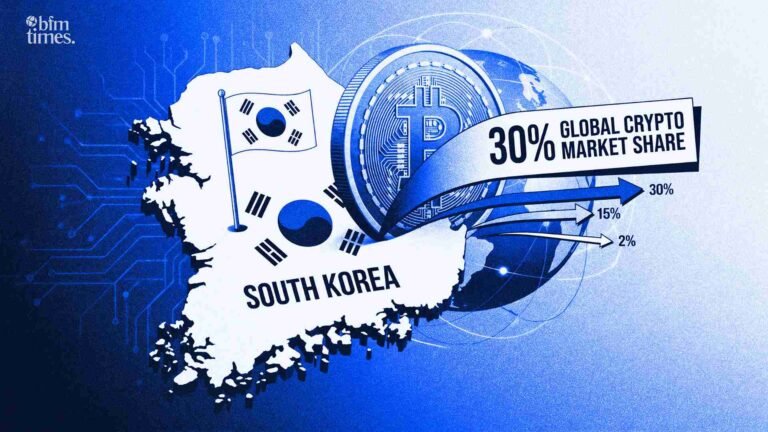
- Domination in the Global Market: South Korea currently owns 30 percent of the total crypto market in the world.
- Interest in Altcoins: In South Korea, 85 percent of trading involves the usage of altcoins compared to other parts of the world.
- Limited Interest in Main Assets: BTC and ETH represent only 9 percent and 6 percent of the South Korean market.
- Large Trading Volumes: On average, South Korean exchanges trade 26 billion dollars weekly.
- Regional Contrast: Although the monthly volume in Japan is a fraction of that in Korea, the depth of the Bitcoin market in Japan is 3 to 5 times greater and more stable.
Also Read: Metaplanet Bitcoin Strategy Expands With $25M Investment Plan & New Venture Arm
Speculative Fever: South Korea’s 26 Billion Dollar Weekly Trading Surge
An innovative report by the cryptocurrency data company Kaiko has shown that South Korea has established itself as the most active retail crypto market in the world. By mid-April 2026, the country accounts for almost 30 percent of all trading worldwide. This influx is defined by a distinctive and highly speculative market structure in which local investors nearly completely shun the blue-chip assets of the crypto world in favor of high-volatility substitute tokens.
The statistics indicate that the global market tends to track the trends of Bitcoin and Ethereum, but the South Korean market is at another frequency. On the large local exchanges such as Upbit, Bithumb, Coinone, and Korbit, 85 percent of the activity is made up of altcoins. By stark comparison, Bitcoin accounts for a volume of only 9 percent, and Ethereum is even lower with only 6 percent.
Such a concentration in altcoins has made South Korea a key price discovery engine for smaller projects. Analysts observe that when a token is listed on a large Korean exchange, it tends to have a “listing premium” where prices can soar by 10 to 40 percent within hours, simply because of the sheer concentration of retail liquidity.
Kimchi Premium and Market Dynamics
The isolation of the South Korean market due to tight capital control and the Travel Rule of digital assets has made the market unique. The majority of trading is done in Won-denominated (KRW) pairs, which tend to trade at a premium to the equivalent assets on other global exchanges, such as Binance or Coinbase. This is what is referred to as the Kimchi Premium, and it has remained the same even after the regulatory measures to align the local market with global trends.
The study by Kaiko points out that the weekly trading volume in Korea has reached 26 billion dollars. In perspective, the monthly trading volume in Japan ranges between 2 and 3 billion dollars. But volume does not necessarily mean stability. The report emphasizes a critical disparity in “market depth.” Market depth refers to the market’s ability to sustain relatively large orders without impacting the price.
Although Japan trades with a fraction of the volume of Korea, its depth in the Bitcoin market is 3 to 5 times greater. This implies that the Japanese market is controlled by institutional investors and more conservative retail investors, who are more focused on Bitcoin, and the Korean market is a haven for high-frequency retail investors.
Regulatory Changes and the Digital Asset Basic Act
The explosive growth and speculative nature of the Korean market have not gone unnoticed by policymakers. The South Korean government is now on the second stage of its Digital Asset Basic Act. The act is expected to subject cryptocurrency exchanges to the same degree of regulation as traditional banks, as they will be treated as quasi-financial institutions.
A major reorganization of exchange ownership has been proposed in the National Assembly recently. Regulators are also thinking of limiting the stakes of large proprietors in exchanges such as Upbit and Bithumb to 20 percent. The purpose of this move is to enhance transparency in governance and avoid conflicts of interest, particularly as the current state of affairs is that Upbit and Bithumb have about 90 percent of the domestic market.
These regulatory changes come at a time when many Korean investors are doubling down on altcoins, even as 40 percent of these tokens are trading at all-time lows. The local population is risk-taking, and this aspect continues to be the main force behind the 26 billion dollar weekly turnover despite the tightening of the reins.
Frequently Asked Questions
Why are South Korean investors more attracted to altcoins than Bitcoin?
The South Korean retail investors have a long-standing attraction to the high-volatility assets, which promise quick and short-term returns. The culture of the local market, high-frequency trading applications, and the listing effect on the domestic exchanges make altcoins more appealing to the average trader than the comparatively stable movements of Bitcoin.
What is market depth, and why is it important?
Market depth is a measure of the amount of buy and sell orders at different prices. Deep market depth, such as experienced in Japan, implies that big trades can be made without triggering substantial price movements. The low market depth, which is common in the Korean altcoin market, implies that a relatively high trading volume can lead to severe price fluctuations.
What is the effect of the Korean Won on the world crypto prices?
Since South Korea contributes 30 percent of the volume in the world, KRW trading pairs have an enormous impact on the world derivatives market. Active trading on Korean exchanges can frequently result in a rise in open interest and volatility in international perpetual futures of particular altcoins.
Will the Kimchi Premium still exist in 2026?
Oh yes, the Kimchi Premium is still a staple of the Korean market. Local demand tends to be higher than supply because of the limitations on the movement of large sums of capital out of the country, which results in crypto assets being priced at a 2 to 10 percent premium to the global prices.
What are the risks of trading on South Korean exchanges?
The main threats are the extreme volatility associated with the altcoin-based nature of the market and the possible liquidity traps in smaller tokens. Also, the future Digital Asset Basic Act can cause drastic alterations in the way these exchanges work, which can impact user access or listing procedures.
Disclaimer: BFM Times acts as a source of information for knowledge purposes and does not claim to be a financial advisor. Kindly consult your financial advisor before investing.