Key Insights
- The Proclamation: Larry Fink, Chairman and CEO of BlackRock, claims that India has grossly underestimated its own development of digitizing its currency and financial infrastructure.
- Lagging Developed Nations: According to Fink, developed economies such as the United States are now falling behind in terms of pace and magnitude of technological adoption in India.
- The Growth Catalyst: The CEO saw digitization of India as a multi-decade structural narrative that would support an 8 to 12 percent GDP growth rate over the next decade.
- The Future of Tokenization: BlackRock considers India to be the first global laboratory of asset tokenization, which will help to pay less and make investments more democratic.
- Strategic Investment: Fink repeated the message that BlackRock is committed to the Indian market, particularly referring to the success of the JioBlackRock joint venture.
Global Finance Reset: Larry Fink thinks India is winning the race against the West.
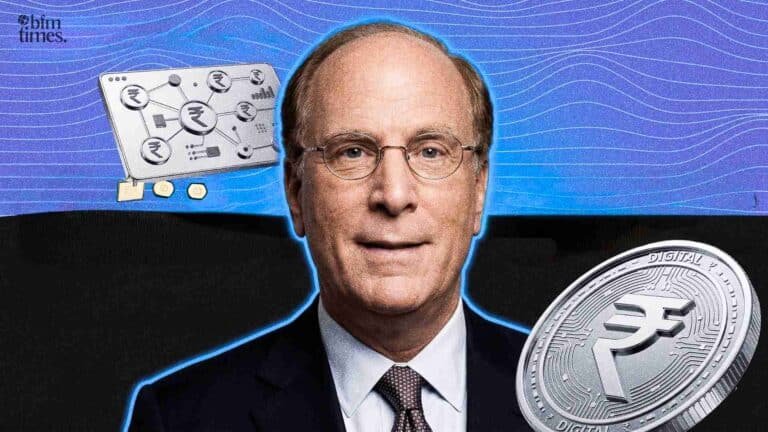
Larry Fink, the chief executive of the largest asset manager in the world, BlackRock, has made a dramatic judgment of the situation in global finance in a series of high profile conversations after his latest annual letter to investors. Fink states that India is no longer catching up with the West; it has already overtaken most of the developed countries in adopting digital payment rails and the digitization of currency.
Fink made the remarks when the Unified Payments Interface (UPI) had hit new heights, handling more than 14 billion transactions each month and annual values of more than 2.5 trillion. Fink, who was speaking with Reliance Industries Chairman Mukesh Ambani, called the Indian economy transformation unprecedented, fueled by a combination of government policy, smartphone penetration, and the deployment of 5G at an unprecedented pace.
The “Underestimation” of Indian Tech
Fink believed that the Indian people and their policy makers tend to underrate the level of development of their system. As the United States and Europe struggle with old banking systems where it takes days to complete a transaction, India has blazed a trail with real-time settlement via UPI and the emerging Digital Rupee (CBDC) pilot, establishing a new global standard.
Fink said: Everywhere I go, I hear the cry of modernization. “But in India, you are already living in the future. The developed world is currently looking at India to understand how to scale digital infrastructure for over a billion people.”
Market Reaction and Digital Asset Trends
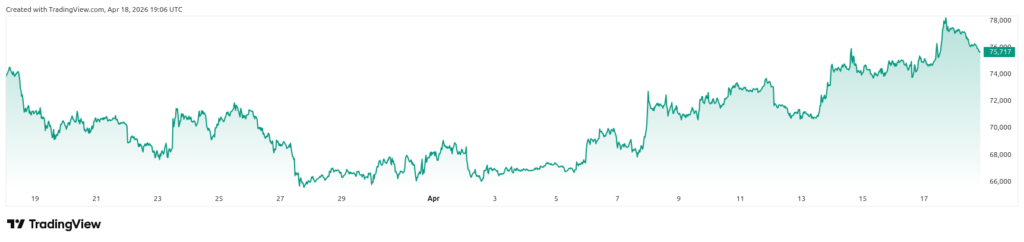
This institutional support has been well received in the market. Today, April 18, 2026, the convergence of conventional finance and digital assets is more apparent than ever. Bitcoin (BTC) has been on a relief rally recently, recovering above $77,000 amid geopolitical de-escalations in the Middle East.
The Future of Tokenization: The Next Frontier.
In addition to mere payments, Fink is placing a big bet on tokenization, or the act of placing traditional assets such as bonds and equities onto a digital registry. He cited India and Brazil as the two countries that are spearheading this. The tokenization would cut investment fees by eliminating intermediaries, and wealth creation would be available to hundreds of millions of retail investors in tier 2 and tier 3 cities in India.
Strategic Significance: A Population-scale Transformation.
The background of the praise by Fink is the India Stack, which is a collection of digital public goods that encompass Aadhaar (identity), UPI (payments), and DigiLocker (data). This infrastructure has enabled India to jump over the credit card age that characterized Western finance for decades.
The JioBlackRock joint venture introduced the first set of funds in 2025, raising nearly 2 billion dollars in just a short time. This was six times the previous industry record in India. The fact that BlackRock has decided to employ another 1,200 specialists in India to enhance its AI and digital capabilities only indicates that the company considers India the back office and the innovation center of the decade to come.
The US has legal impediments like the 1982 Tax Equity and Fiscal Responsibility Act (TEFRA), which unintentionally slows down the issuance of on-chain bonds, but India has had a more flexible regulatory framework. The Reserve Bank of India (RBI) has already been negotiating with various Asian and European central banks to develop cross-border transaction systems based on the Digital Rupee.
Also Read: Institutional Gold Rush: Why BlackRock and JPMorgan are Betting the House on Ethereum
Frequently Asked Questions
What did Larry Fink say about India’s digitization?
According to Larry Fink, India has already overtaken developed countries in the digitization of currency, and India is not as aware of its technological advantage as it should be. He referred to India as a global tech utilization and dispersion leader.
What is the reason why India is ahead of developed countries such as the US?
The real-time payment system (UPI) in India can transfer money in real time, in peer-to-peer amounts, at a scale and cost that the US FedNow or European systems have not yet attained. India has also been able to incorporate digital IDs into the financial services of more than a billion individuals.
What is “Tokenization” and why is it important for India?
In tokenization, rights to an asset (such as a share in a company or a piece of real estate) are transformed into a digital token on a blockchain. This eliminates the middlemen, reduces transaction costs, and enables small-scale investors to purchase portions of costly assets.
How is BlackRock involved in India’s digital economy?
BlackRock has collaborated with Jio (Reliance Industries) to create JioBlackRock, a digital-first asset management company. They have also been pouring money into Indian AI infrastructure and digital payment technologies.
Is UPI being replaced by the Digital Rupee (CBDC)?
No. Digital Rupee and UPI are complementary. UPI is an interbank account transfer system, and the Digital Rupee (CBDC) is a physical cash equivalent in digital form that is issued by the Reserve Bank of India. The two are components of the wider digitization plan of India.
Disclaimer: BFM Times acts as a source of information for knowledge purposes and does not claim to be a financial advisor. Kindly consult your financial advisor before investing.