


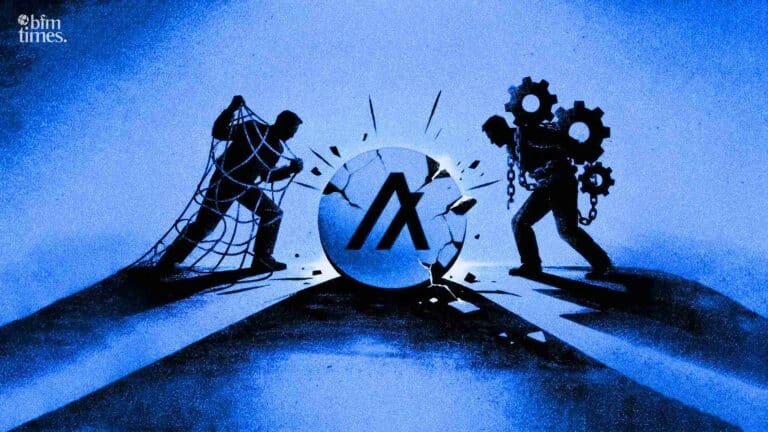
In summary, Algorand faces significant challenges regarding inflationary economics, a relatively small team of developers compared to other competing projects such as Ethereum, and concerns regarding centralization of its governance and relay nodes. Such factors have prevented the success of the ALGO cryptocurrency as far as pricing and mainstream adoption go, despite its high level of technological proficiency.
Challenges within the Market and Limitations.
For one to understand how competitive Algorand is, it is imperative to understand where the platform falls short of the rest of the industry.
1. Structural Tokenomics and Supply Pressure: One of the most common criticisms is the accelerated vesting and the historical schedule of the token release by the Algorand Foundation. Although the circulating supply is now approaching the 10 billion limit (around 89% as of early 2026), years of steady selling pressure by the Foundation and early investors formed a mechanical ceiling on the price of the token. This massive absorption of supply regularly makes ALGO perform poorly compared to its counterparts, even in market rallies.
2. The Developer and Adoption Gap: Algorand has been facing the problem of Network Effect, even though it has a highly advanced mechanism known as Pure Proof of Stake (PPoS). Ethereum attracts developers due to its liquidity or Solana due to its huge user base. Although the recent 2026 upgrades, including the AlgoKit 4.0 and AI-assisted vibe coding tools have made the experience better, the total value locked (TVL) in the Algorand DeFi ecosystem is still far less than that of its main competitors.
3. Relay Node Centralization: Critics frequently cite the Relay Node structure as a risk of centralization. Relay nodes, as opposed to participation nodes, which are involved in consensus, are involved in network communication. Traditionally they were run by a small, vetted group of institutions. Although the Foundation has taken steps in 2026 to open this process and switch to a more peer to peer architecture, the impression of a permissioned layer remains among the purists of decentralization.
Background and Contextual Framework
Algorand was established by MIT professor Silvio Micali, with the mission of addressing the so-called Blockchain Trilemma (security, scalability, and decentralization all at the same time). Although technically successful in speed and finality, its practical decentralization is frequently contested since the Algorand Foundation has a strong influence on the intellectual property of the protocol and its development plan. In March 2026, the Foundation brought core protocol IP directly under its control, a step that was meant to simplify development but also led to new discussions on the centralization of organizations.
Frequently Asked Questions
Is Algorand still considered a “Ghost Chain”?
The word is losing its accuracy in 2026, with unique active wallets increasing to more than 530,000. Nevertheless, in comparison to millions of active users on Layer 2 solutions or Solana, Algorand has an activity gap to bridge to be regarded as a top-tier ecosystem.
Is there a maximum supply of Algorand?
Yes, the maximum supply is hard-capped at 10 billion ALGO. This cap was originally planned to be reached in 2030, although recent estimates indicate that the network will be nearly completely diluted by the end of 2027 or 2028.
What will be the comparison between Algorand and Solana in 2026?
Whereas Algorand has a better instant finality (transactions can never be reversed), Solana has a significantly higher transaction rate and a stronger retail market of NFTs and meme coins. Algorand is now shifting to Agentic Commerce and machine-to-machine payments to identify a niche that is not yet dominated by Solana.
Disclaimer: BFM Times acts as a source of information for knowledge purposes and does not claim to be a financial advisor. Kindly consult your financial advisor before investing.