Key Insights
- Largest Ever Asset Freeze: Tether has recently frozen more than $344 million USDT in two wallet addresses on the Tron blockchain as part of its largest ever stablecoin asset freeze in a major action against Iran.
- Cooperation between Governments: This particular decision was carried out after consultations with the United States Department of Justice (DOJ) and the Office of Foreign Asset Control (OFAC).
- Ties with Iran: These wallets belong to “Operation Economic Fury” which is a US Treasury Department initiative against the Iranian regime’s financial network, according to US Treasury Secretary Scott Bessent.
- Controversy: This is a significant achievement of Tether in the fight against money laundering, but at the same time, it has brought in new controversy about the problem of the centralising nature of Tether and privacy.
- A Landmark Event: This is the second biggest case of frozen funds by Tether, bringing the total amount over $4.4 billion, and more than $2.1 billion of it at the request of US law enforcement.
On April 23, 2026, the largest stablecoin issuer, Tether, made headlines by freezing more than $344 million in USDT related to the Iranian regime. The action, which U.S. officials have described as a key part of “Operation Economic Fury”, marks a significant milestone in the evolution of private stablecoin issuers’ relationships with federal authorities.
Tether froze the assets in two wallets on the Tron blockchain. These wallets have served as “reserve infrastructure” for Iranian state-supported crypto assets, with around $370 million of funds flowing into these wallets since 2021, according to TRM Labs. The blacklisting by Tether makes the tokens permanently “sticky”, stopping them from being washed on decentralized exchanges and used for prohibited purposes.
The Enforcement Arm of the Treasury
U.S. Treasury Secretary Scott Bessent applauded the action, saying that the U.S. will “target all financial lifelines tied to the regime.” The move sees Tether take on the role of an agent for the U.S. government. With CEO Paolo Ardoino at the helm, Tether has evolved from a reactive to a proactive ally for law enforcement around the world.
“USDT is not a safe haven for illicit activity,” Ardoino said in a statement after the announcement. “When we have evidence of potential connections to sanctioned entities or criminal networks, we take action swiftly and decisively.”
The freeze was technically flawless. Tether acts as a central ledger for the USDT token, and can “blacklist” addresses on-chain. When an address is blacklisted, attempts to move USDT from the address will not succeed. On the face of it, the $344 million remains on the Tron blockchain explorer, but it is “dead money”.
A Win for Security or a Step towards Centralisation?
The freezing of $344 million from a sanctioned country is unquestionably a major victory for security, but the “unilateral” nature of the act has left many in the cryptocurrency community concerned. Blockchain technology has long been held out as offering “permissionless” finance – the notion that a central authority could not simply steal or freeze a user’s assets without cause.
The “Operation Economic Fury” freeze is a reminder that stablecoins such as USDT are not “censorship-resistant” cryptocurrencies like Bitcoin. Some have suggested that Tether’s growing willingness to comply with the U.S. government’s demands to freeze accounts has reduced USDT to “Fed-Lite” – a private Central Bank Digital Currency (CBDC) that can be controlled by the government with a phone call.
“Your stablecoins are not your stablecoins,” tweeted one well-known cryptocurrency analyst. “If a company can press a button and make $344 million disappear from the face of the earth, we are not creating a new financial system, we are recreating the old one on a new database.”
Market Reaction and Liquidity Concerns
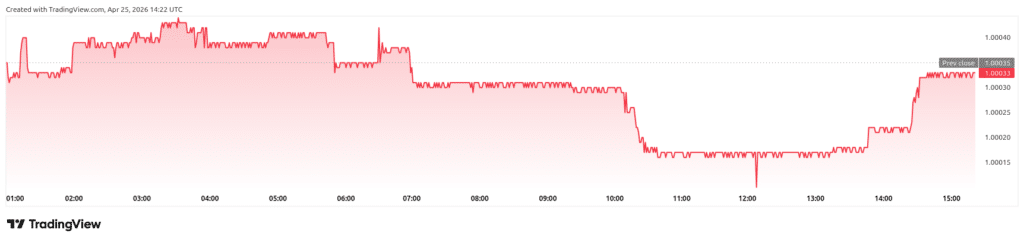
The announcement had a slight impact on the market. USDT dropped slightly, 0.1% on the US dollar, on major exchanges such as Binance and Coinbase as traders weighed up the possibility of further action. But it rebounded within a few hours.
For institutional investors, it is not so much the freeze that is damaging, but the potential precedent. If the U.S. authorities can sanction “material links” to an outlaw regime at large, could legitimate entities inadvertently caught up in a tangle of intermediaries also suffer a freeze? For the time being, the market would probably accept this “centralized guardrail” as the cost of operating in a regulated market, but there is a growing momentum of “decentralized stablecoins” such as DAI, or even more private coins such as Monero, in the wake of such extreme enforcement.
Other Blockchain Sanctions
The April 2026 seizure is not an isolated incident. It comes hot on the heels of the General Exploration of National Interest in United States Security Act (GENIUS Act) of July 2025, which required payment stablecoin issuers to have on-chain freezing functions. This law has essentially forced issuers such as Tether and Circle to bring their policies into line with U.S. national security priorities or face exclusion from the U.S. banking system.
Moreover, Iran’s involvement in the crypto industry has been a concern for some time. According to TRM Labs, in 2024, Iran’s total crypto volume was $11.4 billion due to oil exports and mining activity subsidised by the government. By going after the “intake layer” of these funds (the reserve wallets), Tether and the DOJ are seeking to cut off the regime’s use of stablecoins for wholesale international trade.
This move confirms a new reality in the crypto sector: the “wild west” of stablecoins is no longer. As Tether further integrates its services with the 340+ law enforcement agencies it now serves, the distinction between “private company” and “government entity” becomes increasingly blurred, resulting in a crypto industry split between those who want security and those who want decentralisation.
Also Read: Tether USDT Supply Drop “FTX-Level”
Frequently Asked Questions
Why did Tether freeze $344 million USDT linked to Iran?
Tether froze the funds after authorities linked the wallets to alleged sanctions violations and illegal activity.
How many wallets were involved in the $344 million freeze?
The frozen USDT was reportedly held across two crypto wallet addresses.
Disclaimer: BFM Times acts as a source of information for knowledge purposes and does not claim to be a financial advisor. Kindly consult your financial advisor before investing.