Key Insights
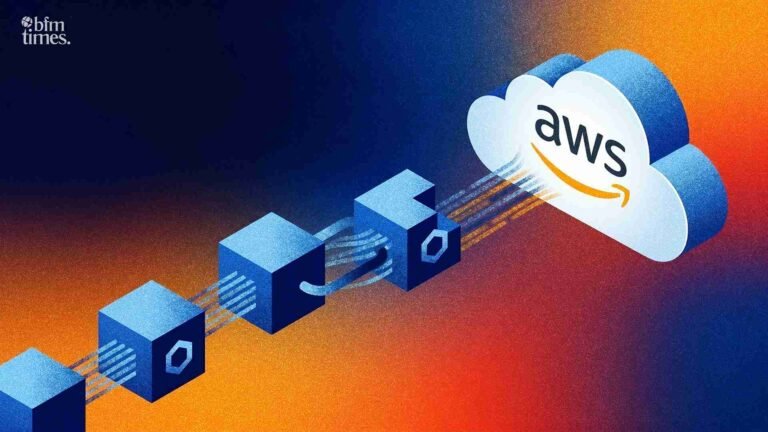
- Marketplace Integration: Amazon Web Services (AWS) has formally launched Chainlink Data Standards in the AWS Marketplace, a significant step towards institutional adoption of blockchain technology.
- Key Services Offered: The listing introduces three of the main Chainlink services: Data Feeds, Data Streams, and Proof of Reserve, to the AWS cloud.
- Target Audience: The integration is particularly aimed at helping financial institutions and Web3 developers to develop hybrid apps that leverage the speed of the cloud with the security of decentralization.
- Simplicity in Operations: The AWS Marketplace listing allows financial companies to access and manage Chainlink oracle services using their existing AWS operational and payment policies.
- Market Reaction: Since the announcement on April 24, 2026, there has been a resurgence in institutional interest in Chainlink (LINK), but it is still trading within a consolidation zone.
Infrastructure Milestone: AWS Is a Bridge to Tokenized Finance
Amazon Web Services (AWS) has committed to the future of hybrid finance with the inclusion of data standards from Chainlink in its Marketplace. The move, confirmed on Friday, April 24, 2026, enables the millions of developers and hundreds of thousands of companies that already use AWS to access enterprise-level blockchain data connectivity tools within the cloud.
The move effectively solves the “oracle problem” – a major challenge in which blockchain smart contracts cannot inherently access data outside the network. By bringing the decentralised oracles of Chainlink onto the world’s largest cloud provider, AWS is delivering a secure, two-way connection that enables external databases and application programming interfaces (APIs) to initiate events on blockchain.
“The launch of the Chainlink data standard on the AWS Marketplace means that developers can use the services they are familiar with to build applications that connect to tokenized assets and smart contracts,” said Simon Goldberg, Web3 Specialist Solutions Architect at AWS.
The Three Pillars of the Integration
The announcement highlights three of Chainlink’s products that form the building blocks for today’s next-generation decentralized finance (DeFi) and real-world assets (RWAs) applications:
Chainlink Data Feeds: These offer decentralized price and market data from hundreds of sources. They are essential for the valuations, settlements, and risk management of DeFi applications.
Chainlink Data Streams: These offer fast market data for trading. This is key to building on-chain financial instruments, such as perpetual futures and options, that need to execute quickly.
Chainlink Proof of Reserve (PoR): This is used for on-chain verification of the assets that are backing stablecoins or tokenised commodities. This offers a transparency not normally found in audits, as collateral can be verified in real-time.
Technical Context: Solving the Interoperability Challenge
The partnership is more than just a listing; it serves as a model for how traditional financial systems will transition to blockchain in the future. In a recent technical blog post, AWS provided reference diagrams of how its serverless computing services, like AWS Lambda and Fargate, can be used in conjunction with Chainlink’s oracle nodes to build compliant trading systems.
Among the examples cited by AWS is managing stablecoin reserves. Here, data from Amazon DynamoDB is pulled by a Chainlink node, which then generates a consensus value and signs it to the Ethereum blockchain. This ensures that the source of truth for the asset’s backing is tamper-evident and accessible to any regulator or auditor.
With the use of AWS Key Management Service (KMS) and Nitro Enclaves with Chainlink, it’s now possible to build environments where financial data can be processed in a “black box,” providing privacy and making the blockchain verifiable.
Market Performance and Institutional Sentiment
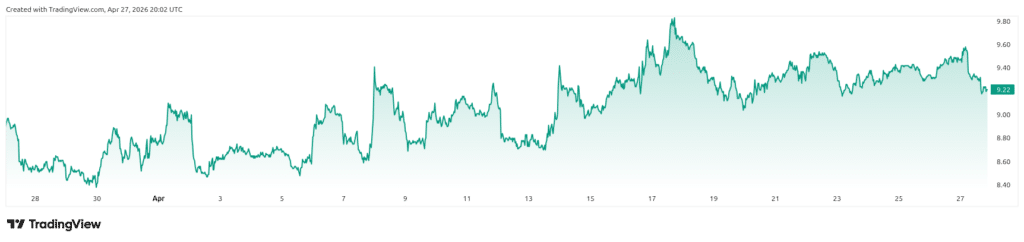
Despite the significance of the agreement with AWS, the price of the token (LINK) has fallen into technical consolidation. The price of LINK has fluctuated between $9.00 and $10.10 in late April 2026. The news has seen an increase in volume, but overall market sentiment has kept the token in a symmetrical triangle.
Market analysts point out that despite the subdued price action, there are “on-chain” fundamentals at play. According to sites such as CoinMarketCap, there’s been a significant rise in whale holdings, with millions of dollars’ worth of LINK being withdrawn from exchanges into cold storage. This is usually a sign of longer-term commitment from institutional investors who see the AWS integration as a catalyst that will have a multi-year impact.
“This is an indication that enterprise blockchain is out of the pilot stage,” said one expert. “When you have AWS supplying the procurement process for Chainlink, you are eliminating the barrier that has prevented banks from getting involved with blockchain-based infrastructure.”
Broader Context: Oracle Wars
The Chainlink and AWS partnership comes at a time when the oracle market is red hot. Rival oracles such as Pyth Network have recently landed deals with prediction markets such as Kalshi, while others are merely focusing on high-frequency trading data.
But Chainlink’s aim seems to be “The Standard”, as the middleware of the financial sector. Through its partnership with AWS, Chainlink is not only positioning itself against other cryptocurrency projects but also as a standard component of the cloud computing landscape.
This latest move follows other recent moves, such as integrating with Coinbase DataLink to bring real-time exchange data on-chain. As other major financial data providers, such as S&P Global and FTSE Russell, are also feeding data through the Chainlink network, it is being seen as the “TCP/IP” of the blockchain industry – the invisible service that allows systems to communicate securely.
The message to the enterprise market is clear: the cloud-to-blockchain bridge has been completed and it is as simple as subscribing to any other SaaS service on the Amazon Marketplace.
Disclaimer: BFM Times acts as a source of information for knowledge purposes and does not claim to be a financial advisor. Kindly consult your financial advisor before investing.