




Selecting the best investment apps for beginners can make or break your first year of investing. The right app makes it cheap and simple to understand what you are doing and includes guardrails so that you end up making risky decisions about which you have no understanding. By 2026, entry-level investing will no longer be about commission-free trading; it will be about intuitive UI/UX, good education, fractional shares, and easy methods of purchasing diversified ETFs. Here is the guide on what to consider, how we tested out beginner investment apps, and a brief list of best investment apps for beginners in the major regions (U.S., India, EU, SEA). There is also a comparison table and an effective checklist to choose the app that would suit your purposes.
- What beginners should look for in investing apps
- How we selected the best investment apps for beginners
- Beginner investment apps: Top picks
- 1. Robinhood (U.S.)
- 2. Fidelity Investments (U.S.)
- 3. Zerodha (India)
- 4. Groww (India)
- 5. Trade Republic (EU)
- Investing apps for beginners: features that matter
- Stock investment apps: stocks, ETFs & diversification basics
- Easy investing platforms: UX, education & guardrails
- Investment apps 2026: trends beginners should know
- How to choose the right app for your goals
- Common mistakes beginners make (and how to avoid them)
- Top beginner investment apps at a glance
- Conclusion
What beginners should look for in investing apps
The rules of the game are safety first and simplicity first. The important thing is to prioritize the platforms where the friction is minimal and the platform helps you avoid the typical errors.
- Regulation & safety: Is registered by local authorities; has well-developed KYC and security measures.
- Low costs: Commission-free, low fund expense ratios, and no open fees.
- Easy UI/UX: Mobile investing is easy to navigate, with simple order processes.
- Education: Lessons, explainers, market basics.
- Fractional shares: Start small; buy ETFs or blue chips without big minimums.
- Guardrails: Risk notifications, position limits, and optional demo.
- Long-term tools: Recurring investments/SIPs, ETF discovery, and portfolio insights.
How we selected the best investment apps for beginners
We considered platforms based on a beginner-first framework:
- Compliance with the regulations in respective jurisdictions (e.g., SEC/FINRA, SEBI, and FCA equivalents).
- Prices & minimums: Trading fee, account fee, minimum investment.
- Asset coverage: Assets, ETFs, mutual funds, and basic crypto, where available.
- Onboarding: Rapid KYC, honest financing solutions, and effective app changes.
- Education & protections: paper trading/demo mode, risk profiling, alerts.
- Support & stability: Customer support, update rate, and app store ratings.
This approach brings up forex brokers who advocate crypto (however, not relevant in this case) and rather focuses on the access to stock investment applications and diversified ETFs that can be comprehended and adhered to by novices.
Beginner investment apps: Top picks
The five region-suited leaders who have good safety, minimal friction, and novice tools are provided below.
1. Robinhood (U.S.)

Overview & who it’s for: Easy, mobile investing for U.S. beginners wanting stocks, ETFs, and only a limited amount of crypto under one roof.
Assets supported: U.S. stocks, ETFs, options (advanced), and basic crypto.
Fees & pricing: No commission trades; the standard account has no monthly fee.
Beginner features: fractional shares, recurring purchases, basic charts, and the education center.
Onboarding & KYC: Rapid electronic KYC; expedited funding solutions.
Pros:
- Mobile investing, clean UI.
- Fractional shares and recurrent investments.
- No trading commissions
Cons:
- There are a few research tools of advanced use.
- Options are risky for the beginner.
- Crypto features vary by state
Best for: first ETF purchases and long-term investment with basic recurring strategies.
For official info, head to their site: https://robinhood.com/us/en/
2. Fidelity Investments (U.S.)
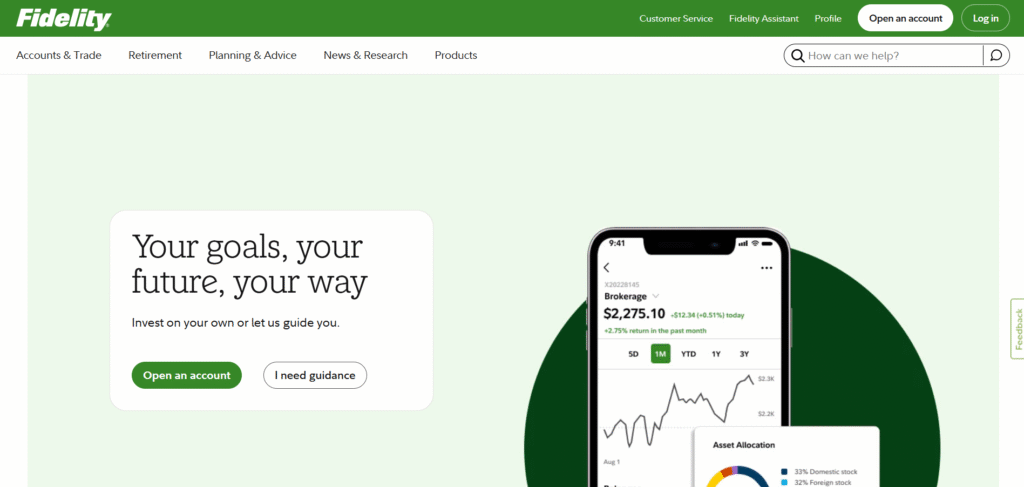
Overview & who it’s for: Full-service broker and high education level among beginners who may develop deeper research in the future.
Assets supported: Stocks, ETFs, mutual funds, and bonds; no retail crypto trading.
Fees & pricing: no commission-free stock/ETF; no account minimums.
Beginner features: goal tracker, paper trading, learning center, fractional shares.
Onboarding & KYC: Strong KYC; various validities of funds.
Pros:
- Good education and research.
- Strong customer support
- Broad asset coverage
Cons:
- The app UI is not as minimalistic as it feels heavy.
- New users are overwhelmed with more features.
- No direct crypto trading
Best for: Tactical investing: long-term portfolios that use ETFs.
For official info, head to their site: https://www.fidelity.com/
3. Zerodha (India)
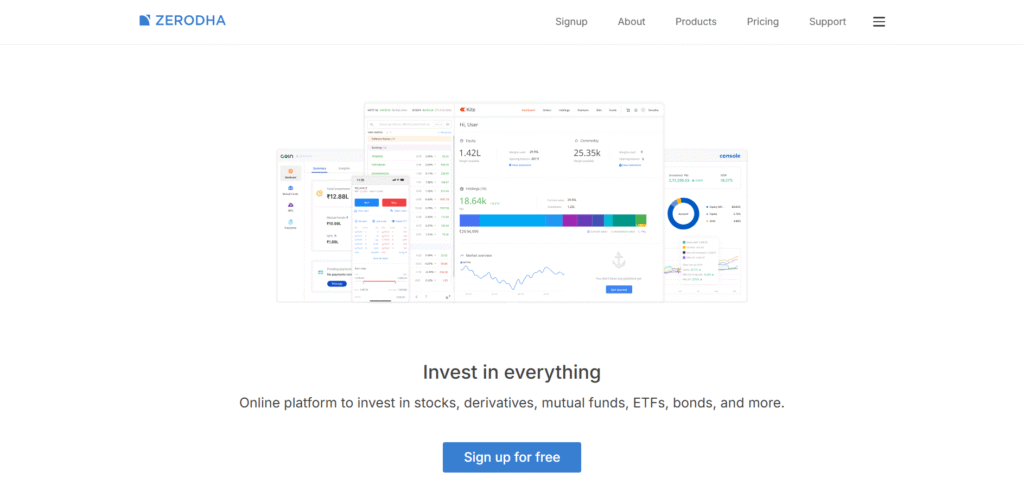
Overview & who it’s for: India is the low-cost leader that has a beginner orientation and is for those who have clear pricing and execution.
Assets supported: Indian stock, ETF, mutual funds, and no crypto trading.
Fees & pricing: There is no commission on the delivery of equity, and the flat fee on intraday/derivatives is low.
Beginner features: Clean Kite, mutual fund SIPs, and learning materials.
Onboarding & KYC: Full-fledged digital KYC; quick opening of an account.
Pros:
- The low delivery cost of investing is very low.
- Strong SIP and ETF access
- A consistent platform that is updated regularly.
Cons:
- Research tools are basic
- None of the international in-app stocks.
- No demo trading mode
Best for: Long-term ETFs and SIP on Indian markets.
For official info, head to their site: https://zerodha.com/
4. Groww (India)

Overview & who it’s for: Beginner-first design for Indians starting with mutual funds and ETFs, then stocks.
Assets supported: ETFs, mutual funds, and Indian stocks; limited digital gold.
Fees & pricing: Free delivery trades; low-price MF investing.
Beginner features: Plain-language explainers, SIPs, and goal-based investing.
Onboarding & KYC: Easy online KYC; fast funding.
Pros:
- First-time user-friendly UX.
- High mutual fund discovery.
- Easy SIP setup
Cons:
- Fewer advanced order types
- Research depth is limited
- Non-native international assets.
Best for: Micro-investing, SIPs, and ETFs habit-building.
For official info, head to their site: https://groww.in/
5. Trade Republic (EU)

Overview & who it’s for: EU beginners interested in low-cost ETF investing and automated savings strategies.
Assets supported: EU stocks, ETFs, and select crypto exposure in certain regions.
Fees & pricing: Flat trading charges; free savings ETF plans.
Beginner features: ETF savings by fraction, basic recurring investments, and education.
Onboarding & KYC: Digital onboarding; local compliance in the EU markets.
Pros:
- Good in terms of savings of ETF.
- Low, predictable fees
- Clean mobile experience
Cons:
- Limited advanced research
- Countries differ in asset availability.
- Fewer niche markets
Best for: Automated monthly plans in passive ETFs.
For official info, head to their site: https://traderepublic.com/en-de
Investing apps for beginners: features that matter
The investing apps for beginners are the ones that simplify the process, and they reinforce the good behavior:
- Paper trading/demo trading: Practice without risking money.
- Fractional shares: Purchase stocks and ETFs that are of high value in small proportions.
- Recurring investment: Automate long-term investments; minimize timing pressure.
- Risk profiling: Basic questionnaires to match the portfolios with risk tolerance.
- Smart alerts: SIPs, rebalancing, and fee transparency reminders.
Stock investment apps: stocks, ETFs & diversification basics
Most beginners need to start with ETFs when they are starting with stock investment apps:
- Why ETFs first: Instant diversification across markets and sectors.
- Core portfolio concept: broad-market ETF and low-cost bond or balanced fund.
- Position sizing: Single stocks should be small to start with until you gain experience.
- Fees are important: Fund expense ratios silently increase with time.
- Discipline: Recurring buys beat emotional market timing.
Easy investing platforms: UX, education & guardrails
Indeed, simple investment sites are educational as you invest:
- Flow tutorials: Little lessons when you make your first ETF purchase.
- Risk alerts: Obvious disclosures before volatile assets or leverage.
- Beginner modes: minimalistic screens that conceal professional features.
- Accessibility: Intuitive user interface, understandable visualizations, and mobile investing load quickly.
- Education stack: Fundamentals of ETFs, diversification, long-term investing, and fees.
Investment apps 2026: trends beginners should know
Convenience is introduced by the investment apps 2026 landscape, but the point is to be cautious:
- AI suggestions (with limits): Useful summaries, not a replacement for judgment.
- Robo-advisors: Hands-off investment portfolios.
- Better disclosures: Lovelier fee and risk labels through regulators.
- Unified dashboards: Stocks and ETFs with basic crypto towards one (where permitted).
- Better KYC and security: Speedy onboarding without sacrificing safety.
How to choose the right app for your goals
Check this short decision checklist:
- Long-term ETFs/SIPs: Pay attention to low fees, periodical investing, and education.
- Micro-investing: The most important are fractional shares and zero account minimums.
- Hands-off investing: Risk profiling robo-advisors.
- Learning phase: Paper trading and tutorial applications.
- Multi-asset curiosity: Platforms that do not add basic crypto in a rush (region-dependent).
Despite the best investment apps for beginners, results are a matter of habit, including early diversification, automated investment, and not following the trend.
Common mistakes beginners make (and how to avoid them)
- Overtrading: Schedule repeat purchases; check weekly, not daily.
- Chasing hype: ETFs and diversified funds.
- Ignoring fees: Little percentages become huge burdens.
- Lack of diversification: Do not focus on a stock or theme.
- Skipping education: Pre-JIT learning before the addition of riskier assets.
Top beginner investment apps at a glance
| App | Region availability | Assets supported | Fees/commissions | Fractional shares | Education tools | Best for |
| Robinhood | U.S. | Stocks, ETFs, basic crypto | $0 trades | Yes | Basics, in-app tips | First ETF buys, recurring plans |
| Fidelity | U.S. | Stocks, ETFs, mutual funds | $0 stocks/ETFs | Yes | Strong learning hub | Long-term diversified portfolios |
| Zerodha | India | Stocks, ETFs, mutual funds | $0 delivery trades | N/A (ETFs whole) | Learning resources | SIPs, low-cost ETF investing |
| Groww | India | Stocks, ETFs, mutual funds | $0 delivery trades | N/A (ETFs whole) | Plain-language guides | Habit-building for beginners |
| Trade Republic | EU | Stocks, ETFs (limited crypto) | Low flat fee; free ETF SIP | Yes (ETFs) | In-app education | Passive ETF savings plans |
Conclusion
The safest, lowest-cost, easiest-to-use, and most educational investment apps that encourage good habits should be the best investment apps for beginners to start with as first-time investors. Begin with diversified ETFs, automatic recurring contributions, and beginner modes or paper trading to study without the stress. Since the investment apps 2026 will have AI functionalities and autopilot, you have to be on your toes: it is supposed to assist you, but not to make decisions. Choose one of the best investment apps for beginners above that fits your locality and your objectives, invest on a long-term basis, and rely on consistency to work its magic.
Disclaimer: BFM Times acts as a source of information for knowledge purposes and does not claim to be a financial advisor. Kindly consult your financial advisor before investing.