


The Cryptocurrency world is no different from any other industry in that the titans have an outsized impact on its direction. Bitcoin is the digital gold, while Ethereum is the programmable world computer. Binance Coin (BNB) is another giant of the industry in the top tier of global market capitalization. The token started as a simple exchange-based loyalty tool and has grown to become the gas and governance backbone of a massive, multi-chain ecosystem.
- 1. What is a Binance Coin? The Origin Story
- 2. The BNB Chain Ecosystem: Technical Architecture
- 3. BNB Tokenomics: The Burn and the Supply
- 4. BNB Use Cases: Beyond the Exchange
- Trading Fee Discounts
- Binance Launchpad and Launchpool
- Decentralized Finance (DeFi)
- Payments and Travel
- Staking and Governance
- 5. Analyzing the BNB Price: History and Volatility
- 7. Regulatory Challenges and the “Compliance Era.”
- 8. Is BNB a Good Investment? (Pros & Cons)
- 9. The Future of BNB: 2026 and Beyond
- 10. Conclusion: A Token Built to Last?
Related: BNB Price Prediction (2026-2030)
This guide aims to explore what the Binance Coin is, how it works, its use cases, and provide an analysis of whether investing in BNB is a good long-term strategy.
1. What is a Binance Coin? The Origin Story
The Binance Coin is the native coin of its namesake, Binance, the biggest centralized exchange in the crypto world. Introduced to the world in 2017, the exchange rose to the top of the cryptocurrency exchange industry with the highest trading volume ever. The founders of this phenomenal company are Changpeng Zhao (CZ) and Yi He. The Binance coin was originally started as a utility token for the Binance exchange.
The 2017 ICO
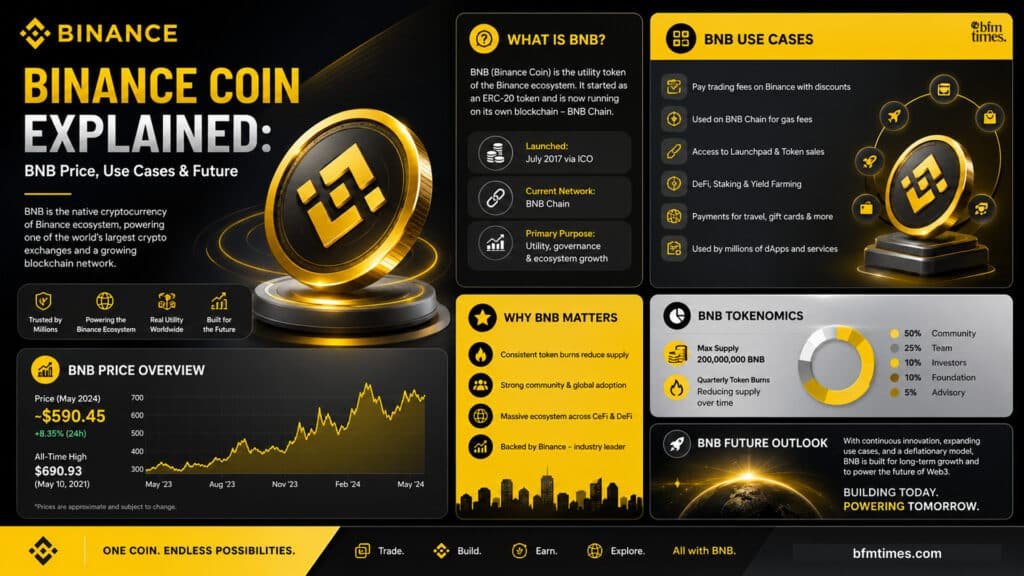
Just a few days before the Binance exchange went live, the company launched Binance Coin with an Initial Coin Offering (ICO). This event saw 100 million(50% of the total supply) BND tokens sold to the public at a rate of $0.15 per token, while the other half was sent to the founding team members and angel investors.
The Evolution of the Token
Initially started as an ERC-20 token on the Ethereum blockchain, it has since evolved with Binance’s ambition to shed the limitations of Ethereum’s congestion and high gas fees. To mitigate these issues with Ethereum, the company launched Binance Chain (BC), its native blockchain, and migration was done via a mainnet swap.
The ecosystem saw further evolution with the introduction of Binance Smart Chain (BSC) in 2020. BSC is a parallel blockchain that comes with its own smart contract functionality and compatibility with the Ethereum Virtual Machine (EVM). 2022 saw these chains rebranded and merged under the umbrella of the BNB Chain, standing for “Build and Build.”
2. The BNB Chain Ecosystem: Technical Architecture
A lot of users are curious about the differences between Binance Chain and Binance Smart Chain. Below, we will go into details about their dual-chain architecture and more.
BNB Beacon Chain (Formerly Binance Chain)
The Binance Chain is the first native blockchain of the Binance ecosystem. Using a endermint-based consensus mechanism, it was designed for high-speed trading and optimized for Binance DEX (Decentralized Exchange). However, it did not allow for the flexibility needed for creating complex smart contracts.
BNB Smart Chain (BSC)
To directly compete with Ethereum, Binance launched the BSC to bring programmability to the world of Binance. It uses a consensus mechanism known as Proof of Staked Authority (PoSA).
- High Speed: Block times are roughly 3 seconds.
- Low Cost: Transaction fees are a fraction of Ethereum’s.
- EVM Compatibility: Developers can easily port Ethereum dApps (like Uniswap clones or NFT marketplaces) over to BSC with minimal changes.
BNB Greenfield
One of the newest introductions to the Binance world is BNB Greenfield, a decentralized storage-oriented blockchain that enables the Binance Coin ecosystem to support data-heavy applications, decentralized hosting, and a “data economy” where users own and monetize their information.
3. BNB Tokenomics: The Burn and the Supply
Behind the rise in the BNB market price over the years is its aggressive deflationary mechanism. The chain uses a “Burn” system to reduce its total supply, unlike Bitcoin that uses a fixed cap and halving cycles.
The Auto-Burn Mechanism
Initially, the company aimed at using using 20% of its quarterly profits to buy back and burn BNB. But to increase decentralization and transparency, it has shifted its approach to BNB Auto-Burn system. This system uses a formula to calculate the amount of token to be burned based on the current price of BNB and the number of blocks generated on the BNB Chain during the quarter.
BEP-95: Real-Time Burning
Taking a page out of Ethereum’s playbook, Binance launched BEP-95, a mechanism that burns a portion of gas fees spent in every single transaction in real-time. This ensures that even with low company profits, the token supply reduction still continues as long as the network is being used.
4. BNB Use Cases: Beyond the Exchange
Utility is one of the most important factors determining the value of a cryptocurrency, and BNB has managed to expand its utility outside the walls of the Binance exchange.
Trading Fee Discounts
The usecase it was originally designed for and its most popular one. Holders of the BNB token can use it to pay trading fees at a significant discount rate on the Binance exchange. This creates great incentive for high-volume traders.
Binance Launchpad and Launchpool
Taking on the role of the kingmaker in the crypto world, Binance requires users to commit or stake their BNB if they want to participate in “Initial Exchange Offerings” (IEOs) or to farm new tokens for free. This removes a significant portion of the token from circulation during popular launches.
Decentralized Finance (DeFi)
The primary gas token on the Binance Coin Smart Chain is BNB. So if you want to swap tokens, lend tokens, or participate in yield farms, you are required to pay the transaction fee in BNB. Binance Coin is also commonly used as collateral for decentralized loans on the chain.
Payments and Travel
Binance Coin has made many high-profile partnerships to improve its real-world utility, such as its partnerships with Binance Pay and Travala. These partnerships enable users to use BNB to do things ranging from booking flights and hotels to paying for retail goods at thousands of merchants globally.
Staking and Governance
Holders of Binance Coin can earn a portion of the transaction fees as rewards by staking their tokens with validators to secure the network. Also, Binance Coin holders are given a voice in the governance of the BNB Chain through voting on “Binance Evolution Proposals” (BEPs).
5. Analyzing the BNB Price: History and Volatility
The BNB price history is a masterclass in crypto growth.
- 2017-2018: This period saw BNB hang between $1 and $20.
- 2021 Bull Run: Huge rise in BNB prices from about $40 in early 2021 to an all-time high of nearly $690 in May 2021. This can be attributed to the exponential growth of BSC due to user flight from high gas fees on Ethereum.
- 2022-2023 Bear Market: A period of correction that succeeded its earlier exponential growth in 2021. However, unlike most other Ethereum competitors, it remained more stable, mostly due to the sustained volume of the Binance exchange.
- 2024-2025: With market maturity and a changing global regulatory landscape, there was some price stability, and growth resumed. Backed by the new philosophy of “Build and Build” and new airdrop incentives for holders.
6. The Risk Factor: What if an Exchange Fails?
Even with its great utility, the success of Binance Coin is inherently connected to the state of the Binance ecosystem, which brings up the issue of systemic risk.
Centralization is a double-edged sword in the crypto world. Even with its incredible history of liquidity and innovation, the connection of Binance Coin to the exchange means that bad news for the exchange would often be bad news for the token’s value.
The Overnight Shutdown Scenario
This is why it is important for investors to know how stable Binance Coin is. The industry is not new to the phenomenon of collapsing global exchanges (FTX, MT. Gox), so what happens when that happens:
- Liquidity Evaporates: Exiting positions on your trades becomes almost impossible.
- Collateral Damage: Other Web3 projects integrated with the exchange’s native chain have their primary bridge to the fiat world destroyed.
- Contagion: Many other platforms and tokens linked to the exchange via loans or liquidity pools will also likely collapse.
So while still decentralized, the status of the BNB token rests inherently on the status of the Binance exchange.
7. Regulatory Challenges and the “Compliance Era.”
This would be an incomplete guide if we did not mention the regulatory milestones in Binance’s history. The crypto world woke to news of a historic $4.3 billion settlement with the US Department of Justice (DOJ) and the Commodity Futures Trading Commission (CFTC). The aftermath of this ruling saw CZ resign as CEO and Richard Teng appointed as his replacement.
The Impact on BNB
This historic moment had a notable effect on the price of BNB at the time, with investors initially fearing the end of Binance. This fear was quickly replaced by a “relief rally” that followed after it was shown that the settlement also provided a clear path forward under a compliance-first framework for the company. This legal clarity was enough to improve confidence for many institutional investors who preferred this state to the prior shadowy nature of the company. The full picture shows that this event helped stabilize the BNB price and allowed it to maintain its position as a top-3 altcoin.
8. Is BNB a Good Investment? (Pros & Cons)
As an investor, if you are trying to decide if it’s a good idea to invest in BNB or not, you need to look at its strengths and weaknesses and ensure it aligns with your trading strategy and goals.
The Case for BNB (The Pros)
- Unrivaled Utility: Arguably, Binance Coin has one of the highest real-world and on-chain utility of any token on the market.
- Deflationary Pressure: It uses a mathematically sound mechanism to reduce token supply, which is a really bullish sign for its future value.
- Ecosystem Dominance: Going by the number of unique active wallets, the Binance Coin chain maintains the most active chain. Although it lags behind Ethereum in “Total Value Locked” (TVL).
- Exchange Support: Backed by the world’s largest exchange, it has almost unmatched marketing and liquidity advantages.
The Case Against BNB (The Cons)
- Centralization Concerns: Although the project has made many moves to make Binance Coin more decentralized, its inherent connection to the Binance Centralized Exchange looms large. A regulatory crackdown on the exchange would have a notable impact on the token.
- Competition: It has strong competition in Solana, Base, and various Ethereum Layer 2s (Arbitrum, Optimism) that are actively competing with it for the same users and developers that made it what it is today.
- Dependency: The long-term success of the BNB token is heavily dependent on the continued success and legal status of Binance.
9. The Future of BNB: 2026 and Beyond
The project’s future goals revolve around three core metrics: Scalability, Security, and Storage.
Layer 2 Solutions (opBNB)
To scale to the next billion users, the chain has introduced opBNB, an optimistic rollup based on the OP Stack. This new launch enables faster transactions and even lower fees, which makes it ideal for high-frequency gaming and social media applications on the blockchain.
Mass Adoption via Web3
The company has engaged in heavy investments in Web3 accessibility. In an effort to bridge the gap between “Centralized Finance” (CeFi) and “Decentralized Finance” (DeFi), the company has introduced integrated Web3 Wallets into the Binance App.
Decentralized Storage (Greenfield)
The launch of Greenfield comes in an era where AI and Big Data are arguably the most important industries. Demands for decentralized data storage have been rising, and Binance Coin Greenfield is Binance anser to that call. It has quickly become the go-to standard for decentralized hosting, adding a new layer to BNB use cases that many other tokens do not have.
10. Conclusion: A Token Built to Last?
Initially discounted as nothing but a “discount coupon” for traders, Binance Coin(BNB) has grown to become the fuel for the global decentralized economy. Shedding its humble beginnings as an ICO, it has taken its position as a resilient titan in the crypto world.
Taking on the role of an Ethereum competitor, the Binance Smart Chain provides a fast, cheap, and user-friendly alternative to the complex world of Ethereum. While it is not exempt from the volatility that defines the global crypto world and the unstable global regulatory landscape, BNB’s aggressive burn schedule and almost unmatched utility make it one of the most compelling projects in the space.
Whether BNB is a good investment for you depends on your risk tolerance and your belief in the “Binance” brand. However, ignoring its impact on the industry is impossible. As the ecosystem continues to “Build and Build,” Binance Coin is likely to remain at the forefront of the Web3 revolution.
Disclaimer: BFM Times acts as a source of information for knowledge purposes and does not claim to be a financial advisor. Kindly consult your financial advisor before investing.