RWAs have become one of the fastest-growing sectors in the Web3 and crypto ecosystem. Real World Asset (RWA) institutions are looking for safe, yield-generating blockchain opportunities, and retail investors are seeking transparent investment options; RWAs are bridging the traditional financial world with decentralised technology.
In essence, RWA protocols take real-world value—in the form of real estate, commodities, treasury bills, invoices, or bonds—onto blockchain networks that are secure, programmable, and tradable. The rapid growth of tokenisation globally will not only make it easy for RWAs to transform global finance but also free up trillions of dollars in on-chain liquidity.
Do you know? Most RWAs are tokenized with the ERC-20 Standard.
What Is RWA (Real World Assets)?
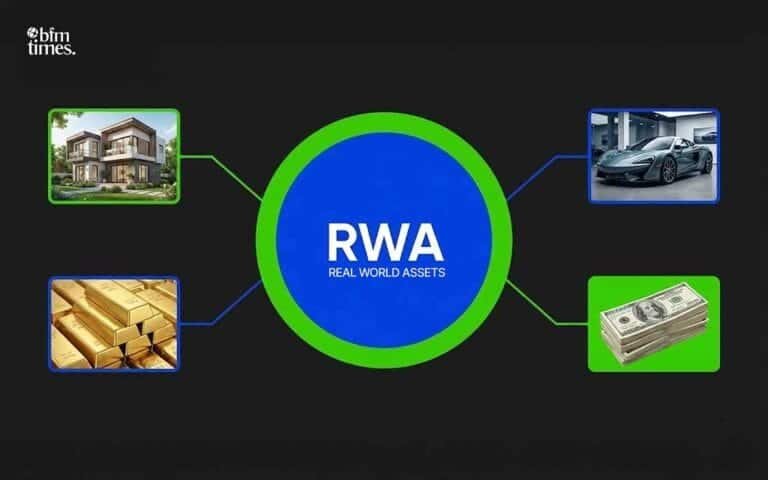
Real World Assets are a mix of real and traditional financial assets that are converted into digital assets and represented as tokens on a blockchain. The assets that fall into this category are
- Real Estate
- Government bonds
- Corporate debt or invoices
- Precious metals such as gold
- Commodities
- Art, collectables, and luxury items
Real World Assets tokenisation enables splitting a physical asset into digital tokens that represent a portion of ownership, yield, or revenue. These tokens can subsequently be exchanged, loaned, or pledged on blockchain networks.
In conventional finance, investing in properties or bonds requires many intermediaries and a large amount of capital; the process also takes a long time to settle. Real World Assets tokenisation opens the following new ways:
- Entry barriers are drastically reduced
- Liquidity gets higher
- Transacting becomes very transparent
- Fractional ownership is now possible.
- At any time, you can participate in the global market.
These advantages point to Real World Assets as the primary reason institutional investors would embrace crypto. Some of the largest investment companies, banks, and fund managers worldwide are already considering blockchain-based tokenisation as their key to more efficient financial markets.
How Do RWAs Work?
RWA tokenisation is a step-by-step process that integrates regulatory supervision, blockchain technology, and decentralised smart contracts. Here’s the typical journey of RWAs from inception to finalisation:
1. Identification of the Asset
The first step of tokenisation is to pick a real asset—an estate or a Treasury bill—and then verify its value, ownership, and documentation for legal conversion into digital tokens.
2. Legal Structuring
In the first place, a legal company is set up for the asset tokenisation, and this company could be a trust or Special Purpose Vehicle (SPV). In this manner, the rights of the token holders to revenue, ownership, or yields are made verifiable. Regulatory compliance is taken care of throughout the procedure.
3. Token Minting
As soon as the legal structuring of the asset is done, a matching digital token is issued on the blockchain.
There are two main models of tokens generally used:
- Asset-backed tokens—Each token represents a physical share of the asset.
- Synthetic tokens—They signify the price movement of the asset without actual ownership.
All these tokens are safeguarded through smart contracts, which also guarantee transparency and automated asset management.
4. Trading and Usage on the Blockchain
Once minted, RWA tokens are allowed to:
- be traded on DEXes
- be utilised as collateral for the lending protocol
- incorporated in DeFi yield products
- divided into smaller ownership units
This makes the assets that are generally hard to sell, like real estate or invoices, and always available as digital instruments with high liquidity.
5. Yield Distribution
RWAs pay the real-world yields such as rent, interest, or coupon payments. The smart contracts distribute returns automatically to token holders. This, in turn, offers more yield opportunities for DeFi users who are not crypto-dependent.
6. Redemption
Holders of tokens can exchange them for the underlying real-world assets. For instance, a user with T-Bill tokens can exchange them for cash in USD.
The Leading 3 RWA Chains That Are Powering the Tokenisation Revolution
A few blockchain networks have become the front-runners in Real World Assets tokenisation. These chains are committed to providing security, compliance, institutional partnership, and real-world integration. Here are the three RWA chains that are the most significant contributors to the tokenisation revolution:
1. Ethereum
Also Read: What is Ethereum?
Ethereum remains the leading blockchain for tokenising real-world assets (RWAs) on the electronic ledger. It is not only a mature ecosystem but also still provides robust developer tools and full institutional integration.
Reasons why Ethereum is at the Top of RWA Tokenisation:
- Has the biggest share of RWA protocols such as MakerDAO, Ondo Finance, Centrifuge, and Maple Finance
- Very liquid markets with solid DeFi infrastructure
- Covered by exchanges, custodians, and regulators all over the world
- Reliable smart contract platform
Ethereum has been, and remains, the primary network used by a number of large banks and financial institutions working on tokenized bond or fund projects.
2. Polygon
Polygon is known as a very efficient Layer-2 and multi-chain solution with exceptional scalability. It is cost-effective in the application of RWA non-tokenisation.
Main Benefits of Polygon for RWAs:
- Transaction costs are ridiculously low.
- The market for the assets is the one with high demand and thus high throughput.
- A global bank is among the major enterprises with which the company partners.
- A Layer 2 zkEVM environment is developed for safe and lawful transactions
Polygon has been a major player in the international space, helping develop tokenised treasury products, tokenised invoices, and corporate debt pilots.
3. Avalanche
Avalanche’s subnet architecture is what has gained it large popularity, and this feature is perfect for regulated RWA tokenisation contexts.
The reasons Avalanche tops the Real World Assets chain list are
- • Legal compliance subnets that are highly customizable
- • Big institutions like JPMorgan, WisdomTree, and Citi are trying out tokens.
- • The combo of the high speed and low cost is a great alternative to using Ethereum.
- • Smart contracts targeted to enterprises are already up and running on the platform.
- Avalanche’s dynamic nature and collaboration with institutional investors have made it a strong player in the global RWA market, which is still developing rapidly.
Conclusion
The concept of Real World Assets (RWA) is one of the most promising innovations in crypto, integrating the stability of traditional finance with the transparency and efficiency of blockchain technology. Asset tokenisation is unlocking new forms of liquidity and global investment opportunities, ranging from real estate to treasury bills. With the leading chains, namely, Ethereum, Polygon, and Avalanche, driving adoption, RWAs are destined to transform the global financial environment and speed up the entrance of institutions into Web3.
Disclaimer: BFM Times acts as a source of information for knowledge purposes and does not claim to be a financial advisor. Kindly consult your financial advisor before investing.