

The pillars of innovation in the rapidly changing world of blockchain are scalability, privacy, and security. Zero-Knowledge (ZK) protocols, Rollups, and sophisticated cryptographic protocols such as STARK and SNARK are among the most radical technologies that enable such features. These are the tools that are defining the future of Ethereum and solutions in layer-2 and beyond.
- Table of Contents
- Definition: Zero-Knowledge Protocols? Definition
- Key Benefits:
- Rollups
- Types of Rollups
- 1. ZK Rollups
- 2. Optimistic Rollups
- zkEVM: Zero Knowledge Ethereum Virtual Machine
- STARK: Transparent Scalable Argument of Knowledge
- SNARK: Noninteractive Succinct Argument of Knowledge
- The Reason Why Zero-Knowledge Protocols are Game Changers
- The Future of Blockchains with ZK
- Conclusion
Let us deconstruct these ideas in an appealing, inventive, and understandable way.
Table of Contents
Definition: Zero-Knowledge Protocols? Definition
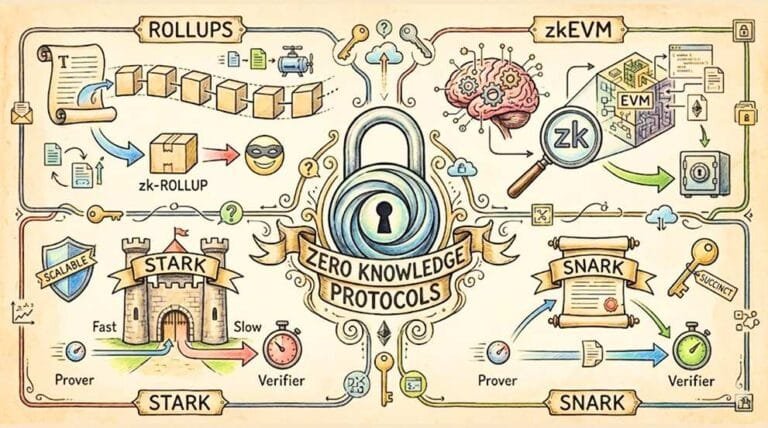
Zero-Knowledge Protocols (ZKPs) are cryptographic techniques that enable one party to demonstrate to another that a statement is true without any additional information. Suppose you are over 18, but you just need to identify yourself without presenting your ID, ZKPs do that on the web.
Key Benefits:
- Privacy: Sensitive information is kept confidential.
- Security: Security is mathematically ensured.
- Efficiency: Minimises on-chain storage of data and computation.
ZKPs have now become essential in blockchain to conduct private transactions, verify identities, and enable layer-2 scaling systems, facilitating user confidentiality and trust.
Rollups
Rollups are layer-2 scaling protocols designed to increase blockchain throughput and reduce transaction costs. Rollups roll or pack several transactions into a single batch and then upload it to the main Ethereum chain.
This will enable Ethereum to handle thousands of transactions per second (TPS) without overloading the leading network.
Types of Rollups
1. ZK Rollups
In ZK Rollups, transactions are authenticated off-chain with zero-knowledge proofs and a cryptographic proof is provided to Ethereum.
Advantages: Immediate finality, greater security, reduced charges.
Cons: More complicated to execute; off-chain is computationally intensive.
2. Optimistic Rollups
Optimistic Rollups assume that transactions are valid and only perform fraud proofs when someone challenges a transaction.
Advantages: It is simpler to implement and is compatible with existing smart contracts.
Disadvantages: Finality is slower with challenged periods, and dispute resolution is required.
ZK Rollups vs. Optimistic Rollup:
ZK Rollups prioritize speed and cryptographic certainty, whereas Optimistic Rollups prioritize flexibility and ease of deployment.
ZK Rollups: ZK Rollups are designed to support high-volume DeFi applications; Optimistic Rollup: Optimistic Rollups are designed to support legacy dApps that are migrating to layer-2.
zkEVM: Zero Knowledge Ethereum Virtual Machine
The next generation of Ethereum EVM is zkEVM, which incorporates the compatibility of EVM and zero-knowledge proofs.
Use: Runs smart contracts off-chain and produces verifications that are confirmed on-chain.
Benefits:
- Reduced gas fees.
- Quickened transaction throughput.
- Complete EVM compatibility by developers.
zkEVM is the solution between the EVM development process and the state-of-the-art scaling of Ethereum in terms of layer-2, which makes Ethereum more scalable and efficient without the loss of decentralization.
STARK: Transparent Scalable Argument of Knowledge
STARKs are a form of zero-knowledge verifiable which allow transparent and scalable verification.
It should also be noted that, unlike SNARKs, STARKs do not have a trusted setup, which results in them being more secure and trustless.
They are quantum and scalable and therefore offer long-term blockchain security.
Applications: ZK Rollups, self-proofs, and massive layer-2.
SNARK: Noninteractive Succinct Argument of Knowledge
SNARKs are proofs of computation using zero-knowledge and can be verified succinctly and without interaction.
Advantages: Proofs are very small and quickly verified.
Con: It needs to be trusted and could be security-threatening in the event of compromise.
Applications: zkRollups, privacy-preserving DeFi, confidential smart contracts.
The Reason Why Zero-Knowledge Protocols are Game Changers
- Privacy: The users will be able to make transactions without sharing sensitive information.
- Scalability: Off-chain computations eliminate congestion and gas costs in the network.
- Interoperability: zkEVM enables currently available Ethereum dApps to scale.
- Security: STARKs and SNARKs offer cryptographic guarantees of reliability.
Rollups, zkEVM, and ZKPs are driving Ethereum into the next phase of blockchain adoption, where private, high-speed, and low-cost transactions are the norm.
The Future of Blockchains with ZK
Zero-knowledge protocols are not just a new trend; they are a serious upgrade of blockchain technology. Using STARKs, SNARKs, zkEVM, and Rollups, developers can develop fast, secure, and private applications that were not practically achievable on Ethereum.
With the increase in the use of layer-2s, we will likely see an explosion in privacy-friendly DeFi, scalable NFTs, and blockchain-based business services. For developers and investors, knowledge of ZKPs has become not just optional but mandatory.
Conclusion
Rollups, zkEVM, SNARKs, and Zero-Knowledge Protocols are changing the way we conceptualize blockchain. These technologies address the fundamental weaknesses of Ethereum and lead to a more decentralised future, namely one that is faster, cheaper, and more secure.
When you are a developer working on the following DeFi protocol, a business considering blockchain implementation, or a fan following crypto innovation, zero-knowledge technology is the foundation of Web3 scalability and privacy. The future is ZK-powered, and it is coming even sooner than you believe.
Disclaimer: BFM Times acts as a source of information for knowledge purposes and does not claim to be a financial advisor. Kindly consult your financial advisor before investing.